
남극 아문젠해에서 규조 군집을 이용한 고환경 변화 기록

초록
남극 아문젠해 만내 Getz ‘A’ Ice Shelf 인근에서 획득한 AM22-GC10B로부터 과거 빙붕의 분포 변화를 알아보기 위해 규조를 분석하였다. 총 22속 50종의 규조가 동정되었으며, 규조 개체수 농도는 0.5~8.3×10⁷/g의 범위에 해당하였다. 규조 군집의 해빙종과 공해종의 분포 양상, 대자율값을 분석하여 총 3개의 군집대를 설정하였고, 이는 과거 환경 변화를 뚜렷하게 보여준다. 군집대 I 은 규조 산출이 거의 없고 대자율 값이 높게 나타나는 특징을 보이며, 이는 빙하하부에서 형성된 환경을 지시한다. 군집대 II는 규조류 개체수가 증가하고 대자율 값이 감소하는 경향을 나타내며, 이는 빙하하부 환경에서 벗어나 계절적으로 해빙이 없는 해양 환경으로 전이되는 빙해양 환경을 지시한다. 군집대 III에서는 개체수와 휴면포자(Chaetoceros resting spores)의 수가 뚜렷하게 증가하고 해빙종의 산출이 감소하는 반면 공해종의 산출이 증가하는 양상을 보이는 것은 계절적으로 해빙이 사라진 환경에서 퇴적된것으로 해석된다.
Abstract
To reconstruct past ice shelf behavior, diatoms were analyzed from core sediments obtained near the Getz ‘A’ Ice Shelf in the Amundsen Sea embayment of Antarctica. A total of 50 diatom species representing 22 genera were identified from AM22-GC10B, with abundances varying from 0.5 to 8.3×10⁷/g. By examining the patterns of sea ice, open ocean species, and magnetic susceptibility (MS) values, three assemblage zones were established. These zones reveal significant changes in the paleoenvironment: Diatom assemblage zone I corresponds to subglacial condition, characterized by low diatoms and high magnetic susceptibility values. Diatom assemblage zone II represents the glacialmarine, showing a shift from subglacial to seasonal open marine conditions, with increasing diatom abundance and decreasing magnetic susceptibility. Diatom assemblage zone III indicates a seasonal open marine period, characterized by high diatom abundance, increasing Chaetoceros resting spores, decreasing sea ice species, and increasing open ocean species.
Keywords:
Antarctica, Amundsen Sea embayment, diatom assemblage, sea ice species, open ocean species키워드:
남극, 아문젠해 만, 규조 군집, 해빙종, 공해종1. 서 론
아문젠해 만(ASE: Amundsen Sea Embayment)은 서남극 빙상의 약 35%를 배수하며 남극 빙상/빙붕 중 가장 빠르게 감소하는 지역 중 하나이며, 지난 20년 동안 아문젠해 만(예: 파인 아일랜드(Pine Island)와 스웨이츠(Thwaites))의 빙하 표면 고도가 3.5∼5.5 ma-1만큼 감소했다(Shepherd et al., 2004; Scott et al., 2009). 서남극 빙상은 최대 3.3 m의 잠재적 해수면 상승의 가능성을 가지고 있으며(Bamber et al., 2009), 남극 주변에서 가장 빠르게 얇아지는 빙붕을 포함하고 있다(Pritchard et al., 2012). 이러한 얇아짐과 관련된 빙하 융빙수(glacial meltwater; MW)의 가장 큰 공급원 중 하나는 아문젠해 만(ASE)이다. 1996년부터 2006년 사이에 서남극에서 아문젠해와 벨링스하우젠해(Bellingshausen Sea)의 연안을 따라 얼음 질량(ice mass)의 손실이 59%정도 증가하였으며(Rignot et al., 2008), 아문젠해 지역에서 감소된 ice mass의 총량은 81±17 km3/년으로 나타났다(Rignot et al., 2004). 빙하가 얇아지고 후퇴의 속도는 가속되었으며, 서남극빙상(West Antarctic Ice Sheet, WAIS)의 안정성에 중요한 변화를 일으키고 있다(Joughin and Alley, 2011; Konfirst et al., 2012). 이러한 현상은 따뜻한 환극 심층수(Circumpolar Deep Water)에 의한 기저빙하 용융에 많은 영향을 미친다. 이 지역에 분포하는 파인 아일랜드 빙상은 서남극빙상의 유출을 억제하는 버팀목 역할을 해주고 있으나 현재의 유출 속도롤 볼 때, 약 100년 이내에 안정성을 잃고 해수면을 3.3-5 m 상승시키게 할 수 있다고 보고되었다(Vaughan, 2008; Bamber et al., 2009). Pattyn과 Morlighem (2020)의 연구에서는 남극 빙상의 일부 지역은 빙하 기후 시스템의 강력한 긍정 피드백(positive feedbacks)으로 인해 현재 관측되는 것보다 더 빠른 해수면 상승으로 이어질 가능성이 있다고 하였다. Hillenbrand et al. (2010)은 아문젠해 만에서 채취한 5개의 코어퇴적물을 연구 한 결과, 빙하 하부의 접지선에 인접한(grounding-line proximal facies) 퇴적상 위에서 순수한 규조연니층을 발견하였고, 상대적 고강도(relative paleointensity; RPI)연대 측정 결과 내대륙붕(inner shelf)에 12,000-12,700 cal yr BP이전에는 얼음이 없었다고 제시하였다. 아문젠해는 남극 주변을 돌고 있는 순환심층수가 유입되어 빙붕이 빠르게 녹아내리고 있는 지역으로 빙붕의 융빙에 의해 봄철과 여름철에 식물 플랑크톤의 번성이 활발하기 때문에 규조 군집변화를 이용한 퇴적기록을 이용하기에 좋은 지역이다. 국내에서의 아문젠해 산출 규조에 대한 연구는 아문젠해 폴리냐(polynya)의 가운데 지역에서의 결과로 10.5 cal. ka BP에 계절적 개방수역(seasonal open water)에 놓이기 시작했음이 보고 되었다(Kim et al., 2023). 본 연구는 아문젠해 폴리냐의 내부에 위치한 Getz ‘A’ Ice Shelf의 인접 부근에서 채취한 코어퇴적물의 규조 군집변화를 통해, 이지역의 과거 환경변화를 파악하는데 목적이 있다.
2. 연구 지역 및 연구 방법
2.1. 연구 지역
Getz 빙붕의 면적은 33,200 km2, 길이가 505 km로 지난 20년 동안 극적으로 얇아졌으며, 1992년에서 2001년 사이에는 1년에 -36 ± 2 cm의 고도 변화가 기록되었다(Shepherd et al., 2004). 아문젠해에 영향을 미치는 주요한 세 개의 수괴가 존재하며, 300∼600 m 깊이에 변환환극심층수(mCDW; modified Circumpolar Deep Water; 1.13∼1.55℃), 상부 50∼100 m에 남극표층수(AASW; Antarctic Surface water; -1.5℃), 이들 두 수괴 사이에 겨울수괴 (Winter Water, WW; -1.14∼-1.67℃)가 존재한다(Dutrieux et al., 2014). 환극심층수(Circumpolar Deep Water; >2℃)는 Dotson-Getz Trough를 통해 서쪽 아문젠해 만 대륙붕을 가로질러 흐르고 대륙붕수 및 빙하 융빙수와 혼합되어 변환환극심층수를 형성한다. 남극표층수는 남극 여름에 관찰되며 태양 복사를 통해 가열되고 해빙에 의해 영향을 받는다. 겨울수괴층은 변환환극심층수위에 더 차갑고 신선하며, 산소가 많이 함유된 수괴로 계절적으로 존재한다(Biddle et al., 2017).
2.2. 연구 방법
Getz ‘A’ 빙붕 부근에서 규조를 연구하기 위해 AM22-GC10B (73°98.2853'S, 115°76.9077'W)코어를 채취하였고, 수심 1249 m에서 시추한 퇴적물의 코어 총길이는 5.35 m이다(그림 1). AM22-GC10B코어는 단면에 대한 면밀한 육안 관찰과 X-선 사진의 분석 결과, 하부로부터 diamicton (260~500 cm), sandy mud (260~160 cm)과 bioturbated mud (0~160 cm)로 이루어져 있으며, 규조의 연구를 위하여 0~260 cm 구간에서는 10 cm 간격, 270~500 cm 구간에서는 ∼80 cm 간격으로 총 31개의 시료를 분석하였다(그림 2). 규조 추출 및 관찰을 위하여 Bak and Lee (2017)의 실험 방법을 수행하였으며, 규조 정량분석을 위한 실험과 계산은 Scherer (1994)의 방법을 수정하여 사용하였다. 각 층준으로부터 채취한 건조시료 2 g에 묽은 염산(10%) 25 ml와 과산화수소수(35%) 15 ml를 첨가한 후 가열판(hot plate)위에서 1시간 이상 가열한다. 2차로 묽은 염산과 과산화수소수 15 ml를 첨가하여 끓여 준 후 24시간 정도 반응시킨다. 1차 증류수 세척 과정을 3번 이상 반복하여 산이나 부유성 물질들을 모두 제거한다. 침전물 중 부표본을 취하여 슬라이드글라스가 장치된 settling container에 넣고 저온의 건조기(약 50℃) 안에서 건조 시킨다. 접착제를 이용하여 커버글라스를 고정시킨 후, Zeiss Axioscope 5 광학현미경을 이용하여 400-1000배로 각 층준에서 300개체 이상을 동정하였으며, 개체수가 매우 적은 구간에서는 view field를 300개 이상 관찰하였다.
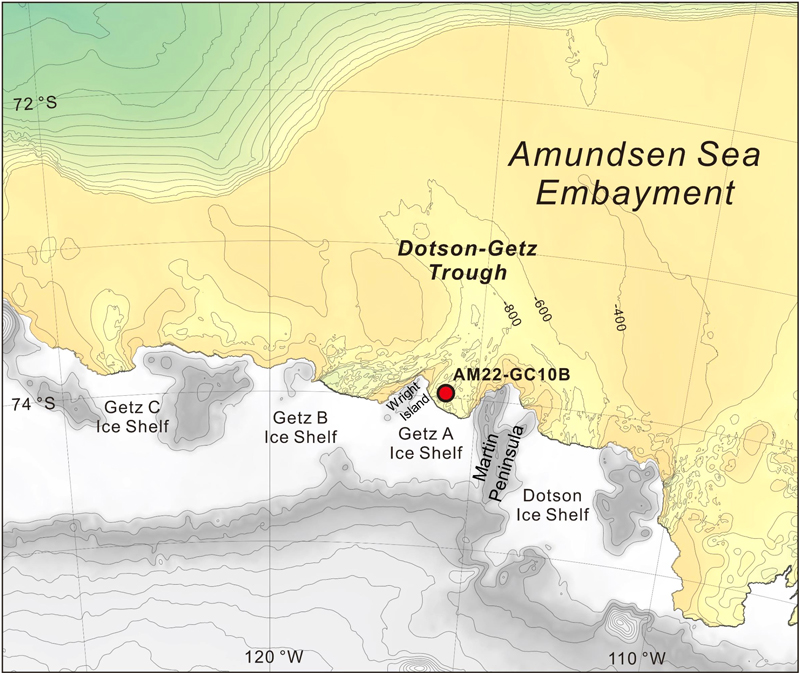
Location map of core AM22-GC10B in Antarctica Bottom depth (colored, negative) and ice shelf draft (adapted from Arndt et al., 2013).
절개되지 않은 코어에서 대자율(magnetic susceptibility, MS) 값은 1 cm 간격으로 Bartington MS2C 센서를 이용하여 극지연구소에서 측정하였다.
3. 결과 및 토의
3.1. 규조 분석
AM22-GC10B의 각 층준으로부터 총 22속 50종의 규조가 동정되었으며, 정량 분석의 결과로 규조 개체수 농도가 0.5∼8.3 ×10⁷/g 범위로 나타났다. 산출된 규조 군집에서 가장 다량으로 산출된 종은 Fragilariopsis curta (34.2%)이며, Eucampia antarctica var. recta (18.4%), Shionodiscus gracilis (4.5%), Fragilariopsis ritscheri (4.4%), Fragilariopsis vanheurckii (4%)순으로 산출되었고 나머지 종들의 산출률은 매우 적고 보존 상태가 불량하였다.
대자율 값은 100∼1600 ×105 SI의 범위로 나타났으며, 규조 종의 산출이 많은 0~260 cm에서는 전반적으로 낮은 값을 보였으며, 반대로 산출이 거의 되지 않는 260~500 cm 까지는 높은 값(>800 ×105 SI)을 보였다(그림 2). 대자율 값은 빙하가 전진하는 시기에는 육지퇴적물의 유입으로 인해 높은 값이 나타나고, 빙하가 후퇴하거나 안정되는 시기에는 표층 생산력이 상대적으로 증가하기 때문에 낮은 값이 나타나는 경향이 있다(Jovane et al., 2019).
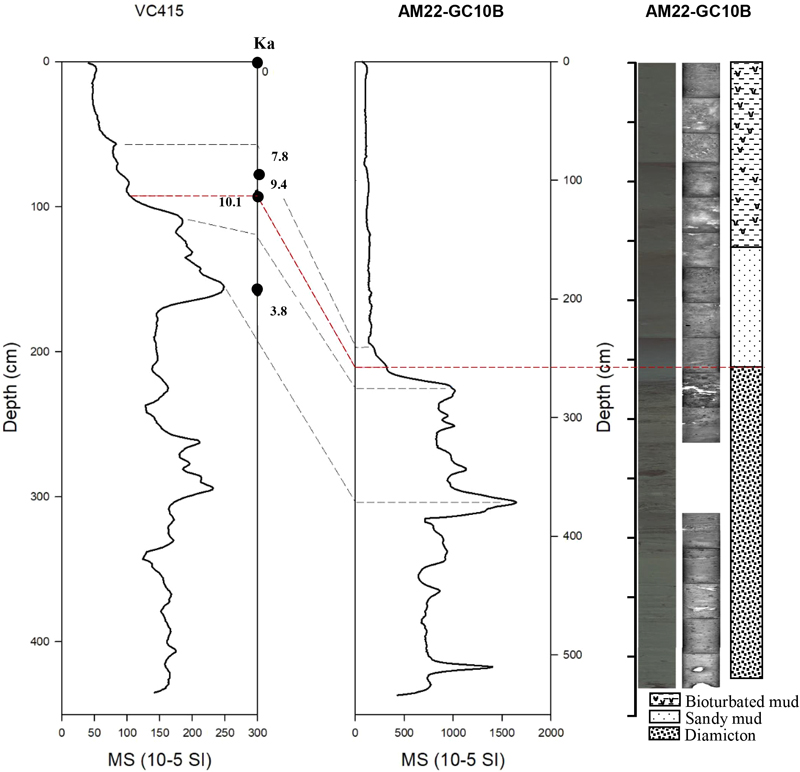
Age of deglaciation based on the magnetic susceptibility values of the VC415 (Smith et al., 2011) and AM22-GC10 cores (this study) and sediment core log for AM22-GC10B.
연구 코어 AM22-GC10B로부터 산출된 주요 종들의 산출 분포를 근거로 3개의 군집대를 설정하였다(그림 3).
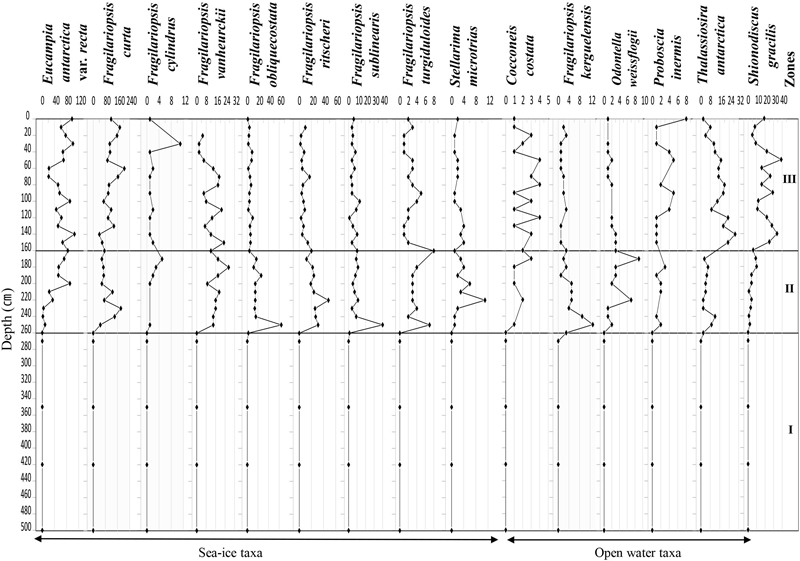
Down-core variations of abundance of the sea ice and open water species, and diatom assemblage zones from AM22-GC10B.
규조군집대 I: 260∼500 cm
규조 군집대 I은 산출이 거의 없는 구간으로서 규조의 생존 및 보존이 어려운 기저빙하의 영향이 우세한 환경조건을 지시한다.
규조군집대 II: 160∼260 cm
이 구간에서는 해빙종인 F. curta, F. vanheurckii, Fragilariopsis obliquecostata, F. ritscheri, Fragilariopsis turgiduloides 및 Stellarima microtria의 산출이 상대적으로 풍부하게 나타난다. 또한, 공해종으로서 Fragilariopsis kerguelensis, Odontella weissflogii의 산출도 상대적으로 높게 나타나는 구간이다(그림 3). 해빙종이 공해종보다 풍부하게 나타나는 혼합 규조 조성을 보여준다.
규조군집대 III: 0∼160 cm
규조 군집대 II에서 풍부하게 나타났던 해빙종인 F. vanheurckii의 산출이 점진적으로 줄어들며, F. obliquecostata, F. ritscheri의 산출도 감소하는 경향을 보인다(그림 3). 이와 대조적으로 해빙의 가장자리에서 번성하는 것으로 알려진 E. antarctica var. rercta와 함께 공해종인 Thalassiosira antarctica와 Shionodiscus gracilis의 산출이 규조 군집대 II에 비하여 상대적으로 증가하는 양상을 보인다(그림 3).
3.2. 고환경 및 토의
AM22-GC10B코어 퇴적물에서는 시대 지시종 및 재이동 규조각의 산출이 거의 나타나지 않는다. 군집대 I에서는 규조의 산출이 거의 없고, 대자율 값이 높게 나타나는 것으로 보아 규조의 일차 생산성이 매우 낮은 환경으로 생각된다(그림 4). Smith et al. (2011)은 본 연구코어와 인접한 곳에서 획득한 VC415에서 해저에 접지된 기저 빙상(grounded ice sheet) 환경으로부터 해빙이 없는 환경(open marine)으로 전이되기까지 빙하하부(facies 3; subglacial), 근위 접지선(facies 2; proximal grounding line), 계절적으로 개방된 해양(facies 1; seasonal open marine)에서 퇴적된 세가지 퇴적상을 식별하였다. 따라서, 군집대 I은 규조가 거의 산출되지 않는 것으로 보아 빙상으로 덮여 있었던 빙하하부 환경에서 퇴적된 것으로 해석된다. 군집대 II는 규조의 절대 개체수는 0.5∼3.2 ×10⁷/g 범위에 해당하고, 대자율 값이 급감하는 구간이다(그림 4). 이 구간에서는 해빙종(F. curta, F. vanheurckii, F. obliquecostata, F. ritscheri, F. turgiduloides 및 S. microtria)과, 공해종인 F. kerguelensis와 O. weissflogii의 산출이 높게 나타난다(그림 3). 또한, 휴면포자(Chaetoceros RS)의 산출이 증가한다(그림 4). 이러한 군집 변화를 고려하면 군집대 I에서 나타났던 빙하하부에서 퇴적된 환경에서 계절적으로 개방된 해양환경으로 변화하는 전이구간으로 빙해양(glaciomarine)환경으로 생각된다. 이 시기에 산출되기 시작하는 F. ritscheri는 해수면 온도가 0-3℃일 때 가장 풍부하게 관찰되며, 해빙(sea-ice) 지속 기간이 연간 9개월일 때 가장 풍부하게 나타난다. 또한, 해빙에서 채취한 표본보다 인접한 수층에서 더 풍부하게 발견되는 것은 융빙수 환경을 선호할 가능성을 시사한다(Armand et al., 2005). 군집대 II내에서는 하부에서 가장 풍부하게 산출되며 상부로 갈수록 감소하는 경향을 보인다.
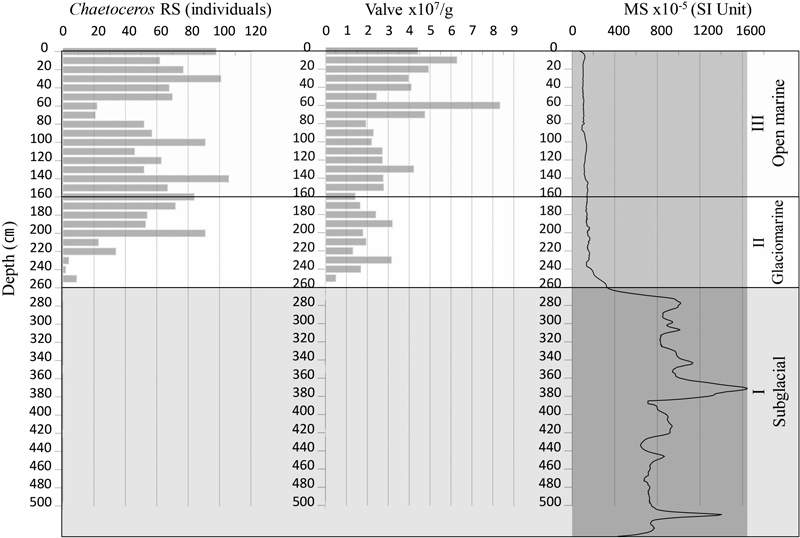
Down-core variations of Chaetoceros RS, valve abundance (×107/g) and whole-round MS (×10-5) from AM22-GC10B. The paleoenvironment changes from subglacial to open marine.
F. kerguelensis는 현재 남극해 퇴적물에서 우세하게 산출되는 구성요소이며(Burckle and Cirilli, 1987), 특히 해빙대의 북쪽에서 발견되는 퇴적물에서 두드러지게 산출된다(Esper et al., 2010). 그러나, 퇴적물에서의 상대적인 풍부성은 미세한 규질각의 선택적 용해에 의해 종종 과대평가 될 수 있다는 점을 고려해야 한다. 현재 표층수에서 F. kerguelensis은 남반구의 봄철 동안 풍부하게 관찰된다(Cortese and Gersonde, 2007). Thoma et al. (2008)에 의해 개발된 아문젠해 해양학 모델에 의하면 늦겨울부터 봄철까지 아문젠해 저기압이 남서쪽으로 이동하면서 대륙붕으로의 순환심층수(Circumpolar Deep Water, CDW)의 용승이 증가하는 것으로 나타난다. 따라서, 군집대 II 하부에서 F. kerguelensis의 산출이 증가하는 것은 이러한 CDW 용승의 영향으로 해석될 수 있다.
빙하가 후퇴한 이후, 동남극과 서남극 대륙붕에 육성기원 퇴적층과 함께 혼합 규조 군집을 포함하는 휴면포자가 풍부한 퇴적층이 쌓였다(Hillenbrand et al., 2010). Leventer et al. (2006)은 동남극 대륙붕에서는 철이 풍부한 융빙수가 유입되면서 성층화된 표층수내에서 봄철에 대규모 번성이 일어나 휴면포자가 풍부하게 나타난다고 설명하였다. 또한, 규조류는 염분 부족이나 질소의 결핍에 의해서 해빙경계(sea-ice edge) 부근에서 휴면포자를 형성하게 된다(Leventer, 1991, 1992; Crosta et al., 1997). 이러한 관점에서 규조 군집대 II를 살펴보면 휴면포자의 산출이 상부로 갈수록 증가하는 경향을 나타낸다.
아문젠해 만 중심부에 위치한 헌트 블러프(Hunt Bluff)의 마지막 빙하기는 아마도 마지막 빙하기 극대기(21.1 ± 5.8 ka)에 시작되어 대륙붕에서 빙상이 완전히 후퇴한 시기인 9.6 ± 0.9 ka에 끝난 것으로 보고 되었다(Johnson et al., 2017). 또한 Smith et al. (2011)은 Dotson 빙붕과 Getz 빙붕 연구를 통해 서부 아문젠해 만의 빙하 후퇴는 현재로부터 22.4 ka에 이미 시작되었음을 밝혔다. 이 빙하는 13.8 ka에 중간 대륙붕에 도달했고, 12.6에서 10.1 ka사이에는 내륙 대륙붕이 현재 빙붕 전선에서 약 10∼12 km 떨어진 지점까지 후퇴했다고 보고하였다. VC415과 AM22-GC10B 코어의 위치가 매우 가깝게 분포하고 있어 연대 측정이 되어 있는 VC415코어의 대자율 값과 비교해 본 결과, 규조 군집대 II는 빙하후퇴의 전이구간으로, 빙하가 현재 빙붕 전선에 가까운 위치까지 녹은 시점은 10.1 ka에 대비될 수 있다(Smith et al., 2011)(그림 2). 그러나, 정확한 빙상 후퇴시기를 파악하기 위해서는 동위 원소 분석에 의한 연대 측정이 필요하다. 군집대 III의 규조 개체수는 1.4∼8.3 ×10⁷/g 범위이며, 대자율 값은 군집대 II에 비해 약간 감소한다. 이 군집대에서는 휴면포자 산출이 풍부하게 나타난다(그림 4). F. curta는 정착빙(fast ice)과 유빙(pack ice)에서 풍부하게 산출되며 성층화된 해역에서 융빙수 공급의 지시자로서도 매우 유용하다(Garrison et al., 1987; Leventer and Dunbar 1987, 1988, 1996; Cunningham and Leventer, 1998). 군집대 III에서는 이러한 F. curta가 매우 풍부하게 산출된다. T. antarctica는 공해종으로 알려져 있으나 대륙주변부 해빙단(marginal ice edge) 환경에서도 일차 생산자로서 중요한 역할을 하며(Leventer and Dunbar, 1987, 1988, 1996; Fryxell and Kendrick, 1988; Leventer, 1992; Leventer et al., 1993; Taylor et al., 1997), 연안 해빙과 떠다니는 판상 얼음(platelet ice)들이 있는 환경에서도 산출된다(Hasle and Heimdal, 1968; Villareal and Fryxell, 1983; Smetacek et al., 1992; Gleitz et al., 1996). T. antarctica와 S. gracilis는 냉수역(Cold Open Water)에 분포하며, 차가운 해수면 온도를 가진 해빙 가장자리 근처에 개방 수역 조건이 존재함을 나타낸다(Barbara et al., 2013). 군집대 III의 T. antarctica는 하부에서 가장 풍부하게 나타나지만 상부로 갈수록 감소하는 경향을 보이며, S. gracilis는 60 cm 층준 상부에서 감소하는 경향을 보인다.
군집대 III에서 상대적으로 풍부하게 나타나는 Cocconeis spp.은 10 m 이상의 수심에서 서식하며(Whitehead and McMinn, 1997), 해안의 조하대에서 봄/여름에 대규모 번성을 일으킨다. 이 종은 빙하가 없는 기간 동안 수층의 강한 난류를 지시하는 것으로 알려져 있다(Heil, 2006; Barbara et al., 2013). 따라서, 군집대 III는 계절적인 공해 환경에서 퇴적되었음을 알 수 있다.
4. 결 론
남극 아문젠해 만내 Getz ‘A’ Ice Shelf (빙붕) 인근에서 채취한 코어 퇴적물 AM22-GC10B를 분석하여 총 22속 50종의 규조를 동정하였으며, 이를 바탕으로 퇴적 시기 동안 빙붕의 분포 변화를 파악하였다. 규조 개체수 농도는 건조 중량 1 g당 0.5~8.3×10⁷의 범위로 일차 생산성이 높지 않으며, 군집대 I에서는 거의 산출되지 않는다.
규조 군집의 해빙종과 공해종의 산출 분포 양상 및 대자율값에 의하여 3개의 군집대를 설정하였다. 군집대 I (260∼500 cm)은 규조가 살기 어려운 빙하하부(subglacial) 환경에서 퇴적된 시기에 해당되며, 군집대 II (160∼260 cm)는 군집대 I보다 온난한 시기이나 해빙종들의 산출이 우세하게 나타나는 것으로 보아 빙하하부 환경의 영향 아래에서 계절적으로 해빙이 줄어드는 빙해양(glaciomarine) 환경에서 형성된 것으로 해석된다. 군집대 III (0∼160 cm)는 해빙종의 산출이 줄어들고 공해종의 산출이 증가하며, 휴면포자의 산출이 풍부한 것으로 보아 계절적으로 개방된 해양(open marine) 환경에서 퇴적되었다. 정확한 빙상 후퇴의 시기를 알기 위해서는 연대 측정이 필요하나 현대 빙붕 전선에 가까운 위치로 빙하가 녹은 시점은 기존의 연구 결과(Smith et al., 2011)와 대비해 볼 때 10.1 ka에 해당된다.
Acknowledgments
이 연구는 한국해양과학기술원 부설 극지연구소의 “과거 온난기의 서남극 빙상 후퇴 및 해양 순환 변화 연구(PE25090)”과제와 정부(과학기술정보통신부)의 재원으로 한국연구재단의 지원을 받아 수행된 연구(No. 2022R1A2C1091796)입니다. 논문심사과정에서 값진 조언을 해주신 심사위원들께 깊은 감사를 드립니다.
References
-
Armand, L.K., Crosta, X., Romero, O. and Pichon, J.-J., 2005, The biogeography of major diatom taxa in Southern Ocean sediments: 1. Sea ice related species, Palaeogeography, Palaeoclimatology, Palaeoecology, 223, 93-126.
[https://doi.org/10.1016/j.palaeo.2005.02.015]

-
Arndt, J.E., Schenke, H.W., Jakobsson, M., Nitsche, F.O., Buys, G., Goleby, B., Rebesco, M., Bohoyo, F., Hong, J., Black, J., Greku, R., Udintsev, G., Barrios, F., Reynoso-Peralta, W., Taisei, M. and Wigley, R., 2013, The International Bathymetric Chart of the Southern Ocean (IBCSO) Version 1.0-A new bathymetric compilation covering circum-Antarctic waters. Geophysical Research Letters, 40, 3111-3117.
[https://doi.org/10.1002/grl.50413]
-
Bak, Y.S. and Lee, Y.U., 2017, Late Quaternary Paleoclimatic change in the Ulleung Basin, East Sea, Korea. Acta Geologica Sinica, 91, 263-269.
[https://doi.org/10.1111/1755-6724.13076]
-
Bamber, J.L., Riva, R.E., Vermeersen, B.L. and LeBrocq, A.M., 2009, Reassessment of the potential of the West Antarctic icesheet. Science, 324, 901-903.
[https://doi.org/10.1126/science.1169335]
-
Barbara, B., Crosta, X., Schmidt, S. and Massé, G., 2013, Diatoms and biomarkers evidence for major changes in sea ice conditions prior the instrumental period in Antarctic Peninsula. Quaternary Science Reviews, 79, 99-110.
[https://doi.org/10.1016/j.quascirev.2013.07.021]
-
Biddle, L.C., Heywood, K.J. and Kaiser, J., 2017, Glacial Meltwater Identification in the Amundsen Sea. Journal of Physical Oceanography, 47, 933-954.
[https://doi.org/10.1175/JPO-D-16-0221.1]
-
Burckle, L.H. and Cirilli, J., 1987, Origin of diatom ooze belt in the Southern Ocean: implications for late Quaternary paleoceanography. Micropaleontology, 33, 82-86.
[https://doi.org/10.2307/1485529]
-
Cortese, G. and Gersonde, R., 2007, Morphometric variability in the diatom Fragilariopsis kerguelensis: Implications for Southern Ocean paleoceanography. Earth and Planetary Science Letters, 257, 526-544.
[https://doi.org/10.1016/j.epsl.2007.03.021]
-
Crosta, X., Pichon, J.-J. and Labracherie, M., 1997, Distribution of Chaetoceros resting spores in modern peri-Antarctic sediments. Marine Micropaleontology, 29, 283-299.
[https://doi.org/10.1016/S0377-8398(96)00033-3]
-
Cunningham, W.L. and Leventer, A., 1998, Diatom assemblages in surface sediments of the Ross Sea: relationship to present oceanographic conditions. Antarctic Science, 10, 134-146.
[https://doi.org/10.1017/S0954102098000182]
-
Dutrieux, P., De Rydt, J., Jenkins, A., Holland, P.R., Ha, H.K., Lee, S.H., Steig, E.J., Ding, Q., Abrahamsen, E.P. and Schröder, M., 2014, Strong sensitivity of Pine Island ice-shelf melting to climatic variability. Science, 343, 174-178.
[https://doi.org/10.1126/science.1244341]
-
Esper, O., Gersonde, R. and Kadagies, N., 2010, Diatom distribution in southeastern Pacific surface sediments and their relationship to modern environmental variables. Palaeogeography, Palaeoclimatology, Palaeoecology, 287, 1-27.
[https://doi.org/10.1016/j.palaeo.2009.12.006]
-
Fryxell, G.A. and Kendrick, G.A., 1988, Austral spring microalgae across the Weddell Sea ice edge; spatial relationships found along a northward transect during AMERIEZ 83. Deep Sea Research Part A. Oceanographic Research Papers, 35, 1-20.
[https://doi.org/10.1016/0198-0149(88)90054-4]
-
Garrison, D.L., Buck, K.R. and Fryxell, G.A., 1987, Algal ice edge assemblages in Antarctic pack ice and in ice-edge plankton. Journal of Phycology, 23, 564-572.
[https://doi.org/10.1111/j.1529-8817.1987.tb04206.x]
-
Gleitz, M., Grossmann, S., Scharek, R. and Smetacek, V., 1996, Ecology of diatomand bacterial assemblages in water associated with melting summer sea ice in the Weddell Sea, Antarctica. Antarctic Science, 8, 135-146.
[https://doi.org/10.1017/S095410209600020X]
-
Hasle, G.R. and Heimdal, B.R., 1968, Morphology and distribution of the marine centric diatom Thalassiosira antarctica Comber. Journal of the Royal Microscopical Society, 88, 357-369.
[https://doi.org/10.1111/j.1365-2818.1968.tb00618.x]
-
Heil, P., 2006, Atmospheric conditions and fast ice at Davis, East Antarctica: A case study. Journal of Geophysical Research: Oceans, 111, C05009.
[https://doi.org/10.1029/2005JC002904]
-
Hillenbrand, C.-D., Smith, J.A., Kuhn, G., Esper, O., Gersonde, R., Larter, R.D., Maher, B.A., Moreton, S.G., Shimmield, T.M. and Korte, M., 2010, Age assignment of a diatomaceous ooze deposited in the western Amundsen Sea Embayment after the last glacial maximum. Journal of Quaternary Science, 25, 280-295.
[https://doi.org/10.1002/jqs.1308]
-
Johnson, J.S., Smith, J.A., Schaefer, J.M., Young, N.E., Goehring, B.M., Hillenbrand, C.-D., Lamp, J.L., Finkel, R.C. and Gohl, K., 2017, The last glaciation of Bear Peninsula, central Amundsen Sea Embayment of Antarctica: Constraints on timing and duration revealed by in situ cosmogenic 14C and 10Be dating. Quaternary Science Reviews, 178, 77-88.
[https://doi.org/10.1016/j.quascirev.2017.11.003]
-
Joughin, I. and Alley, R.B., 2011, Stability of the West Antarctic ice sheet in a warming world. Nature Geoscience, 4, 506-513.
[https://doi.org/10.1038/ngeo1194]
-
Jovane, L., Florindo, F., Acton, G., Ohneiser, C., Sagnotti, L., Strada, E., Verosub, K.L., Wilson, G.S., Iacoviello, F., Levy, R.H. and Passchier, S., 2019, Miocene Glacial Dynamics Recorded by Variations in Magnetic Properties in the ANDRILL-2A Drill Core. Journal of Geophysical Research: Solid Earth, 124, 2297-2312.
[https://doi.org/10.1029/2018JB016865]
-
Kim, M., Lee, J.I., Bak, Y.-S., Hillenbrand, C.-D., Yang, E.J., Montlucon, D.B., Haghipour, N., Eglinton, T.I. and Hwang, J., 2023, Holocene Palaeoenvironmental and Palaeoproductivity Changes in the Western Amundsen Sea Embayment of Antarctica. Journal of Geophysical Research: Oceans, 128, e2023JC019797.
[https://doi.org/10.1029/2023JC019797]
-
Konfirst, M.A., Scherer, R.P., Hillenbrand, C.-D. and Kuhn, G., 2012, A marine diatom record from the Amundsen Sea Insights into oceanographic andclimatic response to the Mid-Pleistocene Transition in the West Antarctic sector of the Southern Ocean. Marine Micropaleontology, 92-93, 40-51.
[https://doi.org/10.1016/j.marmicro.2012.05.001]
-
Leventer, A., 1991, Sediment trap diatom assemblages from the northern Antarctica Peninsula region. Deep Sea Research Part A. Oceanographic Research Papers, 38, 1127-1143.
[https://doi.org/10.1016/0198-0149(91)90099-2]
-
Leventer, A., 1992, Modern distribution of diatoms in sediments from the George V Coast, Antarctica. Marine Micropaleontology, 19, 315-332.
[https://doi.org/10.1016/0377-8398(92)90036-J]
-
Leventer, A., Domack, E., Dunbar, R., Pike, J., Stickley, C., Maddison, E., Brachfeld, S., Manley, P. and McClennen, C., 2006, Marine sediment record from the East Antarctic margin reveals dynamics of ice sheet reces-sion. GSA Today, 16, 4-10.
[https://doi.org/10.1130/GSAT01612A.1]
-
Leventer, A. and Dunbar, R., 1987, Diatom flux in McMurdo Sound, Antarctica. Marine Micropaleontology, 12, 49-64.
[https://doi.org/10.1016/0377-8398(87)90013-2]
-
Leventer, A. and Dunbar, R., 1988, Recent diatom record of McMurdo Sound, Antarctica: implications for history of sea ice extent. Paleoceanography, 3, 259-274.
[https://doi.org/10.1029/PA003i003p00259]
-
Leventer, A. and Dunbar, R., 1996, Factors influencing the distribution of diatoms and other algae in the Ross Sea. Journal of Geophysical Research, 101, 18489-18500.
[https://doi.org/10.1029/96JC00204]
-
Leventer, A., Dunbar, R. and DeMaster, D.J., 1993, Diatom evidence for Late Holocene climatic events in Granite Harbor, Antarctica. Paleoceanography, 8930, 373-386.
[https://doi.org/10.1029/93PA00561]
-
Pattyn, F. and Morlighem, M., 2020, The uncertain future of the Antarctic Ice Sheet. Science, 367, 1331-1335.
[https://doi.org/10.1126/science.aaz5487]
-
Pritchard, H.D., Ligtenberg, S.R.M., Fricker, H.A., Vaughan, D.G., van den Broeke, M.R. and Padman, L., 2012, Antarctic ice-sheet loss driven by basal melting of ice shelves. Nature, 484, 502-505.
[https://doi.org/10.1038/nature10968]
-
Rignot, E., Thomas, R.H., Kanagaratnam, P., Casassa, G., Frederick, E., Gogineni, S., Krabill, W., Rivera, A., Russell, R., Sonntag, J., Swift, R. and Yungel, J., 2004, Improved estimation of the mass balance of glaciers draining into the Amundsen Sea sector of West Antarctica from the CECS/NASA 2002 campaign. Annals of Glaciology, 39, 231-237.
[https://doi.org/10.3189/172756404781813916]
-
Rignot, E., Bamber, J.L., Van der Broeke, M.R., Davis, C., Li, Y., Van der Berg, W.J. and Van Meijgaard, E., 2008, Recent Antarctic ice mass loss from radar interferometry and regional climate modeling. Nature Geosciences, 1, 106-110.
[https://doi.org/10.1038/ngeo102]
-
Scherer, R.P., 1994, A new method for determination of absolute abundance of diatoms and other siltsized sedimentary particles. Journal of Paleolimnology, 12, 171-179.
[https://doi.org/10.1007/BF00678093]
-
Scott, J.B.T., Gudmundsson, G.H., Smith, A.M., Bingham, R.G., Pritchard, H.D. and Vaughan, D.G., 2009, Increased rate of acceleration on Pine Island Glacier strongly coupled to changes in gravitational driving stress. The Cryosphere, 3, 125-131.
[https://doi.org/10.5194/tc-3-125-2009]
-
Shepherd, A., Wingham, D. and Rignot, E., 2004, Warm ocean is eroding West Antarctic ice sheet. Geophysical Research Letters, 31.
[https://doi.org/10.1029/2004GL021284]
-
Smetacek, V., Scharek, R., Gordon, L.I., Eicken, H., Fuhtbach, E., Rohardt, G. and Moore, S., 1992, Early spring phytoplankton blooms in ice platelet layers of the southern Weddell Sea, Antarctica. Deep Sea Research Part A. Oceanographic Research Papers, 39, 153-168.
[https://doi.org/10.1016/0198-0149(92)90102-Y]
-
Smith, J.A., Hillenbrand, C.-D., Kuhn, G., Larter, R.D., Graham, A.G.C., Ehrmann, W., Moreton, S.G. and Forwick, M., 2011, Deglacial history of the West Antarctic Ice Sheet in the western Amundsen Sea Embayment. Quaternary Science Reviews, 30, 488-505.
[https://doi.org/10.1016/j.quascirev.2010.11.020]
-
Taylor, F., McMinn, A. and Franklin, D., 1997, Distribution of diatoms in surface sediments of Prydz Bay, Antarctica. Marine Micropaleontology, 32, 209-229.
[https://doi.org/10.1016/S0377-8398(97)00021-2]
-
Thoma, M., Jenkins, A., Holland, D. and Jacobs, S., 2008, Modeling Circumpolar Deep Water intrusions on the Amundsen Sea continental shelf, Antarctica. Geophysical Research Letters, 35, L18602.
[https://doi.org/10.1029/2008GL034939]
-
Vaughan, D., 2008, West Antarctic Ice Sheet collapse - the fall and rise of a paradigm. Climatic Change, 91, 65-79.
[https://doi.org/10.1007/s10584-008-9448-3]
-
Villareal, T.A. and Fryxell, G.A., 1983, Temperature effects on the valve structure of the bipolar diatoms Thalassiosira antarctica and Porosira glacialis. Polar Biology, 2, 163-169.
[https://doi.org/10.1007/BF00448966]
-
Whitehead, J.M. and McMinn, A., 1997, Paleodepth determination from Antarctic benthic diatom assemblages. Marine Micropaleontology, 29, 301-318.
[https://doi.org/10.1016/S0377-8398(96)00036-9]