한국 화산섬 제4기 퇴적물의 루미네선스 신호 특성 비교

초록
석영을 이용한 광여기루미네선스(Optically Stimulated Luminescence, OSL) 신호의 물리적인 특성은 석영의 기원과 퇴적환경에 따라 차이를 보인다. 이번 연구는 한국의 대표적인 화산섬인 제주도와 울릉도 퇴적물의 루미네선스 신호 특성을 파악하기 위해 각 연구 지역에서 채취한 미고화 퇴적물에서 석영을 분리하여 CW (Continuous Wave) OSL과 LM (Linearly Modulated) OSL 분석을 실시하였다. 또한, 광물 조성을 파악하기 위하여 X선 회절(X-ray diffraction, XRD) 분석을 실시하였다. 루미네선스 신호 특성을 비교해 본 결과, 제주도 퇴적물에서 분리한 석영은 OSL 연대측정에 적합한 fast component가 우세한 신호 특성을 보이는 반면, 울릉도 퇴적물에서 분리한 석영은 OSL 연대측정에 적합하지 않은 slow component가 우세한 신호 특성을 보였다. 울릉도 시료의 경우 Tsukamoto et al. (2007)이 보고한 화산 기원 석영의 루미네선스 신호 특성과 매우 유사한 경향을 보였다. XRD 분석 결과, 제주도 시료는 석영이 주성분으로 확인되었으나 울릉도 시료는 석영 이외에도 장석 및 휘석 등의 광물이 다량 포함되었다. 이는 울릉도 시료의 루미네선스 신호가 석영 뿐만 아니라 다른 광물들에서도 기인했을 가능성을 시사한다. 제주도 퇴적물의 석영 기원은 화산 기원이 아닌 과거 대륙붕 퇴적물이 화산 분출 시 화산 쇄설물에 혼입되었을 가능성과 빙하기 시기 해수면이 낮아져 육상화 된 제주 인근에서 바람에 의해 세립질 퇴적물이 유입되었을 가능성이 제시된다.
Abstract
The physical characteristics of optically stimulated luminescence (OSL) signals from quartz vary depending on their provenance and depositional environment. This study aimed to identify the luminescence signal characteristics of sediments from Jeju Island and Ulleung Island, two representative volcanic islands in Korea. Quartz was separated from Quaternary unconsolidated sediments collected from each study area, and CW (continuous wave) OSL and LM (linearly modulated) OSL analyses were conducted. In addition, X-ray diffraction (XRD) analysis was performed to determine mineral composition. The results indicate that quartz from Jeju Island exhibits signal characteristics dominated by the fast component, which is highly suitable for OSL dating, whereas quartz from Ulleung Island is dominated by the slow component, which is less suitable for OSL dating. This pattern is consistent with the luminescence characteristics of volcanic-origin quartz reported by Tsukamoto et al. (2007). XRD analysis revealed that Jeju sample consist predominantly of quartz, while Ulleung sample contain substantial amounts of feldspar and pyroxene in addition to quartz. This suggests that the luminescence signals of Ulleung samples may originate not only from quartz but also from other minerals. The provenance of quartz in Jeju sediments is inferred to be non-volcanic, potentially derived from ancient continental shelf sediments mixed with volcaniclastics during eruptions, or from fine-grained quartz transported by wind from exposed areas near Jeju during glacial periods when sea level was lower.
Keywords:
volcanic island, OSL signal property, quartz, Ulleung Island, Jeju Island키워드:
화산섬, OSL 신호 특성, 석영, 울릉도, 제주도1. 서 론
한반도 주변의 화산섬은 제주도, 울릉도 그리고 독도가 대표적이며, 해저에서 발생한 화산 활동으로 분출된 화산재와 용암이 지속적으로 축적되면서 현재의 모습이 완성되었다. 각각의 화산섬들은 시기별로 고유한 지질학적 형성과정을 겪었으며, 이러한 형성 시기를 규명하기 위하여 다양한 연대측정법들이 적용되어져 왔다. 특히, 화산암 사이에 협재되어있는 제4기 미고화 퇴적층의 형성 시기 규명은 퇴적층 상하부에 분포하는 화산체의 분출 연대 하한과 상한을 규정하기 위한 목적으로 연구되었고, 미고화 퇴적층의 퇴적시기 규명을 위하여 방사성 탄소(14C)와 OSL (Optically Stimulated Luminescence: 광여기루미네선스) 연대측정법이 널리 사용되어 왔다. 제주도에서는 석영을 이용한 OSL 연대측정이 현재까지 활발히 이루어져 왔으며(Cheong et al., 2007; Lee et al., 2015; Kim, 2016; Kim et al., 2016; Yeo et al., 2019), 다수의 제4기 퇴적층 연대가 성공적으로 산출된 바 있다. 반면, 울릉도의 형성 시기를 규명하기 위하여 나이테 연대측정(tree-ring dating), 40Ar/39Ar 및 14C연대측정법 등이 적용되어 왔으나(Okuno et al., 2010; Im and Choo, 2015; Hwang et al., 2021), 석영을 이용한 OSL 연대측정 결과는 아직까지 보고된 바 없다. 이는 OSL 연대측정 방법이 울릉도 퇴적물 시료에 적합하지 못하여 충분히 활용되지 못하였거나 제주도에 비하여 울릉도 지질 연구 자체가 활발하지 못하였던 결과로 해석된다. 이처럼 두 섬이 같은 화산 기원 섬 임에도 불구하고 OSL 연대측정의 적용 가능 여부에 차이를 보이는데, 이러한 원인은 아직까지 명확히 밝혀지지 않았다. 이번 연구에서는 제주도와 울릉도에서 채취한 퇴적물 시료에서 분리한 석영을 대상으로 루미네선스 신호 특성을 비교하고, X선 회절(X-ray diffraction, XRD) 정성 분석을 통하여 광물 조성을 확인하였다. 이를 통하여 제주도와 울릉도에서 석영을 이용한 OSL 연대측정 가능 조건이 다른 원인을 밝히고자 한다.
2. 연구지역과 시료채취
울릉도(그림 1b)는 동해의 중서부 후방분지(back-arc basin)에 위치한 제4기 화산섬이다. 화산체는 해저면에서 약 3,000 m가량 솟아있으며, 해수면 위로 노출된 부분은 높이 982 m에 달한다(Kim et al., 2014). 울릉도는 신제3기(Neogene) 플라이오세(Pliocene)부터 제4기(Quaternary) 홀로세(Holocene)에 이르기까지 여러 차례 화산활동을 거쳐 형성된 것으로 알려져 있다. 해수면 아래 화산체는 플라이오세에 형성되었고, 해수면 위의 화산체는 제4기 동안 일어난 여러 화산 활동에 의해 형성된 것으로 추정된다(Kim and Lee, 2008). 육상에 노출된 부분은 주로 현무암, 조면안산암, 조면암, 포놀라이트 용암 및 암맥으로 구성되어 있고, 이외의 화산쇄설성 퇴적물로 이루어져있다(Hwang et al., 2014; Kim et al., 2014). 이번 연구에서는 울릉도 동북쪽 연안 지역 일대에서 획득한 해안 시추 코어 퇴적물에서 3개의 OSL 시료를 채취하였다.
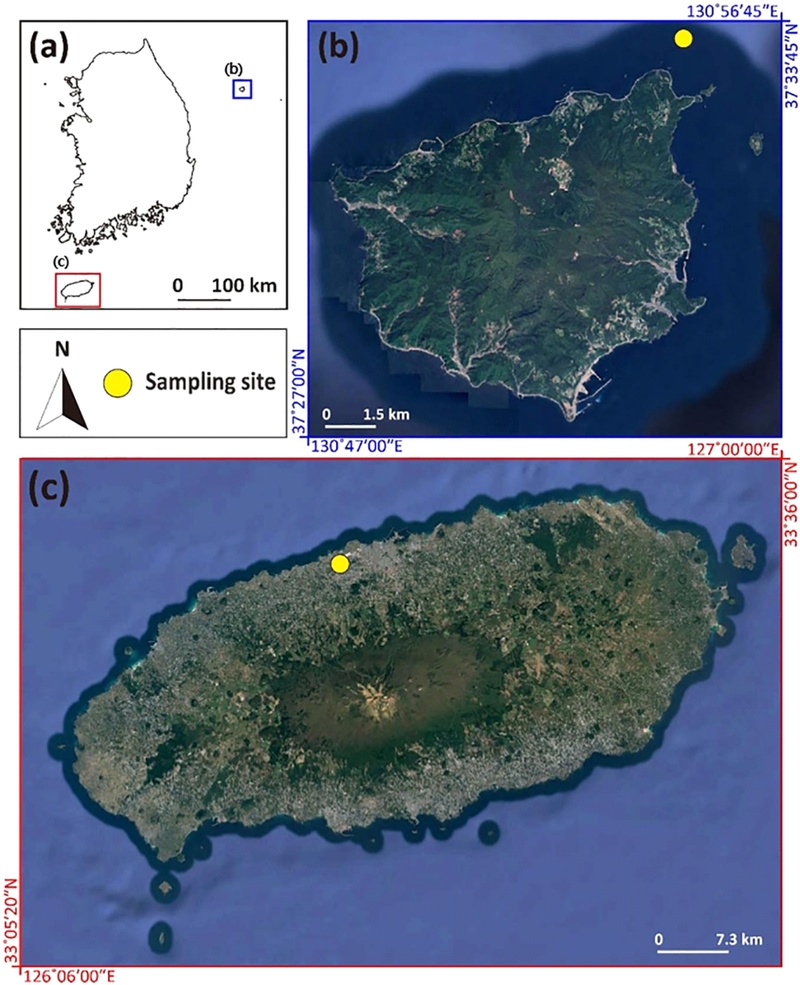
(a) Location map showing the study areas. (b) Ulleung Island and (c) Jeju Island.
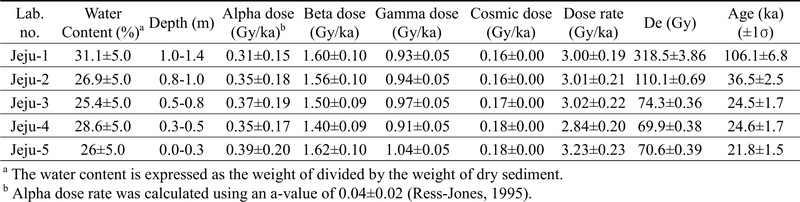
제주도(그림 1c)는 화산활동 이전 시기의 주로 대륙붕 천해환경에서 쌓인 미고결 사질 퇴적층인 U층(Unconsolidated Formation: Koh, 1991)이 화산암체 아래에 분포하며, 그 위로 약 188~50만 년 전 천해환경에서 화산활동 초기 단계에 형성된 서귀포층이 놓여 있다(Sohn and Park, 2004; Koh et al., 2013). 이후 수성 및 육상 화산활동으로 형성된 현무암층이 서귀포층 위에 두껍게 분포하며, 약 30만 년 전부터 홀로세에 이르기까지 활발한 육상 화산활동이 이어지면서 현재의 제주도 지형이 형성되었다(Koh et al., 2013). 이번 연구에서는 제주시 북쪽에 위치한 외도동 고고 유적 발굴 조사지에서 미고화 퇴적층 단면을 대상으로 5개의 OSL 시료를 채취하였다. 해당 퇴적층은 약 1.8 m 두께로, 상하 간 뚜렷한 색상 차이를 보였다(그림 5).
3. 연구방법
OSL 연대측정에 사용되는 석영이나 장석과 같은 광물은 자연상태에서 트랩(trap)이라 하는 격자 결함 형태의 빈 공간을 가진다. 광물이 퇴적된 이후 주변 토양으로부터 자연방사선을 받는데, 이때 받은 전자가 이온화(ionized)된 후 트랩에 저장된다. 이후 특정 파장 이상의 빛이나 특정 온도 이상의 열 자극을 받으면 트랩에 포획된 전자가 해방되어 빛을 방출하는 루미네선스(luminescence) 현상이 발생한다(Aitken, 1998). 트랩의 깊이에 따라 전자의 방출 속도는 달라지며, 얕은 트랩에 갇힌 전자는 빛에 민감하여 약한 자극에도 빠르게 방출된다. 빛에 의해 야기되는 루미네선스 신호는 fast, medium, slow components로 구분 가능하다. fast component가 우세할수록 퇴적물이 태양광에 노출되었을 때 신호가 소멸되는 현상(bleaching)이 잘 이루어져 OSL 연대측정에 유리하다. 반면에, slow component는 높은 열적 안정성(thermal stability)으로 인하여 깊은 트랩에 갇힌 전자가 잘 방출되지 않고, 신호가 잘 소멸되지 않는(poor bleachability) 특성을 가지고 있어 해당 component가 우세할수록 OSL 연대측정에는 불리하다(Bailey et al., 1997).
석영의 루미네선스 신호는 CW (Continuous Wave) OSL과 LM (Linearly Modulated) OSL을 이용하여 각각의 components를 분리할 수 있다. 루미네선스 신호는 여러 종류의 트랩에서 기인한 복합신호로서 전체적으로는 비1차 반응속도(non-first-order kinetics) 형태로 나타난다(Aitken, 1998). CW-OSL 분석에서는 이러한 신호를 fast, medium, slow components로 단순 분리할 수 있다. 분리된 신호들은 지수함수 감쇄곡선(exponential decay curve) 형태로 나타낼 수 있으며, fast component가 가장 먼저 방출되고 이어서 medium과 slow components가 순차적으로 방출된다(Bailey et al., 1997). LM-OSL은 여기 광원의 세기를 선형적으로 증가시키면서 루미네선스 신호를 측정하기 때문에 자극 세기가 증가함에 따라 CW-OSL과 동일하게 fast, medium, slow components 순으로 전자가 방출되어 시간에 따른 피크 형태로 나타난다. 또한, 겹치는 OSL 신호를 식별하여 분리할 수 있어 동일한 component에서도 slow1, slow2 등으로 세분화 할 수 있기 때문에 보다 정밀한 component별 특성 분석이 가능하다(Bulur, 1996). 이전 연구(Bulur et al., 2000; Kuhns et al., 2000; Singarayer and Bailey, 2003)에서도 LM-OSL을 이용하여 석영의 component를 세 개 이상으로 분리한 바 있다(Jain et al., 2003).
이번 연구에서는 제주도와 울릉도에서 채취한 미고화 퇴적물로부터 석영을 분리하여 루미네선스 신호 특성과 XRD 광물 조성 분석을 수행하였다. 석영 분리는 Park et al. (2018)과 Lee et al. (2023)의 OSL 전처리 과정을 참고하여 90-250 μm 크기의 조립질 석영과 4-11 μm 크기의 세립질 석영으로 분리하였다. 울릉도 시료에서는 세립질 석영의 양이 충분하지 않아 조립질 석영만이 분리되었고, 제주도 시료에서는 조립질 석영과 세립질 석영 모두가 분리되었다.
이번 연구에서는 울릉도 시료에서 세립질 석영이 분리되지 않았기 때문에, 두 섬 모두에서 분리된 조립질 석영을 대상으로 루미네선스 신호 특성을 비교하였다. 제주도 시료의 경우 세립질 석영의 높은 포화선량(saturation) 특성을 활용하여(Kim et al., 2015) OSL 연대의 상한을 확장하고자 세립질 석영을 이용한 OSL 연대측정이 실시되었다. OSL 연대는 퇴적 이후 광물에 축적된 전자 에너지의 방출량인 등가선량(equivalent dose, De)을 주변 토양에서 방출된 방사선량 값인 연간선량(dose rate)으로 나누어 계산된다(Aitken, 1998). 등가선량 측정법은 단일시료 재현법(single-aliquot regenerative-dose protocol; Murray and Wintle, 2000)을 적용하였고, 측정 장비로는 한국지질자원연구원이 보유한 Risø사의 TL/OSL DA-20 reader가 사용되었다. 본 장비에는 0.088 Gy/sec의 선량률을 가지는 90Sr/90Y 베타 선원이 장착되어 있다. 470±20 nm 파장의 Blue LEDs 광원이 루미네선스 발광에 사용되었고, 생성된 루미네선스 신호는 광전자 증배관(photomultiplier tube, PMT)을 통해 검출된다. PMT 전면에는 Hoya U-340 필터(2.5 mm 및 5 mm 두께)가 장착되어 있어 루미네선스 신호만을 선택적으로 검출할 수 있다. 연간선량(dose rate)은 감마선 분광 분석법(gamma-ray spectrometry)으로 측정하였으며 분석 장비로는 한국지질자원연구원이 보유한 고순도 감마선 검출기(Canberra SEGc 3018)가 사용되었다. 방사성 핵종 농도로 측정된 데이터는 OSL 연대 계산에 직접 사용할 수 없으므로, 이를 방사선 흡수선량 단위(Gy)로 환산하는 변환계수를 적용하여 연간선량을 산출하였다(Olley et al., 1996). 마지막으로 OSL 전처리 이후 분리된 시료들의 광물 조성을 확인하기 위하여 분리된 시료들을 약 10 μm 내외로 분쇄한 뒤 한국지질자원연구원이 보유한 Philips X’Pert MPD 장비를 이용하여 XRD 분석을 수행하였다.
4. 결과 및 토의
이번 연구는 제주도와 울릉도에서 채취한 시료들 중 대표시료 1개씩을 선택하여 루미네선스 특성을 비교 분석하였고 그 결과를 해석하였다. 그림 2는 제주도와 울릉도 시료의 CW-OSL 및 LM-OSL 신호를 component 별로 분리하여 비교한 결과이다. 표 1에서는 CW-OSL 신호를 SigmaPlot 소프트웨어를 이용해 곡선 분해(curve deconvolution)한 후, fast, medium, slow component 각각을 지수함수 감쇄(exponential decay) 모델에 적용하여 분리하였고 이를 통해 세 가지 component의 상대적 비율을 비교하였다. 제주도 시료의 CW-OSL 분석 결과(그림 2a; 표 1), fast component가 가장 빠르게 전자를 방출하며 소멸하였고, fast component는 전체 신호의 약 81.4%로 매우 우세하게 나타났다. medium과 slow components는 각각 13.9%, 5.0%로 상대적으로 적은 비율을 차지하였다. LM-OSL 분석(그림 2c)에서도 제주도 시료는 fast component의 피크가 우세하게 관찰된 반면, medium과 slow components는 상대적으로 낮은 피크의 비율을 보였다. 반면, 울릉도 시료의 CW-OSL 분석 결과(그림 2b; 표 1), fast component의 초기 신호 강도(luminescence intensity)는 제주도 시료에 비하여 현저히 낮게 나타났고, 상대적 비율은 14.9%에 불과하였다. 하지만, medium과 slow components은 초기 신호 강도 세기가 fast component에 비해 높으며, 각각 비율은 44.9%, 40.2%를 차지하여 우세한 경향을 보였다. LM-OSL 분석(그림 2d)에서는 fast component가 관찰되지 않았고, medium component와 slow component 1, 그리고 slow component 2가 주요 신호로 관찰되었다.
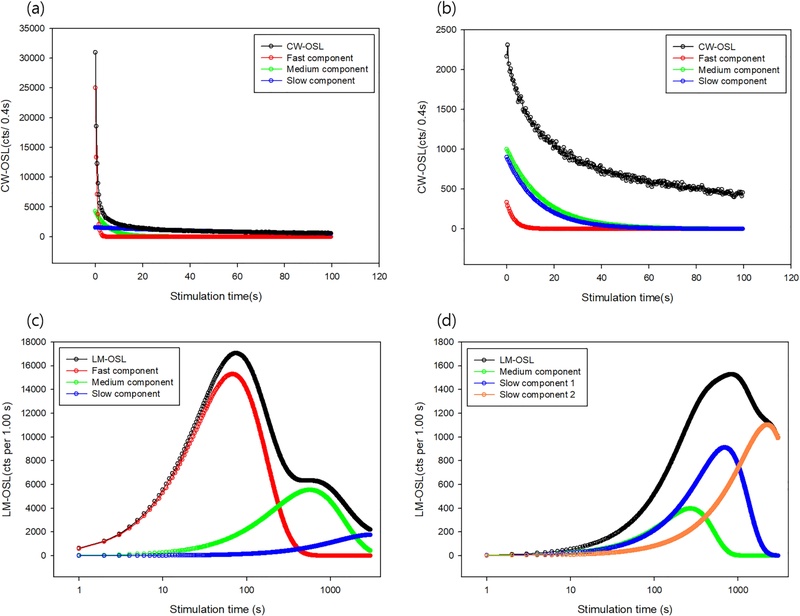
Graphs showing the component separation results of CW-OSL and LM-OSL signals: (a) CW-OSL signal from Jeju Island, (b) CW-OSL signal from Ulleung Island, (c) LM-OSL signal from Jeju Island, and (d) LM-OSL signal from Ulleung Island.

Component ratio information from CW-OSL component separation from the samples collected in this study.
제주도 시료에서는 OSL 연대측정에 적합한 조건 중 하나인 fast component가 우세하게 나타나는 경향을 보여준다. 반면, 울릉도 시료의 경우 CW-OSL 분석에서는 fast component의 기여도가 매우 낮게 나타났고 LM-OSL 분석에서는 관찰되지 않았다. 이는 fast component의 기여도가 극히 낮아 LM-OSL 에서는 배경 신호에 묻혀 검출되지 않았을 것으로 추정된다. 이러한 결과는 Tsukamoto et al. (2007)이 보고한 화산 기원 석영의 루미네선스 신호 특성과 유사한 경향으로 확인된다. Tsukamoto et al. (2007)의 화산 석영을 이용한 CW-OSL의 경우(그림 3a) component 분리를 수행하지 않았으나 OSL 신호 강도가 상대적으로 낮게 나타나며 루미네선스 신호가 천천히 감쇄하는 곡선의 형태를 보고하였다. 이는 울릉도 시료의 CW-OSL 결과와 유사한 경향으로 LM-OSL component 분리 연구 결과(그림 3b)는 울릉도 시료의 LM-OSL 그래프와 마찬가지로 fast component가 존재하지 않고, medium component와 slow component가 우세한 특징을 보인다. 이러한 특성은 화산 석영의 형성 과정과 연관되는데, 화산 석영은 약 573℃ 이상의 고온에서 결정화된 후, 분출 시 매우 빠르게 냉각된다. 이러한 급속 냉각 과정으로 인해 일반 석영에 비해 격자 결함과 불순물이 더 많이 형성되며, 이로 인해 루미네선스 발광 특성이 달라지게 된다(Tsukamoto et al., 2007). 따라서 울릉도 동북쪽 연안 지역에서 채취한 시추 코어 퇴적물은 화산 기원 석영이 주를 이루며 이러한 특성을 반영하는 것으로 추측할 수 있다.
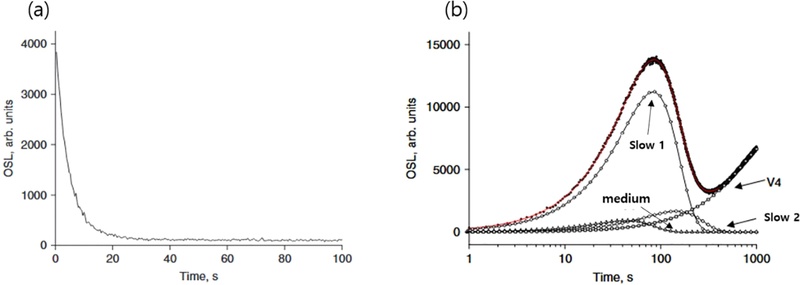
Volcanic-origin quartz: (a) OSL decay curve and (b) LM-OSL (modified from Tsukamoto et al., 2007).
각 시료의 광물 조성을 확인하기 위한 XRD 정성 분석 결과는 그림 4와 같다. 제주도 시료는 석영의 대표 피크(20.8°, 26.6°)가 매우 뚜렷하고 우세하게 관찰되었다(그림 4a). 반면, 울릉도 시료에서는 석영 분리를 위한 전처리 과정을 거쳤음에도 불구하고 장석류 광물인 Andesine의 피크(27.8°)가 주를 이루고 석영은 일부 포함된 것으로 관찰되었다(그림 4b). 이러한 결과는 울릉도 시료의 루미네선스 신호에 장석 성분이 크게 기여하였을 가능성을 배제하기 어렵다. 이는 석영 분리를 위한 전처리 과정에서 장석이 완전히 제거되지 못하였을 경우 화산 석영과 같은 루미네선스 특성이 관찰될 수 있는 가능성을 제시한다.
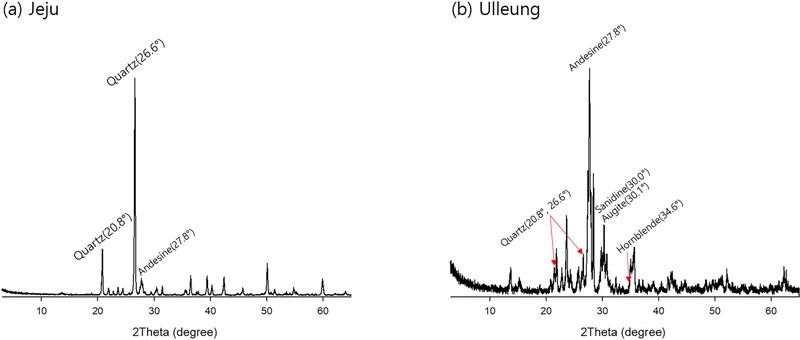
XRD analysis results indicating the mineral compositions from (a) Jeju Island and (b) Ulleung Island.
제주도 시료의 경우 일반적인 화산 기원 석영의 루미네선스 특성과 다르게 루미네선스 신호에서 fast component가 매우 우세하게 나타났고 XRD 정성분석에서는 매우 뚜렷한 석영 피크가 관찰되었다. 따라서 이러한 결과들은 제주도 퇴적물에서 분리된 석영이 비화산 기원의 석영일 가능성을 시사한다. 제주도 석영이 비화산 기원일 경우, 제주도 퇴적물에 분포하는 석영의 기원은 크게 두 가지 가능성이 존재한다. 첫 번째, Koh (1991)에서 밝힌 제주 화산 활동 이전 플라이오세-플라이스토세 시기의 미고결 사질 퇴적층인 U층으로부터 기원하였을 가능성이다. 이는 화산 분출 시 대륙붕 퇴적물이 화산 분출물과 혼재되어 퇴적되었고 이후 재동(reworking)되어 현재의 퇴적물에 포함되었을 가능성이 존재한다. 두번째 가능성은 Lim and Matsumoto(2008)에서 제안한 바와 같이 풍성(aeolian) 기원의 세립질 석영이 바람에 의해 운반 및 퇴적된 후 재동 되었을 가능성이다.
이번 연구에서는 제주도 외도동 시료에서 세립질 석영을 이용한 OSL 연대측정이 성공적으로 수행되었으며(그림 5; 표 2), 뚜렷한 수직적 층서성이 확인되었다. 상부 퇴적층의 연대는 21.8±1.5 ka로, 이는 해수면이 상대적으로 낮았던 시기인 해양동위원소 단계(Marine Isotope Stage, MIS) 2의 최종 빙기 최성기(Last Glacial Maximum: LGM, 약 19-27 ka)에 해당한다(Clark et al., 2009). 이 시기에는 제주도 주변이 육상화 되었고(Lee et al., 2022), 서풍 또는 북서풍 강화에 의해 주변 퇴적물로부터 세립질 석영이 풍성으로 유입될 수 있는 가능성이 높아졌다. 한편, 최하부 퇴적층은 106.1±6.8 ka의 연대를 나타내며, 이는 해수면이 높았던 간빙기인 MIS 5e 최종 간빙기(Last Interglacial, LIG 약 115-130 ka)에 해당한다(Dahl-Jensen et al., 2013). 당시 환경은 해수면이 높아져 제주도 주변으로부터 풍성 퇴적이 일어나기 어려운 조건이었으므로, 최하부 퇴적층의 석영은 제주 화산체 하부에 분포하는 미고결 퇴적층인 U층으로부터 기원하였을 가능성이 제기된다. 그러나 외도동 퇴적층이 성공적인 OSL 연대측정과 함께 뚜렷한 수직적 층서성을 보여줌에도 불구하고, 퇴적 시기와 해수면 변동 정보만으로 퇴적물의 기원지를 명확히 규명하기는 어렵다. 또한, 해당 퇴적층은 1차 퇴적 기작으로 형성된 퇴적물이 아니라, 2차적으로 재 이동된 퇴적물일 가능성이 높기 때문에 현 단계에서 석영의 기원을 단정하기는 어렵다. 보다 명확한 석영의 기원 해석을 위해서는 지화학적 분석 등 추가적인 연구가 필요할 것으로 판단된다. 한편, 이번 연구 결과는 제주도와 울릉도의 일부 지역에서 채취된 시료 분석 결과로 두 섬 전체 특성을 일반화하기에는 한계가 존재한다.
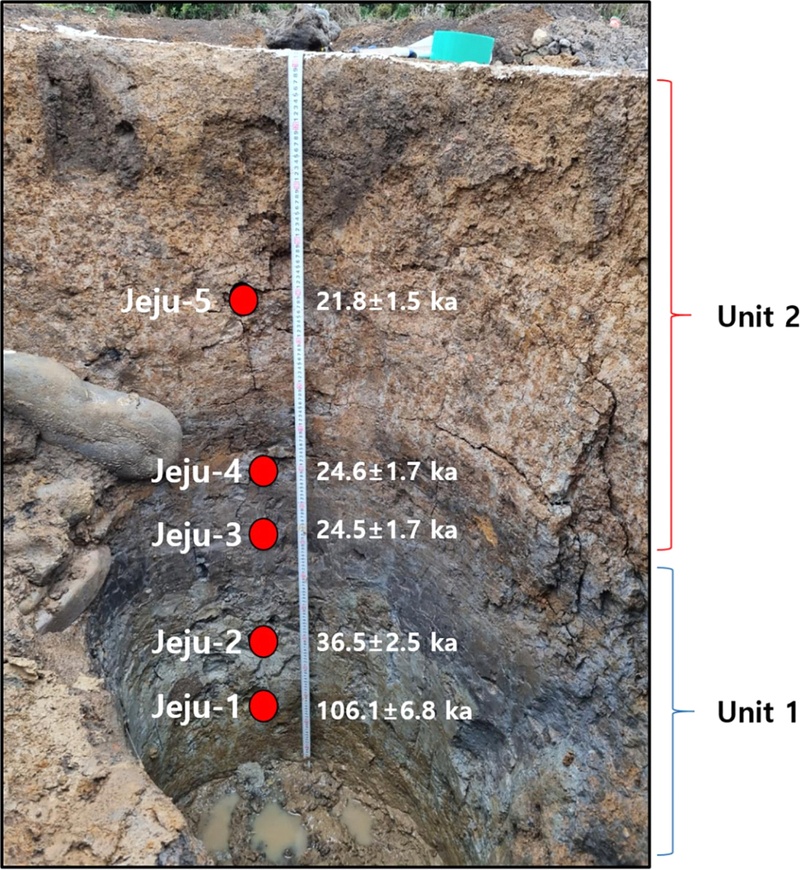
The Oedo-dong trench section showing the location of OSL samples and two units by stratigraphic changes. Unit 1 consists of grey silty clay, while Unit 2 appears to be an oxidized sediment layer with visible soil wedge structures.
Dose rate information, equivalent dose values and OSL ages obtained from Jeju Island samples.
5. 결 론
이번 연구에서는 제주도와 울릉도 시료들의 루미네선스 특성과 광물 조성을 비교하였다. 그 결과, 제주도 시료는 OSL 연대측정에 적합한 fast component가 우세한 특성을 보이는 반면, 울릉도 시료는 medium 및 slow components가 우세하고 fast component는 약 10%에 불과하였다. 이러한 특성들은 울릉도 시료가 전형적인 화산 기원 석영의 루미네선스 특성과 일치하며 OSL 연대측정에는 부적합함을 지시한다. XRD 분석 결과, 울릉도 시료에는 Andesine 등 석영 이외의 광물들이 확인되었기 때문에 관찰된 루미네선스 신호 특성이 화산 기원 석영이 아닌 장석 신호로 인한 결과일 가능성도 제시된다. 제주도 시료의 fast component가 우세한 루미네선스 특성은 화산 석영과 상반되며 제주도 미고화 퇴적층 내 석영이 화산 기원이 아닌 외부 기원의 비화산성 석영에서 기인하였을 가능성을 시사한다. 제주 석영의 기원에 대해서는 U층으로부터의 석영 기원과 해수면의 낮아짐에 따라 바람으로 인해 세립질 석영이 풍성으로 기원하였을 가능성이 제시된다. 외도동 퇴적층 단면의 OSL 연대 결과, 최상부 퇴적층(21.8±1.5 ka)은 마지막 빙기 최성기(LGM) 시기에 해당하며, 최하부 퇴적층(106.1± 6.8 ka)은 마지막 간빙기(LIG) 시기에 해당한다. 이를 바탕으로 상부 퇴적층은 풍성 기원, 하부 퇴적층은 미고결 사질 퇴적층(U층)으로부터 석영이 기원하였을 가능성이 있으나, 해당 퇴적층은 2차적으로 재동되어 퇴적된 것으로 해석되기 때문에 석영의 정확한 기원을 규명하기 위해서는 지화학적 분석 등 추가적인 연구가 필요하다.
Acknowledgments
본 연구는 한국지질자원연구원의 기본 사업으로 수행한 “지질기록체를 활용한 인간간섭의 기후환경변화 영향연구(25-3413)”와 국토해양기술연구개발사업 “서남해역 해저 활성단층 특성 규명 연구(25-9851)” 과제의 지원으로 수행된 연구입니다. 건설적 비평과 수정을 해주신 심사위원분들과 편집위원님들께 감사를 드립니다.
References
-
Aitken, M.J., 1998, An Introduction to Optical Dating. Oxford University Press, Oxford.
[https://doi.org/10.1093/oso/9780198540922.001.0001]

-
Bailey, R.M., Smith, B.W. and Rhodes, E.J.,1997, Partial bleaching and the decay form characteristics of quartz OSL. Radiation measurements, 27, 123-136.
[https://doi.org/10.1016/S1350-4487(96)00157-6]
-
Bulur, E., 1996, An alternative technique for optically stimulated luminescence (OSL) experiment. Radiation Measurements, 26, 701-709.
[https://doi.org/10.1016/S1350-4487(97)82884-3]
-
Bulur, E., Bøtter-Jensen, L. and Murray, A.S., 2000, Optically stimulated luminescence from quartz measured using the linear modulation technique. Radiation Measurements, 32, 407-411.
[https://doi.org/10.1016/S1350-4487(00)00115-3]
-
Cheong, C.S., Choi, J.H., Sohn, Y.K., Kim, J.C. and Jeong, G.Y., 2007, Optical dating of hydromagmatic volcanoes on the southwestern coast of Jeju Island, Korea. Quaternary Geochronology, 2, 266-271.
[https://doi.org/10.1016/j.quageo.2006.05.002]
-
Clark, P.U., Dyke, A.S., Shakun, J.D., Carlson, A.E., Clark, J., Wohlfarth, B., Mitrovica, J.X., Hostetler, S.W. and McCabe, A.M., 2009, The last glacial maximum. science, 325, 710-714.
[https://doi.org/10.1126/science.1172873]
- Dahl-Jensen, D., Albert, M.R., Aldahan, A., Azuma, N., Balslev-Clausen, D., Baumgartner, M., Berggren, A.-M., Bigler, M., Binder, T., Blunier, T., Bourgeois, J.C., Brook, E.J., Buchardt, S.L., Buizert, C., Capron, E., Chappellaz, J., Chung, J., Clausen, H.B., Cvijanovic, I., Davies, S.M., Ditlevsen, P., Eicher, O., Fischer, H., Fisher, D.A., Fleet, L.G., Gfeller, G., Gkinis, V., Gogineni, S., Goto-Azuma, K., Grinsted, A., Gudlaugsdottir, H., Guillevic, M., Hansen, S.B., Hansson, M., Hirabayashi, M., Hong, S., Hur, S.D., Huybrechts, P., Hvidberg, C.S., Iizuka, Y., Jenk, T., Johnsen, S.J., Jones, T.R., Jouzel, J., Karlsson, N.B., Kawamura, K., Keegan, K., Kettner, E., Kipfstuhl, S., Kjær, H.A., Koutnik, M., Kuramoto, T., Köhler, P., Laepple, T., Landais, A., Langen, P.L., Larsen, L.B., Leuenberger, D., Leuenberger, M., Leuschen, C., Li, J., Lipenkov, V., Martinerie, P., Maselli, O.J., Masson-Delmotte, V., McConnell, J.R., Miller, H., Mini, O., Miyamoto, A., Montagnat-Rentier, M., Mulvaney, R., Muscheler, R., Orsi, A.J., Paden, J., Panton, C., Pattyn, F., Petit, J.-R., Pol, K., Popp, T., Possnert, G., Prié, F., Prokopiou, M., Quiquet, A., Rasmussen, S.O., Raynaud, D., Ren, J., Reutenauer, C., Ritz, C., Röckmann, T., Rosen, J.L., Rubino, M., Rybak, O., Samyn, D., Sapart, C.J., Schilt, A., Schmidt, A.M.Z., Schwander, J., Schüpbach, S., Seierstad, I., Severinghaus, J.P., Sheldon, S., Simonsen, S.B., Sjolte, J., Solgaard, A.M., Sowers, T., Sperlich, P., Steen-Larsen, H.C., Steffen, K., Steffensen, J.P., Steinhage, D., Stocker, T.F., Stowasser, C., Sturevik, A.S., Sturges, W.T., Sveinbjörnsdottir, A., Svensson, A., Tison, J.-L., Uetake, J., Vallelonga, P., van de Wal, R.S.W., van der Wel, G., Vaughn, B.H., Vinther, B., Waddington, E., Wegner, A., Weikusat, I., White, J.W.C., Wilhelms, F., Winstrup, M., Witrant, E., Wolff, E.W., Xiao, C. and Zheng, J., 2013, Eemian interglacial reconstructed from a Greenland folded ice core. Nature, 493, 489-494.
-
Hwang, S.K., Kim, Y.B. and Hwang, J.H., 2014, Rock series and petrochemical classification of the volcanic rocks in Ulleung Island. Journal of the Geological Society of Korea. 50, 61-70 (in Korean with English abstract).
[https://doi.org/10.14770/jgsk.2014.50.1.61]
-
Hwang, S.K., Lee, S.J., Ryu, H.Y. and Jang, Y.D., 2021, 40Ar/39Ar dating and inferences about plumbing system in Nari Caldera, Ulleung Island, Korea. Journal of the Geological Society of Korea. 57, 679-690 (in Korean with English abstract).
[https://doi.org/10.14770/jgsk.2021.57.5.679]
-
Im, J.H. and Choo, C.O., 2015, A Study on Tree-ring Dating and Speciation of Charcoal found in Pumiceous Deposit of the Quaternary Nari Caldera, Ulleung Island, Korea. Economic and Environmental Geology, 48, 501-508 (in Korean with English abstract).
[https://doi.org/10.9719/EEG.2015.48.6.501]
-
Jain, M., Murray, A.S., and Bøtter-Jensen, L., 2003, Characterisation of blue-light stimulated luminescence components in different quartz samples: implications for dose measurement. Radiation Measurements, 37, 441-449.
[https://doi.org/10.1016/S1350-4487(03)00052-0]
-
Kim, G.B., Cronin, S.J., Yoon, W.S. and Sohn, Y.K., 2014, Post 19 ka BP eruptive history of Ulleung Island, Korea, inferred from an intra-caldera pyroclastic sequence. Bulletin of Volcanology, 76, 802.
[https://doi.org/10.1007/s00445-014-0802-1]
-
Kim, J.C., Chang, T.S., Yi, S., Hong, S.S. and Nahm, W.H., 2015, OSL dating of coastal sediments from the southwestern Korean Peninsula: A comparison of different size fractions of quartz. Quaternary International, 384, 82-90.
[https://doi.org/10.1016/j.quaint.2014.09.001]
-
Kim, J.C., Lee, J.Y., Hong, S.S., Lim, J. and Choi, H., 2016, The depositional age of the Quaternary unconsolidated deposits in Nedo-dong, Jeju Island, Korea. Journal of the Geological Society of Korea, 52, 149-154 (in Korean and with English abstract).
[https://doi.org/10.14770/jgsk.2016.52.2.149]
- Kim, K.B. and Lee G.D., 2008, A Study on Volcanic Stratigraphy and Fault of Ulleung-do, Korea. The Journal of Engineering Geology, 18, 321-330 (in Korean with English abstract).
-
Kim, M.J., 2016, Evaluation of the formation and occupation of Gosan-ri archaeological site in Jeju Island using OSL dating. Analytical Science and Technology, 29, 269-276.
[https://doi.org/10.5806/AST.2016.29.6.269]
- Koh, K.W., 1991, Underground state of the Seoguipo Formation, Jeju Island. Research Report of Oceanographic Institute of Jeju National University, 15, 81-92 (in Korean).
- Koh, G.W., Park, J.B., Kang, B.R., Kim, G.P. and Moon, D.C., 2013, Volcanism in Jeju Island. Journal of the Geological Society of Korea. 49, 209-230 (in Korean with English abstract).
-
Kuhns, C.K., Larsen, N.A. and McKeever, S.W.S., 2000, Characteristics of LM-OSL from several different types of quartz. Radiation Measurements, 32, 413-418.
[https://doi.org/10.1016/S1350-4487(00)00065-2]
-
Lee, B.R., Yoo, D.G. and Lee, G.S., 2022, High-resolution sequence stratigraphy and evolution of the Jeju Strait shelf, Korea, since the Last Glacial Maximum. Marine and Petroleum Geology, 135, 105389.
[https://doi.org/10.1016/j.marpetgeo.2021.105389]
-
Lee, G., Park, Y., Kwon, J., Han, M., Yoon, H.H., Choi, H.W. and Kim, J.C., 2023, Formation period of sedimentary layers on Ujeon coast, Jeungdo, Shinan-gun, Jeollanamdo. Journal of the Geological Society of Korea, 59, 651-660 (in Korean with English abstract).
[https://doi.org/10.14770/jgsk.2023.047]
-
Lee, J.Y., Kim, J.C., Lim, J., Hong, S.S. and Kho, J., 2015, The formation age of the soil wedges developed in the Quaternary deposits in Oedo-dong, Jeju Island, Korea. Journal of the Geological Society of Korea, 51, 605-610 (in Korean with English abstract).
[https://doi.org/10.14770/jgsk.2015.51.6.605]
-
Lim, J. and Matsumoto, E., 2008, Fine aeolian quartz records in Cheju Island, Korea, during the last 6500 years and pathway change of the westerlies over east Asia. Journal of Geophysical Research: Atmospheres, 113(D8).
[https://doi.org/10.1029/2007JD008501]
-
Murray, A.S. and Wintle, A.S., 2000, Luminescence dating of quartz using an improved single-aliquot regenerative-dose protocol. Radiation Measurements, 32, 57-73.
[https://doi.org/10.1016/S1350-4487(99)00253-X]
-
Okuno, M., Shiihara, M., Torii, M., Nakamura, T., Kim, K.H., Domitsu, H., Moriwaki, H. and Oda, M., 2010, AMS radiocarbon dating of Holocene tephra layers on Ulleung Island, South Korea. Radiocarbon, 52, 1465-1470.
[https://doi.org/10.1017/S0033822200046555]
-
Olley, J.M., Murray, A. and Roberts, R.G., 1996, The effects of disequilibria in the uranium and thorium decay chains on burial dose rates in fluvial sediments. Quaternary Science Reviews, 15, 751-760.
[https://doi.org/10.1016/0277-3791(96)00026-1]
-
Park, H.E., Choi, J., Choi, J.H., Cheong, D. and Kim, J.C., 2018, Interpretation of Quaternary depositional environment using quartz OSL characteristics. Journal of the Geological Society of Korea, 54, 425-431 (in Korean with English abstract).
[https://doi.org/10.14770/jgsk.2018.54.4.425]
-
Rees-Jones, J., 1995, Optical dating of young sediments using fine-grain quartz. Ancient TL, 13, 9-13.
[https://doi.org/10.26034/la.atl.1995.242]
-
Singarayer, J.S. and Bailey, R.M., 2003, Further investigations of the quartz optically stimulated luminescence components using linear modulation. Radiation Measurements, 37, 451-458.
[https://doi.org/10.1016/S1350-4487(03)00062-3]
-
Sohn, Y.K. and Park, K.H., 2004, Early-stage volcanism and sedimentation of Jeju Island revealed by the Sagye borehole, SW Jeju Island, Korea. Geosciences Journal, 8, 73-84.
[https://doi.org/10.1007/BF02910280]
-
Tsukamoto, S., Murray, A.S., Huot, S., Watanuki, T., Denby, P.M. and Bøtter-Jensen, L., 2007, Luminescence property of volcanic quartz and the use of red isothermal TL for dating tephras. Radiation Measurements, 42, 190-197.
[https://doi.org/10.1016/j.radmeas.2006.07.008]
-
Yeo, E.Y., Choi, J.H., Ahn, U.S. and Cheong, A.C.S., 2019, Quartz OSL dating of palaeosols intercalated with basaltic lava flows and scoria deposits from monogenetic volcanoes in northeastern Jeju Island, Korea. Geosciences Journal, 23, 881-894.
[https://doi.org/10.1007/s12303-019-0010-2]