
국내 현생 해안사구 및 고(古)사구 연구의 동향과 제언

초록
해안사구는 생태, 지형 및 지질학적으로 다양한 기능을 수행하고 있으나 최근 인간 활동 등에 의해 빠르게 축소되고 있다. 본 논평에서는 국내 현생 해안사구의 지형학적 연구 및 형성시기, 그리고 고(古)사구층의 퇴적시기 및 퇴적환경에 관한 연구 동향을 정리하고 향후 연구 방향을 제시하고자 한다. 국내 해안사구 연구는 주로 서해안 지역에 집중되어 있으며, 해안 지형의 장기적 변화와 해안사구 형성에 영향을 미치는 물리적 요인들에 대한 해석에 초점을 맞추고 있다. 특히 광여기루미네선스 연대측정법의 정확도 향상은 해안사구의 형성 시기와 발달 역사에 대한 보다 정밀한 해석을 가능케 하였다. 한편 현생 해안사구 퇴적층 하부에는 색과 고화도 측면에서 뚜렷한 차이를 보이는 고사구층이 흔히 분포하며, 이들에 대한 퇴적 시기 및 퇴적환경 연구도 일부 수행되어 왔다. 이러한 연구는 충청남도 해안을 중심으로 진행되어 왔으며, 최근에는 전북, 전남 및 인근 도서 지역으로도 확장되고 있다. 다만 국내 고사구층 연구는 주로 퇴적 시기 분석에 집중되어 있으며, 해수면 변동이나 해안선 변화의 지표로만 활용되는 경향이 강하다. 해안사구에 관한 지형학적·생태학적 관심이 높아지고 있는 만큼, 향후 이들을 인근의 연안 퇴적체와 대비하여 종합적 연구 대상으로 확장할 필요가 있다.
Abstract
Coastal dunes, which hold significant scenic, geological, and ecological value, are now experiencing substantial reductions in extent due to recent human activities. This review summarizes current research on the geomorphological characteristics and formation ages of modern coastal dunes in Korea, as well as the depositional ages and environments of paleodune deposits, and suggests future research directions. In Korea, most studies have been concentrated along the west coast, focusing on long-term coastal geomorphic changes and the physical factors controlling coastal dune formation. Recent advances in optically stimulated luminescence (OSL) dating techniques have enabled comprehensive investigations into the history of dune formation, providing greater precision in understanding their developmental timelines. Concurrently, paleodune deposits underlying modern coastal dunes are readily identifiable by their distinctive reddish coloration and consolidated texture. While the formation ages and depositional environments of these paleodune deposits have been examined, such studies remain relatively scarce. To date, most research has focused on the coastal regions of Chungcheong Province, with recent efforts extending into the Jeolla Province and adjacent island areas. However, paleodune studies in Korea have predominantly focused on determining depositional ages, often using these deposits as proxies for sea-level changes or shoreline migration rather than considering them as independent geological records. With growing geomorphological and ecological interest in coastal dunes, there is a need to expand geological investigations of paleodune deposits in conjunction with other related coastal sediments.
Keywords:
coastal dune, paleodune, age dating, sea level change, Holocene키워드:
해안사구, 고사구, 연대측정, 해수면 변동, 홀로세1. 서 론
해안사구는 간석지 및 해빈의 모래 퇴적물이 주로 바람에 의해 후방해안(backshore)으로 운반되어 퇴적된 지형으로, 생태, 지형 및 지질학적으로 다양한 가치를 지닌다(Rhew, 2001; Ryu, 2002; Psuty and Ofiara, 2002; Carter, 2013; Choi et al., 2015). 해안사구의 모래는 해빈 침식 발생 시 모래를 보충하여 해안지역을 보호하며, 전사구는 파랑에너지를 분산시켜 폭풍과 해일에 의한 연안 침식 및 침수 피해를 완화시키는 역할을 한다. 다공질의 사구는 지하수 저장에 유리하여 지하수 저장량을 증가시키는 한편, 담수 지하수면을 유지시켜 염지하수의 내륙 침투 및 오염을 방지한다. 또한 해양과 육지 생태계의 점이지대로 독립적인 생태적 환경을 형성하며 사구성 동식물에게 서식지를 제공한다. 지질학적으로는 신생대 제4기 해수면 및 해안선 변동을 기록하고 있으며, 사구 내 보존된 화분이 고생태 및 고환경 복원 등 고기후학적 연구의 지시자로 사용되고 있다(Munyikwa et al., 2004; Choi et al., 2015).
해외 및 국내에서의 해안사구 연구는 생태학을 시작으로, 식생발달 또는 고생물학적/식물생태학적 천이를 중심으로 진행되어 왔다(Cowles, 1899; Kim, 1974; Lee and Chon, 1983; Han, 1984; Jung and Kim, 1998; Kang, 2019). 지형학 및 지질학적 연구는 1970년대부터 2000년대 전까지 주로 입도분석 및 광물조성 등의 전통적인 퇴적학적 연구 방법을 적용하여 수행되었으며, 해빈 및 해안사구의 형성과 해안사구의 지형적 특성, 퇴적환경, 후빙기 해수면 변동 등을 연구 대상으로 하였다. 이후 2000년대에 들어서면서 해안사구에 대한 경제적, 사회적, 학문적 관심이 증가하여 국내 해안사구의 분포와 전반적인 조사가 이루어졌고(Ministry of Environment, 2002; Choi and Kim, 2015; Choi et al., 2015), 연구 방법 또한 광여기루미네선스(optically stimulated luminescence, OSL) 연대측정을 바탕으로 주사전자 현미경(scanning electron microscope, SEM), 대자율(magnetic susceptibility, MS), X선 형광분석(X-ray fluorescene, XRF), 화분분석 및 화학분석 등으로 확장되었다(Kahng, 2003; Munyikwa et al., 2004, 2005; Yang et al., 2008; Park and Park, 2009a; Kim et al., 2010). 지형학 분야에서도 모래의 이동, 지형의 특징과 발달과정, 침식 또는 지형 변화 등을 주요 연구주제로 하여 해안사구의 보전, 관리 및 복원 방향 수립을 위한 기초자료를 제공하였다. 최근에는 주로 원격 탐사, 지리정보 시스템(geographic information system, GIS), 실시간 이동 측위 기술 위성 항법 시스템(real time kinetic global positioning system, RTK GPS) 측량, 탄성파 탐사 등이 널리 이용되고 있다.
본 논평은 한반도 내 해안사구의 분포와 이들에 대해 수행된 지형학, 지질학적 연구현황을 종합적으로 검토하는데 목적이 있다. 특히 분석기법의 변화를 중심으로 한 연구 동향에 대해 살펴보고, 우리나라 해안사구 연구에서 미진한 분야를 도출하여 향후 연구 방향을 제시하고자 한다. 현생사구에 관한 연구사례를 바탕으로 고(古)사구를 대상으로 하는 고환경 복원 연구로의 확장 가능성 또한 함께 논의하고자 한다.
2. 해안사구의 형성과 국내 분포 현황
사구는 모래 크기 입자가 운반 및 퇴적되어 형성되는 둔덕으로, 흔히 내륙사구와 해안사구로 구분된다. 국내에 분포하는 사구는 모두 해안사구이다(Choi et al., 2015)(그림 1). 일반적으로 해안사구는 전사구(foredune)와 이차사구(secondary dune)로 구분한다(Nordstrom et al., 1991). 전사구는 해빈과 맞닿은 곳에서 해안과 평행한 방향으로 열을 이루어 분포하여 간석지 및 해빈과 모래를 직접적으로 교환하며 상호작용한다(Nordstrom et al., 1991; Rhew, 2001; Ministry of Environment, 2002; Kim, 2004). 이차사구는 전사구보다 후방에 위치한 사구를 말하며, 새로운 전사구열의 형성으로 기존의 전사구가 이차사구가 되거나, 전사구의 모래가 재동되어 형성된다(Nordstrom et al., 1991; Rhew, 2001; Ministry of Environment, 2002; Kim, 2004).
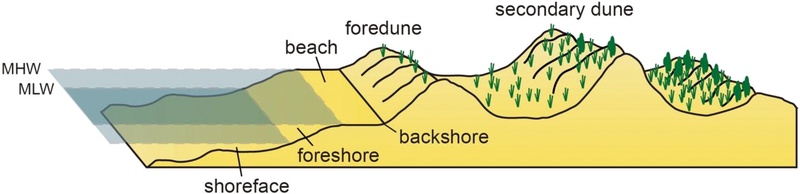
Simplified schematic illustration of a beach environment (after Lee, 2015). The environment comprises the shoreface, foreshore/beach, and backshore, arranged from sea to land. The shoreface and beach are delineated by MLW, while the foreshore lies between the MHW and MLW. Coastal dunes on the backshore are formed from aeolian sands derived from the beach. A secondary dune may form through aeolian reworking of a foredune or when a new foredune develops seaward, reclassifying the former foredune as a secondary dune. MHW: mean high water, MLW: mean low water.
우리나라에 분포하는 해안사구는 일정속도 이상의 바람이 지속적으로 불어 대기 중에 노출된 간석지 및 해빈 모래를 이동시키며, 해빈 후면에 식생이 있어 바람에 의해 이동하는 모래의 퇴적과 고정이 유리한 환경에서 발달한다(Ryu, 2002; Yu and Rhew, 2007; Yoon et al., 2010). 특히 완만한 경사의 해빈에서 조차가 큰 경우에는 저조(low tide)에 사질 간석지가 대기 중으로 넓게 노출되어 바람에 의해 운반될 수 있는 모래의 양이 증가한다. 이러한 지역에 바람과 식생 조건이 충족될 경우 대규모 해안사구 지대(coastal dune field)가 형성될 수 있다(Pethick, 1984; Rhew, 2001).
국내에서 면적이 2,900 m2 이상인 해안사구는 약 199개로 조사되었다(Choi and Kim, 2015)(그림 2). 국내 해안사구는 강한 겨울철 북서 계절풍, 풍부한 모래, 완만한 해빈경사, 대조차, 활발한 식생 등 사구 발달 조건을 충족시키는 서해안에 잘 발달해 있다(Rhew, 2001). 특히 한반도 서해안의 태안반도 일대와 신안군 도서지역에 집중적으로 발달해 있으며 충남, 전남, 제주 및 강원도의 해안을 따라 크고 작은 해안사구들이 분포한다. 동해안은 겨울철-봄철의 북서 계절풍과 급격한 지형구배 등으로 인해 해빈의 배후에 사구지대가 넓게 형성되기 어렵다. 동해안의 해안사구는 파랑 작용에 의해 형성되어 빈제 또는 해빈열(beach-ridge)이라 불리는 사구유형이 대표적으로 나타나며, 파랑의 쳐올림(swash)으로 형성된 낮은 완만한 언덕들이 연속해서 나타나는 특징을 보인다(Hesp et al., 2005). 빈제 위로 바람에 의해 운반된 모래가 쌓이는 풍모(aeolian cap)가 나타나기도 한다(Choi et al., 2015).
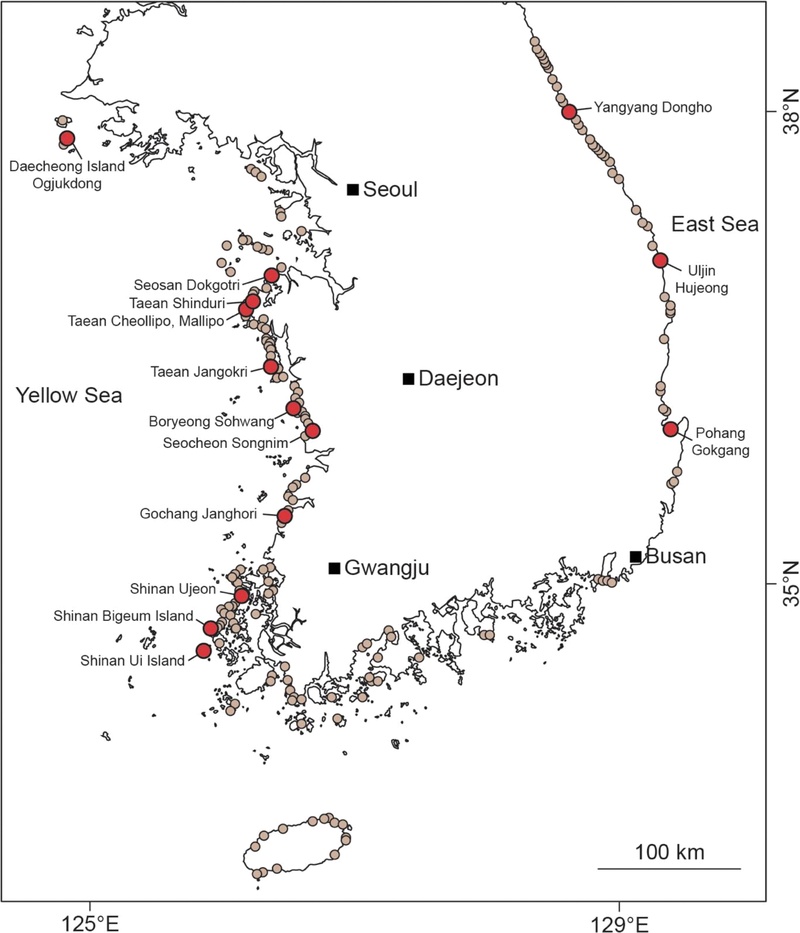
Spatial distribution of coastal dunes across South Korea (after Choi and Kim, 2015). Red dots mark sites referenced in this study.
3. 현생 해안사구 연구
3.1. 지형학적 연구
해안지대의 장기적인 지형 변화에 관한 연구는 지형 형성 과정과 그 요인들의 특성을 밝히고, 이를 통해 해안지대의 지형 변화 예측, 향후 관리 및 보전 방향을 수립하는데 필요한 기초 자료를 제공할 수 있다(Kang and Seo, 2012). 지형학적 연구와 더불어 분포하는 식생이나 생물 등의 생태학적 연구들도 존재하며, 주로 해안사구의 보전 및 복구를 위한 정책 수립의 기초자료 역할을 목적으로 수행되었다(Oh et al., 2005; Shim et al., 2009; Shin et al., 2013; Choi and Kim, 2015; Park et al., 2016; Kang et al., 2017; Lee et al., 2020).
대다수의 국내 해안사구 연구는 사구의 분포가 집중된 한반도 서해안에 집중되어 있다. 한반도 서해안은 대조차해안이며, 세립의 육상 퇴적물을 대량으로 공급받아 해빈보다는 간석지가 잘 발달해 있다. 다만, 서해안 중부 지역은 낮은 해발의 배후산지와 작은 하천들로 인해 퇴적물의 유입량이 적고 파랑 작용이 우세하여 곳에 따라 사주와 같은 모래 퇴적지형과 해빈, 해안사구가 발달해 있다(Kahng, 2003; Yang et al., 2006; Hong et al., 2010). 이러한 해안사구는 충청남도 태안부터 전라남도 영광 일대까지 잘 나타난다.
서해안의 대표적인 해안사구인 신두리 해안사구는 길이가 약 4 km, 폭이 0.5–2 km로, 태안반도의 북서부에 위치한다(Rhew, 2001). 신두리 해안사구 지대의 북부는 양호한 보존 상태를 보이며 인간 활동의 간섭이 최대한 적은 환경이어서 비사(飛砂, aeolian sand)와 풍향, 풍속, 입도 등의 상관관계 및 지형변화 측면에서 연구가 이루어졌다. 신두리 해안사구 지대의 고도변화 모니터링 결과 지형적인 변화는 주로 겨울철에 발생한 것으로 연구되었으며, 겨울철의 북풍 또는 북서풍 계열의 계절풍 영향을 받아 해빈의 모래가 전사구로 이동 및 퇴적된 결과로 해석되었다(Park and Yu, 1979; Rhew, 2001; Seo, 2004; Rhew and Yu, 2009).
신두리 및 인근 보령의 소황사구 연구에서, 북풍 또는 북서풍보다 동풍이나 남서풍 계열의 발생빈도가 높았으나 실제 모래의 이동이 일어났던 시기에는 북풍 내지 북서풍 계열 바람이 우세하였다(Ryu, 2002; Kang and Seo, 2012). 이는 4 m/s 이상의 강한 풍속 하에서 모래의 이동이 수월하기 때문으로 해석되며, 풍향의 빈도가 낮더라도 풍속이 높을 때 비사 이동율이 증가함을 지시한다. 여름철 태풍의 파랑작용으로 인한 큰 침식이 일어나는 사례를 제외하면(e.g., Seo, 2004), 서해안 해안사구의 지형 변화는 주로 북서계절풍에 의해 이루어진다고 볼 수 있다.
도서지역 해안사구는 인위적인 훼손이 적어 보존 상태가 양호하고 규모 또한 상당하여 지형학적 연구 가치가 높게 평가되고 있다(Shin et al., 2017). 인천광역시 옹진군 대청면에 위치한 대청도에는 길이가 약 1.6 km, 폭이 약 0.6km 정도에 이르는 옥죽동 해안사구가 분포한다. 옥죽동 해안사구는 대부분의 해안사구들과 달리 식생보다는 해안에 인접한 산지에 의해 모래 이동이 제한되어 형성된 대규모의 해안사구이다(Park et al., 2009). 바람에 의해 운반된 모래가 퇴적되어 형성된 지형이지만 기반암 산지와의 경계부를 따라 사면 작용이나 유수에 의한 운반이 관찰되기도 하는 독특한 지형적 특성을 나타낸다. 옥죽동 해안사구는 식생피복이 없는 특징과 더불어 경관적으로 매우 뛰어난 평가를 받고 있지만 조림사업 이후 사구지대로 공급되던 모래가 차단되었고 비사의 이동도 제한되고 있어 보전방안 논의의 필요성이 제기되었다(Park et al., 2009; Choi and Kim, 2015; Choi and Kong, 2017)(그림 3).
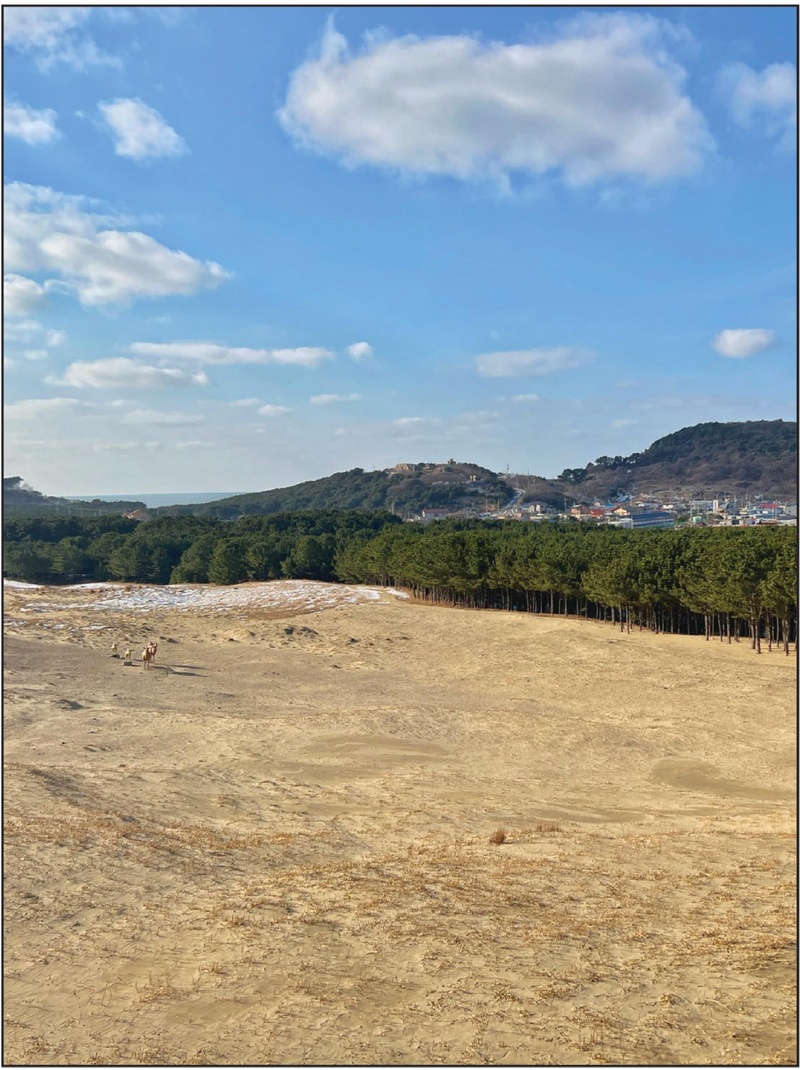
Photograph of the Okjukdong coastal dune and windbreak forest in Daecheongdo Island.
이외에도 전남 신안군 도초면에 위치한 우이도에서 관찰되는 해안사구는 계절에 따라 모래가 산지를 넘어 이동하는 독특한 형태와 상당한 규모로 지형학적 가치가 높아 입도 특성, 사구 분포 형태, 기반암의 풍식흔 등에 기반한 연구가 이루어졌다(Ministry of Environment, 2005; Shin et al., 2017). 신안군 증도의 우전 해안사구 역시 길이가 3 km, 폭이 0.2~0.6 km의 상당한 규모를 나타내며 넓은 조간대와 해빈, 기반암에서의 모래 공급, 북서 계절풍의 모래 운반 등 해안사구가 발달하기에 유리한 조건들을 갖추고 있다(Kim and Han, 2012; Ministry of Environment, 2012).
동해안은 파랑의 작용이 우세하여 해빈이 발달하였으며, 해빈을 대상으로 원격탐사 기법 등을 활용하여 지형 변화, 식생 피복 변화 등에 관한 연구가 수행되었다(Han and Kim, 2010; Bang and Lee, 2011; Shin and Seo, 2011). 해빈 후방에는 해안사구 지형이 흔하게 나타나나(Kim and Park, 2003), 해안사구 중심의 연구는 드물다. 동해안의 대표적인 해안사구인 동호, 후정, 곡강 해안사구들의 퇴적물의 입도는 일반적인 서해안의 해안사구에 비해 조립질로 나타나며, 내륙으로 갈수록 바람에 의해 보다 세립의 모래가 퇴적된 형태를 보인다. 이는 해안사구 전면이 파랑의 영향으로 조립하고 분급도가 낮은 특성을 보이며, 후면으로 갈수록 안정된 풍성환경에서 바람에 의해 입도가 작아지고 분급이 양호한 현상을 보이는 것으로 해석된다(Ministry of Environment, 2003).
해안사구의 퇴적과 침식에 있어서 계절풍의 영향도 중요하지만 지형적인 요인이 해안사구의 장기적인 지형 변화에 큰 영향을 줄 수 있다. 소황사구의 지형 변화는 계절풍의 영향이 주된 요인이었으나, 원격탐사자료 분석을 통해 주변의 인공 구조물에 따라 미피복 해안지대 면적의 감소 및 미피복 해안지대 방향과 북서계절풍의 방향 불일치, 연안류의 흐름 변화가 관찰되면서 인공 구조물에 의한 연안류흐름 변화가 지형 변화를 주로 일으킬 수 있음이 확인되었다(Kang and Seo, 2012). 같은 지역에서 태풍에 의한 해안사구의 침식 이후, 인공구조물이 풍속의 감소와 해빈-사구의 상호작용을 제한하여 모래의 이동과정에 변화를 야기하고 침식이 가속화되어 해안사구의 지형 회복을 어렵게 하였다(Ministry of Environment, 2012). 이는 한반도 서해안의 해안사구 지형이 계절풍과 함께 인공 구조물 등 인접 지역의 지형 요소에 의한 모래의 이동과정 변화에 영향을 받을 수 있다는 점을 시사한다.
3.2. 현생 해안사구의 형성 시기
선행 연구에서 사구층의 형성시기를 방사성탄소(14C) 연대로 제한한 사례가 존재하나, 사구 퇴적물의 재동이 빈번하고 분석에 필요한 유기물이 충분치 않은 조건들 때문에 최근에는 주로 OSL 연대측정을 이용한다. OSL 연대측정은 2000년대 초부터 단일시료재현법(single-aliquot regenerative dose, SAR)이 개발, 사용되었으며 OSL 연대측정을 위한 등 가선량(equivalent dose, De) 측정에 있어 신뢰도가 높다는 평가를 받고 있다(Murray and Wintle, 2000; Duller, 2004; Choi et al., 2008; Kim et al., 2010). 또한 광물이 빛에 노출되면 루미네선스 신호를 잃는 과정인 블리칭(bleaching) 현상이 해안사구 환경에서 해성이나 하성환경보다 잘 이루어지는데, 이는 모래가 풍성 운반 시 빛에 쉽게 노출되기 때문이다. 이러한 조건들은 해안 사구의 OSL 연대측정 적용 가능성을 높이며 신뢰도 높은 퇴적 연대를 제공할 수 있다(Murray-Wallace et al., 2002; Duller, 2004; Choi et al., 2008; Han et al., 2021).
신두리 해안사구를 시작으로, 현재까지 주로 서해안을 따라 분포하는 해안사구의 OSL 연대가 다수 보고되었다(Munyikwa et al., 2004, 2005; Seo, 2005; Choi, 2009; Yu et al., 2009; Hong et al., 2010; Kim et al., 2010; Choi et al., 2014a; Han et al., 2016, 2021; Shin et al., 2017, 2018, 2020; Lee et al., 2023). 이들 중 대다수는 현재 또는 최근까지 성장해온 100년 이내의 연대를 지닌 활동성 해안사구에 해당하나, 일부 사구는 후방 또는 하부층까지 분석되어 발달의 역사에 대한 보다 상세한 연구가 수행되기도 하였다(e.g., Choi, 2009; Yu et al., 2009; Han et al., 2021). 서해안의 해안사구는 고해수면기인 홀로세 동안에도 여러번의 급성장기와 휴지기를 겪은 것으로 보이는데, 광역적 기후변화에 의한 동아시아 계절풍의 변화를 반영했을 가능성이 제기된 바 있다(Yu et al., 2009; Han et al., 2021).
4. 고(古)사구 연구
해안사구는 해빈의 모래가 바람에 운반, 퇴적되어 형성된 지형이므로 해빈의 분포양상, 풍향, 풍속, 해수면 변화등의 환경 영향을 반영한다. 따라서 해안사구의 형성 시기와 분포 양상 변화를 통해 보다 광역적 기후조건이나 해수면 변화 등에 대한 정보를 얻을 수 있다. 여러 번의 성장-휴지기를 겪은 현생사구의 발달사를 광역적 한랭화, 건조화 또는 해수면변동의 결과로 해석한 사례 역시 여기에 해당한다(e.g., Yu et al., 2009; Han et al., 2021). 한편 현생사구 하부에는 흔히 고(古)사구층으로 제안되는 사질층이 종종 발견되며, 이를 이용하여 고환경 복원을 시도한 연구사례가 존재한다. 본 논평에서는 현생으로부터 이어지는 해안사구 층을 현생사구로 기술하고, 색이나 고화도 등의 특징이 이들 층과 확연히 구분되는 퇴적층을 고사구로 표현하였다.
4.1. 고(古)사구층의 퇴적시기
해안사구는 해수면 변화에 민감하게 반응한다. 바다가 해안 퇴적물의 주요 공급원일 때, 해수면의 변화는 퇴적물 수지(budget)의 변화를 수반하며 해안사구는 이에 반응한다(Mauz et al., 2013). 상대해수면(relative sea level, RSL)이 안정적이거나 하강하면 전사구가 바다 쪽으로 전진 또는 다운스테핑(downstepping) 하여 성장하게 되는 반면, 상대해수면의 상승은 전사구의 침식 및 모래의 재동을 유발하여 해안사구가 육지 쪽으로 후퇴하는 오버스테핑(overstepping)이 발생한다(Hesp, 2002; Mauz et al., 2013)(그림 4). 이러한 과정에서 천해성, 풍성, 충적성 퇴적상을 포함한 해안 퇴적 시스템은 해수면 변화에 따라 함께 반응하는 일련의 패키지로 나타날 수 있다(Mauz et al., 2013). 이에 따르면, 현생사구 하부에 위치하는 고(古)사구는 이전 해수면 상승기의 해안사구 기록으로 간주할 수 있다.
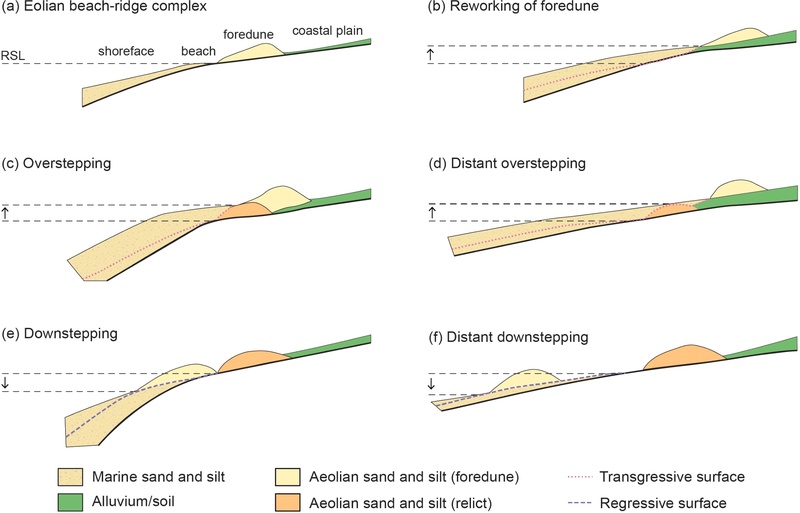
Schematic illustration of the aeolian beach-ridge complex (after Mauz et al., 2013). (a): stratal architecture of an aeolian beach-ridge complex consisting of shallow marine, aeolian, and alluvial deposits; (b): transgressive complex formed by the reworking of the foredune; (c): transgressive complex formed by overstepping processes; (d): transgressive complex formed by distant overstepping; (e): regressive complex formed by downstepping; (f): regressive complex formed by distant downstepping. RSL: relative sea level.
국내에서 고사구가 보고되기 시작하던 시점에서는 이러한 가정을 바탕으로 형성 시기를 추정하였다. 주로 충청남도 해안을 중심으로 현생 해빈 및 현생사구 하부에 고사구 퇴적층이 보고되었는데, 서산 독곶리, 태안 신두리, 태안 장곡리의 현생사구 하부에 존재하는 다소 고화된 암갈색~암황색 퇴적층은 현재의 만조수면 보다 약 2~3 m 위에 위치해 있기 때문에 지금보다 온난하여 해수면이 높았던 시기에 형성되었을 것으로 보았다(Park and Yu, 1979; Park, 1981). 이 층들은 층서 및 신선한 외관 등을 고려하여 홀로세 초기 또는 고해면기에 형성된 것으로 추정하였다. 반면 이러한 고사구층이 그 이전의 고해면기인 플라이스토세의 최후간빙기에 퇴적되었을 가능성이 제안되기도 하였다(Kwon, 1981; Park, 1987; Kahng, 2003; Yang et al., 2008).
이후 이들 고사구층에 대한 OSL 연대측정이 수행되면서 다수의 충남지역 고사구층들의 형성시기가 홀로세 중기 또는 그 이후로 나타났다. Munyikwa et al. (2005), Seo (2005), Choi et al. (2008)은 충남 해안사구지대 하부의 적색 고사구 또는 고토양층의 OSL 연대가 현세 내지 홀로세 후기를 지시함을 보고하였다. 최근에는 전라북도 고창군과 전라남도 신안군 도서지역 해안의 고사구층들의 형성시기가 보고 되었는데, 고창군 장호리 해안의 고사구층의 OSL 연대는 7,000년 ~ 6,000년 전으로 나타났다(Han et al., 2016). 신안군 비금도 해안사구도 최소 7,000년 전 이후 해수면이 안정되면서 형성되었고, 소빙기에 활발한 모래이동이 있었던 것으로 해석되고 있다(Ministry of Environment, 2011).
한편, 고사구층이 강하게 고화되거나 토양화의 정도가 홀로세층에 비해 극심한 경우, 퇴적 이후 오랜 시간이 흐른 것으로 가정하여 최후간빙기 등 플라이스토세 퇴적체로 제안된 사례들이 있다(Kwon, 1981; Park, 1987; Kahng, 2003; Yang et al., 2008). 실제로 상하부의 고화도, 색상의 대비가 인지되는 태안 만리포 해안의 사질층에 대한 OSL 연대 측정 결과 하부에서 약 2만 년 이상, 상부에서 약 1천 년으로 큰 차이를 보인다(Kim et al., 2010). 신안군 증도 우전 해안(그림. 5)과 인천광역시 백령도 가을리(그림. 6)에서도 다소 고화된 사질 퇴적층이 관찰되며, OSL 연대는 최후간빙기 및 최후빙기 등으로 나타났다(Choi et al., 2014b; Shin et al., 2020; Lee et al., 2023). 그러나 이들 지역에서는 최후간빙기에서 최후빙기까지 일관적이지 않은 연대를 보이거나, 연대가 역전되어 나타나는 등 퇴적 시기가 다소 불분명하다. 또한 이들 세 지역 모두에서 공통적으로 최후빙기 연대가 보고되었는데, 이 시기 동안의 해수면 하강은 황해의 대부분을 노출시켜 현재의 해안선 부근이 대체로 육상 환경에 놓였을 것으로 여겨진다. 따라서 이들 적색 사질층을 현생 해안사구와 유사한 퇴적층으로 해석하기 어려우며, 선행 연구에서도 이들 퇴적층의 형성 기작에 대한 다양한 가설이 제기되었다. 이들의 산상이 과거 플라이스토세고사구층으로 추정된 시대미상의 퇴적층들과 유사함을 고려할 때, 해당 시대미상 층들에 대한 연대분석과 퇴적 기작에 대한 재검토가 요구된다.
종합하면, 현재까지 보고된 대부분의 고(古)사구 퇴적체의 형성 시기는 중기 홀로세 이후이며, 해수면이 현재 수준에 도달한 이후의 국지적 해수면 변화 또는 환경 변화를 반영하는 것으로 해석되었다. 한편 일부 지역에서는 고사구의 형성시기를 최후간빙기 또는 최후빙기까지 추정 및 보고하였으나, 해당 사질층의 사구퇴적 여부나 형성 시기에 관해서는 추가 연구가 필요하다. 또한 선행 연구가 충남 지역에 집중되어 있어 충남 이외 지역들의 고사구 퇴적환경에 대한 해석의 여지 역시 존재한다.
4.2. 고(古)사구퇴적층을 이용한 고환경 연구
고사구층 자체를 연구대상으로 한 고환경 연구 사례는 많지 않으며, 형성연대를 바탕으로 해수면 변동에 대한 정보를 얻거나 상위의 현생사구 퇴적층과의 차이를 서술한 사례가 다수 존재한다. 고사구층으로 기술된 퇴적층의 모래 퇴적물들은 흔히 적색 및 적황색의 사질 퇴적물들로 이루어져 있으며, 상위에 놓인 현생사구 퇴적층과는 입도 및 색으로 구분된다(Park and Yu, 1979; Kahng, 2003; Choi et al., 2008; Han et al., 2016; Shin et al., 2020). 또한 해안사구를 덮고 있던 식생이 토양화되어 형성된 흑색사질부식층이 고사구 퇴적층에 협재되어 나타나기도 한다(Park and Son, 2007; Park and Park, 2009a, 2009b; Choi et al., 2014a).
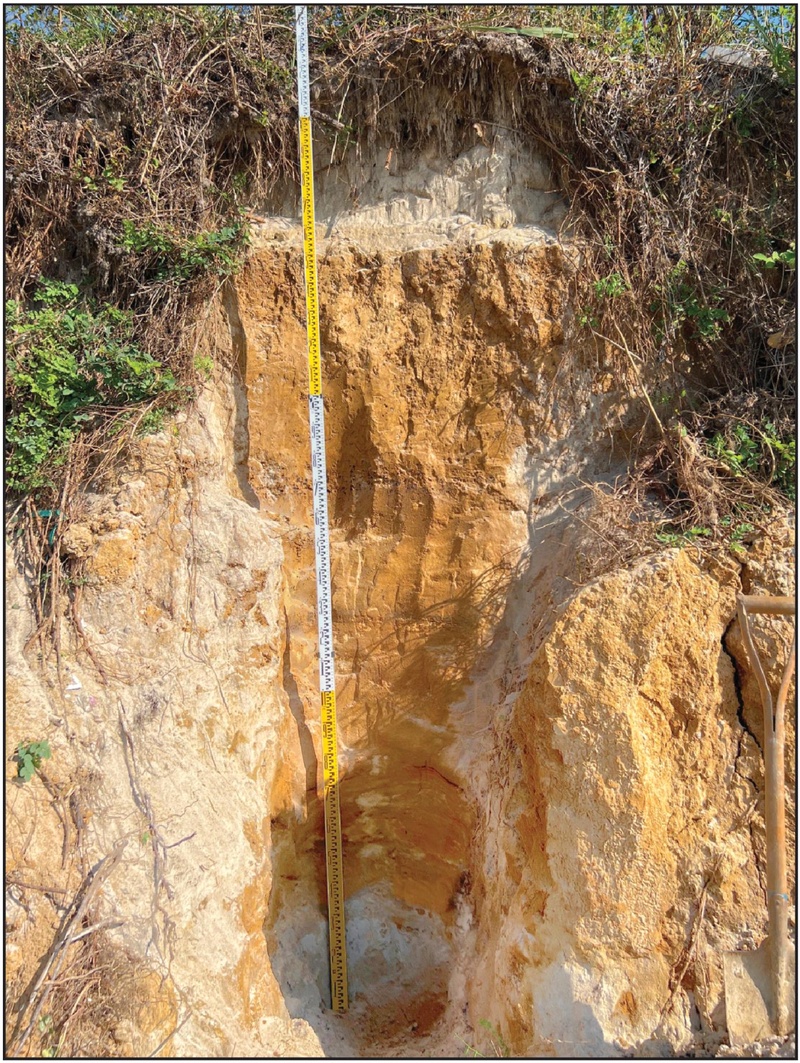
Section photograph of at Ujeon beach, Shinan, showing the color contrast and mechanical differences between the uppermost yellowish modern coastal sand dune and the underlying semi-consolidated reddish-yellow paleosol layer (Lee et al., 2023).
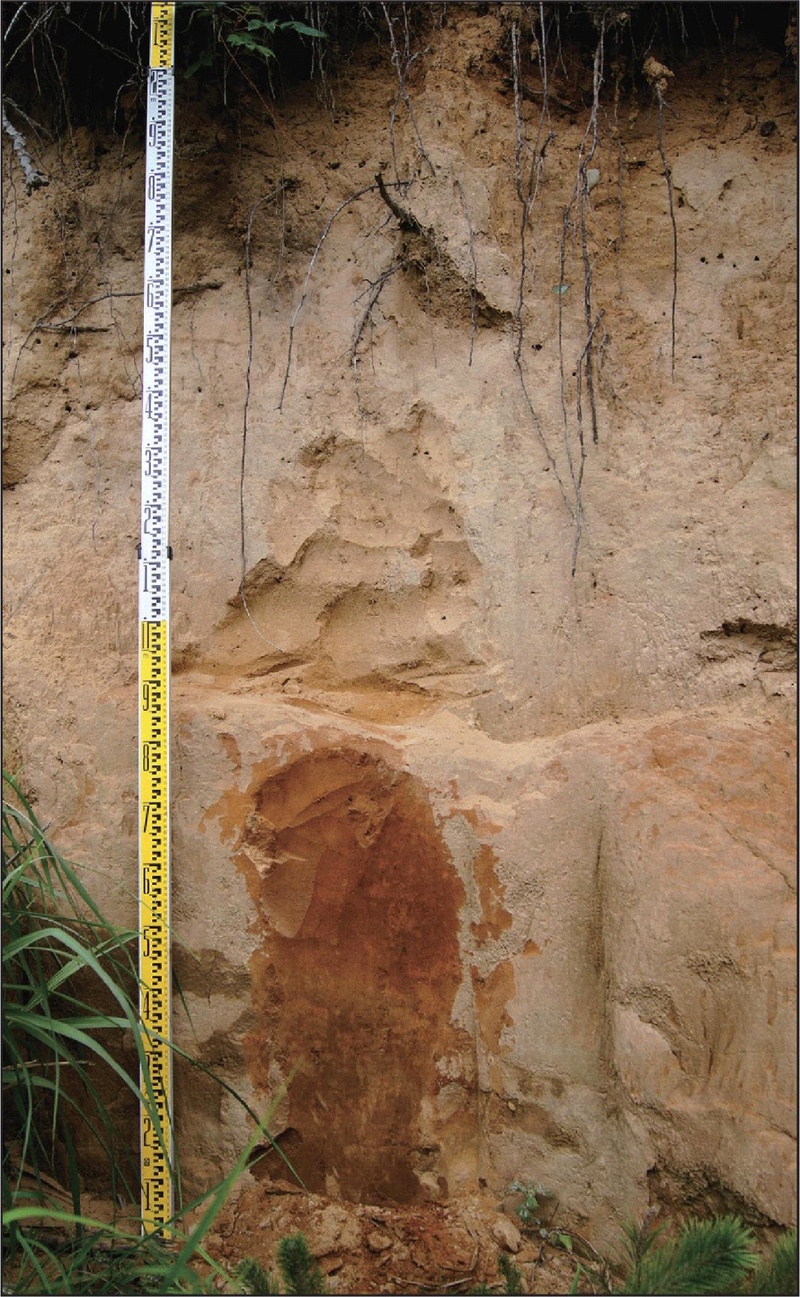
Section photograph of paleodune deposit at Gaeul-ri beach, Baengnyeong Island (reproduced from Shin et al., 2020). The color contrast between upper (dull yellow orange) and lower (dull orange-dull brown) layers indicates the relative antiquity of the lower layer.
입도의 차이는 바람의 세기나 운반 거리의 변화를 반영 할 가능성이 있으나, 퇴적층의 색이 붉은 계열을 나타내거나 고결 되어있는 경우가 많아 고토양화 작용에 의한 결과일 수 있다(Kahng, 2003; Munyikwa et al., 2005; Choi et al., 2008; Han et al., 2021). 특히 Kahng (2003)은 천리포, 만리포, 장항 송림리 등지의 고화된 퇴적층에 자갈이나 점토가 없는 점과 독특한 토양구조를 통해 최후간빙기에 형성된 고사구로 해석하였으며, 고사구층 내 토양층상구조가 주빙하환경에서 결빙작용을 받아 형성된 것으로 제안하였다.
고사구 퇴적층은 지화학 분석을 통해 퇴적활동 중 바람에 의한 영향정도나 해수의 영향, 이벤트 발생 등을 추정할 수 있다(Yang et al., 2008; Han et al., 2016). 고사구층에 협재되어 수 cm의 두께로 나타나는 자갈층의 경우, 태풍에 의한 영향이나 일시적인 해침의 흔적으로 볼 수 있다(Choi et al., 2008, 2014a). 비슷한 형태로 협재되어 나타나는 흑색사질부식층은 해안사구 형성에 휴지기가 발생하여 식생이 발달한 후 다시 풍성 모래에 의해 퇴적되었음을 나타낸다(Park and Park, 2009b).
5. 고찰 및 제언
해안사구는 2000년대 초반에 그 중요성에 대한 인식이 제고되면서 분포 및 면적, 지형 개관, 식생 등에 관한 조사가 전국적으로 이루어졌다. 해안사구의 인문사회적 및 생태적 의의에 기반하여, 국내 해안사구의 형성과 지형학적 변화 연구는 향후 변화 예측과 효과적인 관리·보전 전략 수립에 필요한 기초 자료를 제공하였다. 특히 해안사구 지대지형의 일차적 조절인자는 계절풍과 파랑이지만, 인공 구조물과 방사림 등 인위적 지형 지물이 해안사구의 장기적인 지형 변화에 중요한 영향을 미친 것으로 보인다.
최근 OSL 연대측정 기법의 정확도가 단일시료재현법 등을 통해 크게 향상되면서 해안사구의 형성 시기, 지형변화, 퇴적 속도 등에 관한 보다 정확한 데이터 확보가 가능해졌다. 이로 인해 해안사구의 형성 시기에 대한 연구가 활발히 진행되었으며, 현생사구의 성장 역사를 홀로세 이전까지로 확장하는 계기가 마련되었다. 이는 해안사구를 지질학적 연구의 대상으로서 인식하게 된 전환점이 되어, 하부의 고(古)사구층에 관한 연구 기반도 점차 마련되었다.
현재까지 국내 고사구층에 대한 연구는 주로 퇴적시기에 집중되어 있으며, 고사구층의 존재 여부와 형성 시기를 연안 퇴적의 공간분포와 해수면 변동에 관한 단서로 해석하는 연구사례가 다수이다. 이는 다수의 신생대 제4기 고기 후 연구가 하나의 퇴적단면 또는 퇴적물 코어를 대상으로 다양한 프록시를 통해 시계열적 분석을 시도하는 반면, 해안사구는 동일 지점에서 퇴적과정의 연속성이 낮고 육상과 해양의 역동적인 상호작용이 일어나는 연안퇴적체의 일부로서 존재하는 특성에 기인한다.
이처럼 해안사구는 그 자체로 독립적 지질기록으로서 여겨지기보다는, 해안선의 시공간적 위치를 나타내는 하나의 지표로서 여겨지는 경향이 강하여 본격적 연구 대상으로서는 상대적으로 소외되어 왔다. 해안사구에 대한 지형학적/생태학적 관심이 높아지고 있는 만큼, 이와 관련된 주제인 고사구 내의 고토양화 작용, 식생변화의 기록, 인접한 연안퇴적기록과의 시공간적 연계성 등에 관한 통합적 접근이 시도될 만하다. 이러한 연구는 해안사구의 형성과 변화 과정에 관한 보다 장기적인 관점을 제시하며, 장기적인 연안 환경 변화에 대한 예측 및 보전전략 수립에 중요한 토대를 제공할 수 있으리라 기대된다.
Acknowledgments
본 연구는 과학기술정보통신부 재원으로 한국연구재단의 지원을 받아 수행되었습니다(RS-2025-00563306). 논문에 건설적인 의견을 주신 편집위원과 심사위원께 감사드립니다.
References
- Bang, H.J. and Lee, G.-R., 2011, Geomorphological properties and changes of Goreabul sand beach in Yeongdeok. Journal of the Korean Geomorphological Association, 18, 83-92 (in Korean with English abstract).
- Carter, R.W.G., 2013, Coastal environments: an introduction to the physical, ecological, and cultural systems of coastlines. Elsevier, 616 p.
- Choi, K.H., 2009, Evolution of coastal dune system and sea level change during the Holocene in Korea. Ph.D. thesis, Seoul National University, Seoul, 192 (in Korean).
-
Choi, K.H., Chang, T.S., Choi, J.-H., Kim, Y. and Lee, S.Y., 2014a, Burial storm deposits recorded at the coastal dunes, Dasari, Chungnam Province. Journal of the Geological Society of Korea, 50, 539-549 (in Korean with English abstract).
[https://doi.org/10.14770/jgsk.2014.50.4.539]

- Choi, K.H., Chang, T.S., Choi, J.-H., Seong, Y.B. and Lee, S.Y., 2014b, Ages of paleo-beach deposits and its implications along the coast of Jeung-Do. Annual Summer Conference of the Korean Geomorphological Association, Seoul, August 22-23, 46-47 p.
- Choi, K.H., Kim, J.W., Choi, J.H., Byun, J.M., Hong, S.C., Shin, Y.K. and Lee, S.J., 2008, Luminescence dating of coastal dune sequences on Wonsan Island and its implications. Journal of the Korean Geomorphological Association, 15, 39-51 (in Korean with English abstract).
- Choi, K.H. and Kim, Y.M., 2015, Distribution of coastal dunes and their conservation status in South Korea. Journal of the Korean Geomorphological Association, 22, 123-137 (in Korean with English abstract).
- Choi, K.H., Kim, Y.M. and Kil, J.H., 2015, Coastal Dunes in South Korea: Distribution and Ecosystem. National Institute of Environmental Research, 236 p (in Korean).
-
Choi, K.H. and Kong, H.-Y., 2017, Formation and recent changes of the Okjukdong dunefield, Daecheong Island. Journal of the Korean Geomorphological Association, 24, 91-101 (in Korean with English abstract).
[https://doi.org/10.16968/JKGA.24.4.91]
-
Cowles, H.C., 1899, The Ecological Relations of the Vegetation on the Sand Dunes of Lake Michigan. Part I.-Geographical Relations of the Dune Floras. Botanical gazette, 27, 95-117.
[https://doi.org/10.1086/327796]
-
Duller, G.A., 2004, Luminescence dating of Quaternary sediments: recent advances. Journal of Quaternary Science, 19, 183-192.
[https://doi.org/10.1002/jqs.809]
- Han, G.-S. and Kim, K.-N., 2010, Analysis of land cover change of coastal sand dunes in Yangyang using aerial photographs. Journal of the Korean Association of Geographic Information Studies, 13, 107-118 (in Korean with English abstract).
- Han, H.S., 1984, Study on the distribution of plant species along the environmental gradient at coastal area of Vyn Bay. M.S. thesis, Kongju National University, Gongju (in Korean).
-
Han, M., Kim, J.C., Yang, D.-Y. and Kim, J.Y., 2016, Vertically Development Processes of Jangho-ri Coastal Dune, West Coast of Korea. Journal of the Geomorphological Association of Korea, 23, 79-92.
[https://doi.org/10.16968/JKGA.23.3.79]
-
Han, M., Kim, J.C., Yang, D.Y., Lim, J. and Yi, S., 2021, The main periods and environmental controls of coastal dune development along the west coast of the Korean Peninsula during the mid to late Holocene. Palaeogeography, Palaeoclimatology, Palaeoecology, 569.
[https://doi.org/10.1016/j.palaeo.2021.110345]
-
Hesp, P., 2002, Foredunes and blowouts: initiation, geomorphology and dynamics. Geomorphology, 48, 245-268.
[https://doi.org/10.1016/S0169-555X(02)00184-8]
-
Hesp, P.A., Dillenburg, S.R., Barboza, E.G., Tomazelli, L.J., Ayup-Zouain, R.N., Esteves, L.S., Gruber, N.L., Toldo-Jr, E.E., Tabajara, L.L.d.A. and Clerot, L.C., 2005, Beach ridges, foredunes or transgressive dunefields? Definitions and an examination of the Torres to Tramandaí barrier system, Southern Brazil. Anais da Academia Brasileira de Ciências, 77, 493-508.
[https://doi.org/10.1590/S0001-37652005000300010]
- Hong, S., Choi, J.H. and Kim, J.W., 2010, Mid- to Late Holocene progradational pattern of Shinduri Dunefield: Implications for sea level and climatic changes in the western coast of Korea. Journal of the Korean Geomorphological Association, 17, 87-98 (in Korean with English abstract).
- Jung, Y.-K. and Kim, J.-W., 1998, Coastal sand dune vegetation in Kyungpook Province. Korean Journal of Ecology, 21, 257-262 (in Korean with English abstract).
- Kahng, T., 2003, The Origin of Coastal Dunesand in the Chungcheongnam-do. Journal of the Korean Geographical Society, 38, 505-517 (in Korean with English abstract).
- Kang, D.K. and Seo, J.C., 2012, The morphological changes of the beach and dune using by periodical measurements. Journal of the Korean Geomorphological Association, 19, 69-79 (in Korean with English abstract).
-
Kang, J., Seo, J.C., Rhew, H., Kim, T., Oh, J.S., Lee, J.H., Oh, S. and An, S., 2017, Study on the status and soci-economic characteristics of coastal sand dune in South Korea. Journal of the Korean Geomorphological Association, 24 (in Korean with English abstract).
[https://doi.org/10.16968/JKGA.24.3.149]
-
Kang, T.-G., 2019, Research of landscape ecological field-trip learning program development for students at BiIn Bay, Seocheon in South Chung-chong coastal environment. Journal of the Korean Geomorphological Association, 26, 121-131 (in Korean with English abstract).
[https://doi.org/10.16968/JKGA.26.1.121]
- Kim, B.K., 1974, Paleontological study on the sand dune deposits in Jeju Island. Journal of the Geological Society of Korea, 10, 95-108 (in Korean with English abstract).
- Kim, D.-H., 2004, Spatial distribution of nutrients from sea water and aeolian sands in a coastal dunefield, Sindu-ri, Korea. Journal of Geography, 43, 57-79 (in Korean with English abstract).
- Kim, J.C., Eum, C.H., Yang, D.Y., Kim, G.D., Cheong, D.K. and Choe, H.G., 2010, A preliminary study of paleoenvironments using OSL (Optically Stimulated Luminescence) dating of coastal dune sequences on Manripo area. Journal of the Geological Society of Korea, 46, 207-219 (in Korean with English abstract).
- Kim, J.W. and Han, M., 2012, Report on the Nationwide Detailed Survey of Coastal Dunes, Number, National Institue of Environmental Research, 179-195 p (in Korean).
- Kwon, H.J., 1981, Coastal landforms of T`aean Peninsula and Anmyeon-do. Journal of the Normal College Korea University, 6, 261-287 (in Korean).
-
Lee, G., Park, Y., Kwon, J., Han, M., Yoon, H.-H., Choi, H.-W. and Kim, J.C., 2023, Formation period of sedimentary layers on Ujeon coast, Jeungdo, Shinan-gun, Jeollanamdo. Journal of the Geological Society of Korea, 59, 651-660 (in Korean with English abstract).
[https://doi.org/10.14770/jgsk.2023.047]
-
Lee, J.-Y., Cheong, J.-H. and Kim, H.-S., 2020, A study monitoring the changes in Taean Sindu coastal sand dune vegetation. The Journal of Korean Island, 32, 187-202 (in Korean with English abstract).
[https://doi.org/10.26840/JKI.32.3.187]
- Lee, W.T. and Chon, S.-K., 1983, Ecological studies on the coastal plants in Korea-Floristic composition and standing crop of the sand dune on the southern coast. Journal of Ecology and Environment, 6, 177-186 (in Korean with English abstract).
- Lee, Y.I., 2015, Sedimentary Geology. Sigma Press (in Korean).
-
Mauz, B., Hijma, M.P., Amorosi, A., Porat, N., Galili, E. and Bloemendal, J., 2013, Aeolian beach ridges and their significance for climate and sea level: Concept and insight from the Levant coast (East Mediterranean). Earth-Science Reviews, 121, 31-54.
[https://doi.org/10.1016/j.earscirev.2013.03.003]
- Ministry of Environment, 2002, The guidelines for conservation and management of coastal sand dunes, 50 p (in Korean).
- Ministry of Environment, 2003, Report on the Nationwide Detailed Survey of Coastal Dunes (I), National Institue of Environmental Research, 33-52 p (in Korean).
- Ministry of Environment, 2005, Report on the Nationwide Detailed Survey of Coastal Dunes, National Institue of Environmental Research, 413-437 p (in Korean).
- Ministry of Environment, 2011, Report on the Nationwide Detailed Survey of Coastal Dunes, National Institue of Environmental Research, 47-62 p (in Korean).
- Ministry of Environment, 2012, Report on the Nationwide Detailed Survey of Coastal Dunes, National Institue of Environmental Research, 161-209 p (in Korean).
- Munyikwa, K., Choi, K.-H., Choi, J.-H., Park, K. and Kim, J.-W., 2005, The sedimentology and luminescence chronology of a coastal dune sequence at Unyo Beach, T'aean-Gun. Journal of the Korean Geomorphological Association, 12, 167-178 (in Korean with English abstract).
- Munyikwa, K., Kim, J.-W., Choi, J.-H., Choi, K.-H. and Byun, J.-M., 2004, The Development and Luminescence Chronology of a Coastal Dune from the Shindu Dunefield, T′aean Peninsula. Journal of the Korean Geographical Society, 39, 269-282.
-
Murray, A.S. and Wintle, A.G., 2000, Luminescence dating of quartz using an improved single-aliquot regenerative-dose protocol. Radiation Measurements, 32, 57-73.
[https://doi.org/10.1016/S1350-4487(99)00253-X]
-
Murray-Wallace, C., Banerjee, D., Bourman, R., Olley, J. and Brooke, B., 2002, Optically stimulated luminescence dating of Holocene relict foredunes, Guichen Bay, South Australia. Quaternary Science Reviews, 21, 1077-1086.
[https://doi.org/10.1016/S0277-3791(01)00060-9]
- Nordstrom, K.F., Psuty, N. and Carter, B., 1991, Coastal Dunes: Form and Process. John Wiley & Sons, Inc., 416 p.
- Oh, H.-K., Kim, Y.-H., Beon, M.-S. and Park, J.-M., 2005, A study on flora of the Shindoo-ri coastal dune. The Journal of Korean institute of Forest Recreation, 9, 37-48 (in Korean with English abstract).
- Park, C.Y., Choi, K.H. and Kim, J.W., 2009, Geomorphological charateristics and process of development of Okjuk-dong coastal dune, Daecheong Island. Journal of the Korean Geomorphological Association, 16, 101-111 (in Korean with English abstract).
- Park, D.-W. and Yu, K.B., 1979, A study on the morpholgy of the coastal dunes of the western coast of Korea. Journal of Geography, 1-10 (in Korean with English abstract).
- Park, J.-H. and Park, K., 2009a, Post-glacial environmental changes reconstructed from the pollen analysis in Gimnyeong Sanddune area. Journal of the Korean Geomorphological Association, 16 (in Korean with English abstract).
- Park, K., 1987, A study on the reddish-yellow sedimentary layer with the Cheonripo sand dune, M.S. thesis, Seoul National University, Seoul (in Korean).
- Park, K. and Park, J.-H., 2009b, A study on dune-building periods and soil-forming periods of Gimnyeong sanddune area. Journal of the Korean Geomorphological Association, 16, 111-122 (in Korean with English abstract).
- Park, K. and Son, I., 2007, Luminescence dating results from Kimnyong-Wolchung Coastal Sand-dune and their implications. Journal of the Korean Geomorphological Association, 14, 33-41 (in Korean with English abstract).
- Park, K.M., Kim, S.W. and An, T.S., 2016, An assessment of the conservation status for coastal sand dunes in Incheon: Focused on the Jung gu, Ongjin gun in Incheon. Journal of the Korean Geographical Society, 51, 345-365 (in Korean with English abstract).
- Park, S.P., 1981, The sea-level change of post glacial age in the western coast of Korean Peninsula. Journal of Geography, 8, 11-22 (in Korean with English abstract).
- Pethick, J., 1984, An Introduction to Coastal Geomorphology. Edward Arnold, 272 p.
- Psuty, N.P. and Ofiara, D.D., 2002, Coastal hazard management: Lessons and future directions from New Jersey. Rutgers University Press, 448 p.
- Rhew, H., 2001, Aeolian sand transport and morphological change in the foredune ridge, Shindu dunefield, Korea. Journal of Geography, 38, 31-60 (in Korean with English abstract).
-
Rhew, H. and Yu, K.B., 2009, Pattern of aeolian sand transport and morphological change in the foredune ridge, Shindu Dunefield, Korea: a case study during the winter, December 2000 to March 2001. Journal of Coastal Research, 25, 1015-1024.
[https://doi.org/10.2112/06-0674.1]
- Ryu, W.-S., 2002, Wind and aeolian sand transport in Shinduri coastal dune fields, Korea. Journal of Geography, 40, 93-118 (in Korean with English abstract).
- Seo, J.C., 2004, The effective wind velocity and the patterns of morphological change in the coastal dune area. Journal of the Korean association of regional geographers, 10, 667-681.
- Seo, J.C., 2005, A luminescence dating for a relict dune from the Shindu Dunefield. Journal of the Korean association of regional geographers, 11, 114-122 (in Korean with English abstract).
-
Shim, H.-B., Cho, W.-B. and Choi, B.-H., 2009, Distribution of halophytes in coastal salt marsh and on sand dunes in Korea. Korean Journal of Plant Taxonomists, 39, 264-276 (in Korean with English abstract).
[https://doi.org/10.11110/kjpt.2009.39.4.264]
- Shin, D.S. and Seo, J.C., 2011, The short-term morphological change of the beach and dune using by terrestrial LIDAR. Journal of the Korean Geomorphological Association, 18, 283-296 (in Korean with English abstract).
- Shin, H.S., Kim, H.J., Han, S.H., Ko, S.Y., Kang, H.J., Lee, S.H., Lee, C.Y., Kim, C.B., Bae, Y.T., Shin, J.K. and Yun, C.W., 2013, Classification of west coastal dune vegetation and comparison of the inorganic constituents for the soil and present plants. Journal of Korean Society of Forest Science, 102, 345-354 (in Korean with English abstract).
-
Shin, W.J., Kim, J.W. and Kim, J.Y., 2018, A study on the physicochemical characteristics and formation age of coastal sand dunes in the Okjukdong and Dajindong, Daecheong Island. Journal of the Korean Geomorphological Association, 25, 63-80 (in Korean with English abstract).
[https://doi.org/10.16968/JKGA.25.2.63]
-
Shin, W.J., Kim, J.W., Kim, J.Y. and Choi, J.-H., 2017, The processes of coastal dunes and its geomorphological characteristics, Ui-island, Shinan-gun, Korea. Journal of the Korean Geomorphological Association, 24, 1-13 (in Korean with English abstract).
[https://doi.org/10.16968/JKGA.24.2.1]
-
Shin, W.J., Kim, J.Y. and Lee, J.H., 2020, Sedimentary characteristics and depositional ages of paleo-sand dunes in Gaeul-ri, Baengnyeongdo Island. Journal of the Korean Geomorphological Association, 27, 47-64 (in Korean with English abstract).
[https://doi.org/10.16968/JKGA.27.2.47]
-
Yang, B., Dalrymple, R.W., Chun, S. and Lee, H., 2006, Transgressive sedimentation and stratigraphic evolution of a wave-dominated macrotidal coast, western Korea. Marine Geology, 235, 35-48.
[https://doi.org/10.1016/j.margeo.2006.10.003]
- Yang, D.Y., Kim, J.Y., Kim, J.K., Lim, J. and Nahm, W.-H., 2008, Variations of Selected Major and Trace Elements in the Late Pleistocene of Cheollipo Sand-dune, West Coast, Korea; Preliminary Study. Journal of the Korean Geomorphological Association, 15, 53-60 (in Korean with English abstract).
- Yoon, H.-S., Park, S.-Y. and Yoo, C.-I., 2010, Review of the Functional Properties and Spatial Distribution of Coastal Sand Dunes in South Korea. Journal of Fisheries and Marine Sciences Education, 22, 180-194 (in Korean with English abstract).
-
Yu, K.B., Brook, G.A., Rhew, H., Shin, Y.H., Kim, S.H. and Brook, F.Z., 2009, Episodic coastal dune development in the Taean Peninsula and Anmyeon Island, Korea, during the mid to late Holocene. Journal of Quaternary Science, 24, 982-990.
[https://doi.org/10.1002/jqs.1277]
- Yu, K.B. and Rhew, H., 2007, Coastal Dunes on the West Coast of Korea: A Geomorphological Perspective. Seoul National University Press (in Korean).