
석영입자 표면미세조직 연구의 국내외 연구동향

초록
석영입자 표면미세조직(surface microtextures of quartz grains, SMQ)은 퇴적물 개별 입자의 운반과정을 이해할 수 있는 거의 유일한 자료를 제공한다. SMQ 연구는 1960년대 초의 도입시기부터 지금까지 활발하게 연구되고 있으며, 초기의 형태 중심의 정성적 기재에 집중되었으나, 점차 실내 모형실험, 통계 분석을 거쳐 최근에는 인공지능 기반의 자동분류법이 적용되고 있다. 이를 통해 퇴적학적 활용 외에도, 범죄수사과학, 행성지질학과 같은 다양한 분야로 확장되었으며, 주사전자현미경 외의 고해상도 분석기기를 다양하게 활용하는 연구가 진행되는 추세로 발전하였다. 또한, 토양, 하성, 해빈, 풍성, 빙성 등 국내외 현생 퇴적환경에서의 SMQ 연구 결과를 통해 미지의 시료에 대한 고기 퇴적환경 판별 연구에도 폭넓게 활용되고 있다. 본 논평은 체계적인 SMQ 연구의 시작단계에 해당하는 국내의 연구상황을 고려하여, SMQ의 이론적 배경, 분석기법의 발달 과정 그리고 국내외 연구사례를 종합적으로 소개하고자 하였다. 특히, 이 논평에서는 국내외 퇴적환경별 SMQ 특징을 종합적으로 논의함으로써, 현시점에서의 한계와 앞으로의 발전 가능성을 제안한다.
Abstract
Surface microtextures of quartz grains (SMQ) provide one of the few direct sources of information for reconstructing the transport history of individual sediment grains. Since their introduction in the early 1960s, SMQ studies have been actively conducted, initially focusing on qualitative, morphology-based descriptions, but later advancing through laboratory simulation experiments and statistical analyses, and more recently applying artificial intelligence based automated classification methods. Through these developments, the application of SMQ has expanded beyond sedimentological studies to diverse fields such as forensic science and planetary geology, accompanied by the increasing use of high-resolution analytical instruments beyond scanning electron microscopy. Furthermore, research results from modern depositional environments including soils, fluvial, coastal, aeolian, and glacial settings have been widely applied to the paleoenvironmental interpretation of unknown samples. Considering that systematic SMQ research in Korea is still at an early stage, this review aims to provide a comprehensive overview of the theoretical background, methodological developments, and domestic and international case studies of SMQ. In particular, this paper synthesizes SMQ characteristics across various depositional environments to highlight current limitations and suggest potential directions for future development.
Keywords:
quartz, surface microtexture, sediment, transport process, depositional environment키워드:
석영, 표면미세조직, 퇴적물, 운반과정, 퇴적환경1. 서 론
석영입자 표면미세조직(surface microtextures of quartz grains, SMQ)은 연구자의 관찰시점 이전까지 쇄설성 석영입자에 가해진 모든 물리화학적 작용의 결과적 특징이다. 입도 및 지화학적 특성 등 다른 퇴적학적 특징들이 주로 퇴적 당시의 수력학적 에너지 및 기원지 해석에 활용되는 반면(e.g., Mclaren and Bowles, 1985), SMQ는 퇴적물의 운반과정을 이해할 수 있는 거의 유일한 기회를 제공한다는 점에서 차별적 장점을 지닌다(e.g., Higgs, 1979). 또한, SMQ는 독립적인 증거를 통해 퇴적환경 등 다른 퇴적학적 해석 결과를 검증할 수 있는 기회를 제공한다. 따라서 SMQ를 체계적으로 정리하여 석영입자가 겪었던 다양한 지질학적 작용을 해석할 수 있다면, SMQ는 다른 퇴적학적 분석방법과 상호보완적으로 활용될 수 있음은 물론, 퇴적물의 침식-운반-퇴적 전 주기 과정을 세밀하게 복원하는 데 있어 중요한 축을 담당할 수 있다.
석영 입자의 전반적 형태를 포함한 표면미세조직에 대한 연구는 주사전자현미경(scanning electron microscopy, SEM)을 활용한 현대적 SMQ 분석법이 제안되기 이전부터 진행되어 왔으며, 초기에는 주로 입자의 전체적인 형태, 즉 원마도 및 구형도에 초점이 맞추어졌다(Bond, 1954). 이 시기에는 확대경과 반사현미경 같은 비교적 단순한 기기가 사용되었다. 이후 분석 장비의 발전에 따라 전자현미경(electron microscope)이 도입되었으며, 투과전자현미경(transmission electron microscopy, TEM)을 표면미세조직 연구에 사용하는 시도가 선행되었다(Vos et al., 2014). 하지만 시료 전처리의 어려움과 높은 배율에 비해 낮은 표면 해상력으로 인해 SMQ 분석 도구로서는 널리 사용되지 못했다. 이후 Biederman (1962)과 Krinsley and Takahashi (1962)에 의해 주사전자현미경이 처음 적용되었고, 1965년 첫 상업적 주사전자현미경 모델이 개발되면서 SMQ 분석이 비교적 간단한 절차를 통해 효율적으로 이루어지면서 표면미세조직이 다양한 연구에 활발히 적용되기 시작하였다(Baker, 1976; Breton, 1999; Bongner et al., 2007).
1960년대부터 1970년대까지는 다양한 표면미세조직들이 보고되었으나, 당시에는 각 조직이 어떠한 기작에 의해 형성되었는지를 해석할 수 있는 이론적 기반이나 실험적 근거가 부족하였다(Krinsely and Donahue, 1968). 1980년대와 1990년대에는 퇴적환경을 세분화하여 환경별 SMQ 특징을 기재 및 분류하고, 각 미세조직 별 형성 원리를 이해하기 위한 실내 모형실험 연구가 수행되었다(Lindé and Mycielska-Dowgiałło, 1980). 이와 함께, 미세조직의 출현 빈도를 반정량적으로 파악하여 환경 해석에 활용하려는 시도가 이 시기 동안 이루어졌다(Higgs, 1979). 2000년대와 2010년대에 들어서면서, 주성분분석, 요인분석, 군집분석 등과 같은 다양한 통계 기법을 접목시켜 환경 해석의 객관성을 높이기 위한 연구가 진행되었으며, 실내 모형실험이 고도화되면서 SMQ의 형성 메커니즘에 대한 이해도 향상되었다(Costa et al., 2013).
최근 SMQ는 퇴적학적 활용을 넘어, 범죄수사과학(forensic science), 행성지질학(planetary geology)과 같은 다양한 분야로 확장되기 시작했으며(Bull and Morgan, 2006; Sullivan and Kok, 2017), 2020년부터 현재까지는 인공지능(Artificial Inteligence, AI)을 이용한 표면미세조직 자동분류법 연구가 활발히 수행되고 있다(Sikora et al., 2024). 이와 같은 시도는 오랜 기간 SMQ 분석의 주요 한계로 거론되어 온 연구자의 주관적 판단을 최소화하고, 표면미세조직 분류의 고정밀 정량화를 위함이다. 아울러 최근에는 주사전자현미경 이외에도 공초점레이저주사현미경(confocal laser scanning microscope, CLSM), 원자현미경(atomic force microscope, AFM) 등과 같은 고해상도 분석기기를 다양하게 활용하는 연구가 진행되고 있는 추세이다(Konopinski et al., 2012; Itamiya et al., 2022).
본 논평에서는 체계적인 SMQ 연구의 시작단계에 해당하는 국내의 연구상황을 고려하여 SMQ 분석의 이론적 배경, 분석기법의 발달 과정, 국내외 연구사례를 차례로 소개하고자 하였다. 특히, 퇴적환경별 SMQ의 특징에 대해 상세하게 토론함으로써 현생 퇴적물 SMQ의 객관적 기재 및 기존 결과에 대한 반복검증의 중요성을 제시하고자 하였다. 나아가 SMQ 분석법의 국내 적용을 위한 방법과 현재 직면한 SMQ의 학문적 한계를 극복하기위한 해결방안을 제언하고자 하였다.
2. 연구사
SMQ 분석법은 1962년 국제학술지 Science에 두 편의 논문이 게재되면서 본격적으로 주목받기 시작하였다(Krinsley and Takahashi, 1962a, 1962b). 이들은 당시 최신 기술이었던 주사전자현미경을 활용하여 석영입자의 표면을 정밀 관찰한 뒤 표면미세조직을 보고하였으며, 이를 통해 퇴적환경을 해석하고자 하였다. 풍력 회로 장치(wind circuit device)와 볼 밀(ball mill), 요동테이블(shaking table), 스테인리스 스틸 실린더(stainless steel cylinder) 등 실내 모형실험 장치를 이용하여 각각 풍성, 하성, 해빈, 빙성 조건을 설정한 뒤, 각 모형 환경에서 나타나는 대표적인 표면미세조직들을 정리하였다. 이와 함께 실제 환경에서 채취한 대조군과 비교하여 그 형성 원리를 해석하였다. 또한 단일 표면미세조직만으로는 환경을 완벽히 판단할 수 없으며, 반드시 미세조직들의 조합을 통해 구별되어야 한다는 점을 강조하면서 SMQ 해석의 이론적 기틀을 마련하였다(Krinsley and Takahashi, 1962a, 1962b). 이들은 기초적이고 실질적인 배경 자료 제공하는 데 크게 기여하였으며, 이후 전 세계적으로 다수의 연구자들이 관련 후속 연구를 진행할 수 있는 기틀을 마련하였다(Wilson, 1979; Bull, 1981).
하지만, 후속 연구가 지속적으로 진행되면서, 일부 학자들은 Krinsley 연구팀의 주장을 반박하는 결과를 보고하였으며(e.g., Schneider, 1970), SMQ 기법의 등결과성(equifinality) 문제를 지적하였다(Soutendam, 1967; Schneider, 1970; Bull, 1981). 등결과성이란 서로 다른 작용과 과정에 의해서라도 유사한 결과를 초래할 수 있다는 개념으로, SMQ에서는 서로 다른 퇴적환경일지라도 유사한 표면미세조직이 충분히 형성될 수 있음을 의미한다. 이 문제는 아직까지도 SMQ 기법의 신뢰성을 저해하는 가장 근본적인 문제이며, 퇴적환경 해석의 오류 가능성을 높이는 주된 요인이다(그림 1; Chmielowska et al., 2021).
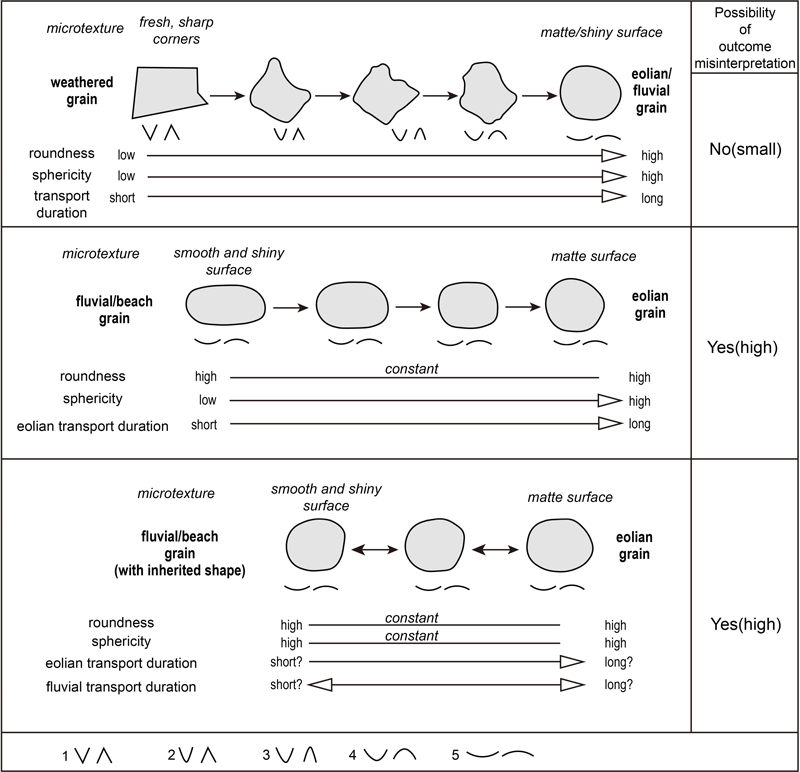
Change in roundness, sphericity, and microtexture of grains in an eolian environment is host-grain dependent, which can cause interpretive problems (Modified from Chmielowska et al., 2021). Classes of grain roundness: 1) v-shape depressions and sharp edges and corners; 2) slightly rounded edges and v-shaped depressions; 3) moderately rounded concave grain parts and slightly smoothed depressions; 4) well-rounded edges and flattened depressions; 5) very well-rounded grains and very shallow depressions.
1973년 Brown은 Nature 지에 게재한 논문을 통해 표면미세조직을 이용한 환경 해석의 타당성에 대해 의문을 제기하였다(Brown, 1973). 그는 환경 조건을 정확히 알고 있는 시료를 대상으로, 각 입자에서 특정 표면미세조직의 발생이 실제 퇴적환경 조건과 일치하는지를 검증하였다. 그 결과, 빙하 작용과는 전혀 관련이 없는 해빈 입자에서도, Krinsley 연구팀이 빙하 환경을 대표하는 것으로 주장한 조직들이 우세하게 나타나는 것이 확인하였다. 이를 통해 Brown은 기존 Krinsley 연구팀의 주장에 일부 무리가 있으며 실제로 다양한 퇴적환경에서 동일한 표면미세조직이 형성될 수 있음을 지적하였다. 또한 그는 퇴적물 분석 기법의 주된 가치가 주로 미지의 과거 퇴적환경 해석에 관한 신뢰성에 있다고 주장하면서 이 기준에 SMQ 기법이 부합하지 못한다는 의견을 제시하였다. 이와 같은 문제점은 이후 연구들에서도 반복적으로 제기되었으며, 연구자들로 하여금 SMQ의 등결과성 문제를 반복적으로 확인하도록 하였다(Setlow and Karpovich, 1972; Brown, 1973; Krinsley and Doornkamp, 1973; Darmody, 1985).
위와 같은 SMQ 기법 적용의 근본적 의문들은 현재까지도 중점적인 논의 대상이지만, 이후의 학자들은 체계적·정량적 분석 절차를 도입함으로써 이 문제를 극복하기 위한 연구를 시도하였다(e.g., Bull, 1981). 모형실험을 통한 정량적 평가 및 통계적 해석을 시도했던 Krinsley and Wellendorf (1980)은 미리 설정된 속도의 바람으로 입자를 이동시켜 풍성 사구에서 나타나는 무질서 편립(upturned plates)의 특성과 풍속 사이의 관계에 대해 규명하고자 했다. 실험을 통해 측정된 각 편립(plate) 사이의 간격과 풍속의 관계는 회귀분석을 통해 그래프와 식으로 나타내었으며(그림 2), 그 결과 실제 현생 사구에서 채취한 석영입자 표면의 편립 간격을 비교했을 때, 예측값과 관측값이 일치하는 것으로 나타났다. 이 연구 결과는 석영입자 표면미세조직 중 무질서 편립의 간격이 최근의 풍속 정보를 정량적으로 제공할 수 있음을 의미한다. 저자는 이에 덧붙여, 현생 퇴적물이 아닌 페름기 사암의 풍속 정보를 복원하였는데, 편립 간격 측정값을 회귀식에 대입하여, 당시 풍속이 29 m/s에 육박하였다는 것을 알아냈다(Krinsley and Wellendorf, 1980). 이는 실내 모형실험 결과를 통해 실제 퇴적환경에 적용 및 정량화하고, 과거 환경까지 복원해 낸 대표적인 사례로 인정받고 있다. Mahaney (2002)는 풍성, 하천, 빙하, 토양 외에도 동굴퇴적물이나 단층대 등 다양한 지질환경에서의 SMQ 결과를 총 정리하였다. 또한, 석영뿐만 아니라, 저어콘, 각섬석, 장석 등과 같은 다양한 광물 입자에도 표면미세조직 분석을 시도하였다(Mahaney, 2002). 이는 석영과 주요 환경에만 국한되던 SMQ 연구의 응용성을 높이는 결과였으나, 표면미세조직의 체계를 자체적으로 설정하였기 때문에 다른 연구결과와의 비교가 어렵다는 평가를 받기도 하였다(Hasson et al., 2024).
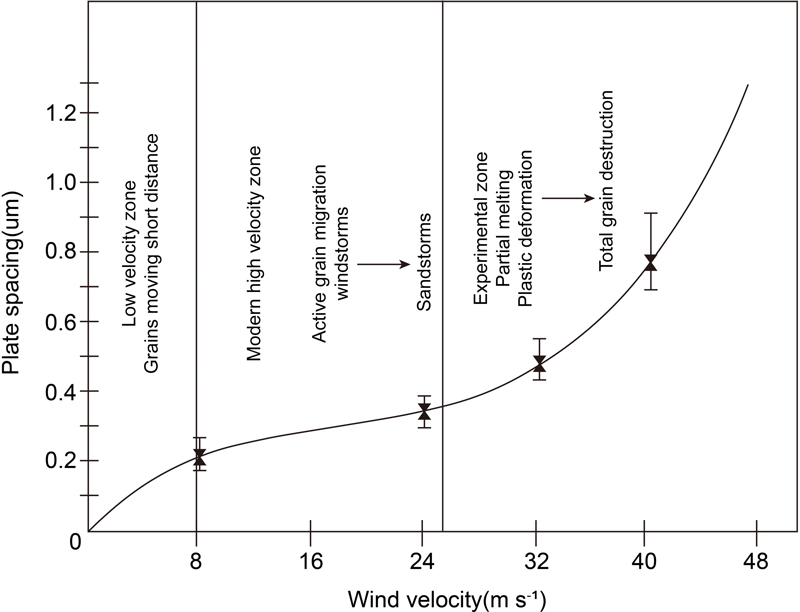
Comparison between changes in slope of experimental data and wind velocity for various types of sand grain movements observed in deserts (Modified from Krinsley and Wellendorf, 1980).
2000년대에 접어들면서, 석영입자가 거의 모든 자연환경에 존재한다는 점 그리고 적은 양의 시료로도 통계적 분석이 가능하다는 SMQ 기법의 장점은 법과학 분야 연구에서도 적용한 바 있다. Bull and Morgan (2006)은 용의자의 차량 두 대에서 채취한 퇴적물과 시신 발견 장소의 퇴적물을 대상으로 SMQ 분석을 수행하였고, 시신 유기에 사용된 차량을 특정하는 데 크게 기여하였다. 이는 SMQ 기법이 범죄 현장에 따라서는 용의자를 배제하거나 특정하는 데 효과적으로 활용될 수 있음을 의미한다. 물론, 범죄 수사에 있어서 결정적인 혹은 독립적 역할을 하는 데에는 한계가 있으나, 다른 법과학 기법들과 함께 사용된다면 경우에 따라 강력한 부수 증거로서 사용될 수 있다(Bull and Morgan, 2006). Vos et al. (2014) 은 이전 연구들의 전처리 방식을 비교하여 표준화된 분석 방법을 제안하였으며, 저자별로 상이하던 기존의 표면미세조직 구분을 34개로 개편하였다(그림 3). 이와 함께 그들은 Higgs (1979)의 연구 이후 여러 연구자들에 의해 제시되었던 각 퇴적환경 별 표면미세조직의 상대적 산출빈도를 통합하여 현재 시점에서 가장 체계화된 분류표를 제안하였다.
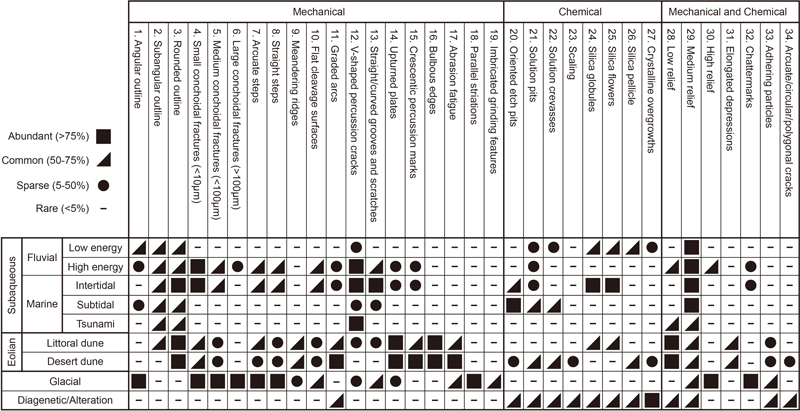
Environmental interpretation of quartz grain microtextures (Redrawn from Vos et al., 2014). “Abundant” means that the feature is present on 75% of the grains, “common” 50-75%, “sparse” 5-50%, and “rare” b5%. The table was compiled from our own data and data of Krinsley and Donahue (1968), Krinsley and Doornkamp (1973), Margolis and Krinsley (1974), Le Ribault (1977), Higgs (1979), Mahaney (2002), Mahaney et al. (2010) and Costa et al. (2013).
2020년대에 들어서, 가장 최근에는 SMQ 분류 과정에서 개입되는 연구자들의 주관성을 최소화하고 분석에 투입되는 시간과 자원을 크게 줄이기 위한 연구가 진행되고 있다. Hasson et al. (2024)은 딥러닝 기반 이미지 분석 기술을 도입하여 SMQ를 자동으로 분류하는 SandAI 모델을 개발하였다. 이 인공지능 모델은 하성, 풍성, 빙성, 해빈 등 다양한 현생 환경의 석영입자를 바탕으로 학습되었으며, 미국 서부에서 채취한 사암의 석영입자에 적용하여 모델 검증을 수행하였다.
3. SMQ의 기술적 방법
SMQ를 정확히 식별하기 위해서는 석영입자 표면의 부착입자(adhering particles)와 기타 유·무기적 피복 물질을 세척하여 제거해야 한다. 하지만, 이러한 물질들은 표면미세조직을 가려 구분에 혼란을 초래하는 동시에, 기원암과 속성작용 동안의 정보를 제공할 수 있다. 따라서 SMQ 분석과정에서는 반드시 세척 입자와 함께 비 세척 입자 또한 관찰하는 것이 중요하다. 이전 연구자들은 염산(hydrochloric acid), 염화주석(tin chloride), 과산화수소(hydrogen peroxide), 칼곤(Calgon) 등 화학적 처리를 거쳐 석영입자 표면의 유기물과 부착입자를 제거해왔다(Krinsley and Doornkamp, 1973; Lewis and Armstrong, 1994; Helland et al., 1997; Helland and Holmes, 1997; Vos et al., 2014). 그러나 전처리 과정에서 산성 용매의 농도가 너무 높거나, 장시간 반응할 경우 석영입자 표면에서 인위적인 용해가 발생되는 문제점이 보고되었다(Higgs, 1979). 뿐만 아니라, 강력한 세척을 위해 초음파세척기(ultrasonic vibration)를 사용하기도 하였는데, 이 또한 입자에 이차적인 인위적 조직을 발생시킬 수 있으므로 통상적으로는 사용하지 않는다(Porter, 1962; Bellanova et al., 2016).
현재 많은 연구자들에 의해 사용되고 있는 세척 방법은 Vos et al. (2014)의 방식으로, 그 절차는 다음과 같다. 퇴적물 시료를 완전 건조시킨 뒤, 석영입자를 무작위 선별한다(그림 4a). 이 과정에서 실험 조건의 표준화를 위해, 분석에 사용할 단결정 석영입자를 확인해야 한다. 또한, 석영입자 고유의 균열은 SMQ 해석에 혼동을 유발할 수 있기 때문에 이러한 균열의 유무를 사전에 확인하여야 한다. 이러한 석영입자의 균열은 취성 광물에 해당하는 석영이 결정화작용, 변성작용, 구조적 작용을 겪으면서 쉽게 형성될 수 있는 구조이다(Mazzullo and Ritter, 1991). 실제로, 텍사스 중부 융기대의 화성암-변성암 기반 토양에서는 57~74%의 석영에 균열이 존재하는 것이 보고된 바 있으며, 이러한 고유의 균열은 SMQ 해석 과정에서 오해석될 여지가 있다.
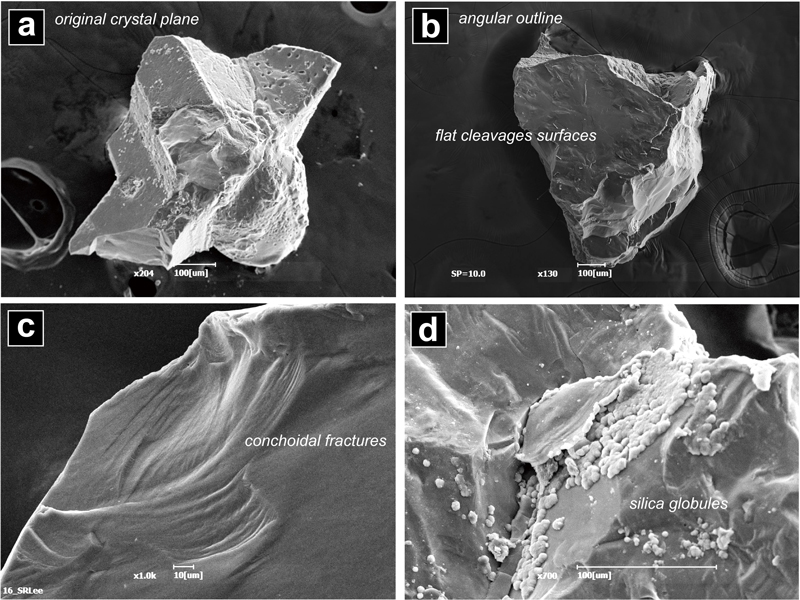
Low and high magnification scanning electron (SEM) images showing various SMQ of the ChunCheon Basin soil, Korea. (a) Quartz grain with original crystal plane. (b) Angular grain with flat cleavages surface. (c) High magnification images showing conchoidal fractures. (d) High magnification images showing silica globules.
대부분의 연구자들은 분석에 사용된 석영입자의 크기를 명시하지 않았으며, 이에 대한 명확한 합의 또한 이루어진 바 없다(Bull, 1981; Mahaney, 2002; Smith et al., 2018). 하지만, 같은 시료 내의 석영입자들이 동일한 환경에서 같은 작용을 겪더라도, 크기가 서로 다를 경우 서로 상이한 조직을 발생시킬 가능성이 있다(Krinsley and Doornkamp, 1973). 즉, 입자 크기가 클수록 특정 표면미세조직의 형성 면적 범위가 상대적으로 더 넓어질 가능성이 있다(Krinsley and Smith, 1981; Mahaney, 2002; Smith et al., 2018). 따라서 분석 이전에 비슷한 크기의 입자를 선택하는 것이 필요하며, 0.1~2.0 mm 범위의 석영입자를 선택하는 것을 권장하고 있다(Vos et al., 2014). 최근에는 이보다 더욱 좁은 범위의 입자를 위조로 분석하는 사례가 증가하고 있다(Baek and Jo, 2023).
이렇게 선별된 석영입자에 대해 표면의 탄산염과 철산화물 제거를 위해 15% 염산(HCl) 용액에 10분간 가열한다. 그 후 잔여 염산이 충분히 제거될 수 있도록 증류수로 3차례 세척한다. 다음으로, 이들 석영입자를 다시 50 g/L 피로인산나트륨 용액(tetrasodium pyrophosphate)에 10분 가열하여 입자 표면의 점토와 부착입자들을 제거한 뒤, 마찬가지로 증류수로 3회 이상 세척한다. 세척한 석영입자들은 60℃로 설정된 건조기에서 완전 건조시킨다. 이 방법은 입자의 인위적 표면 손상 가능성을 낮출 수 있으며 절차가 비교적 간단한 장점을 지닌다. 하지만 세척을 반복하는 과정에서 소량의 석영입자 시료가 유실되거나 부착 입자가 효과적으로 제거되지 않는 등의 문제가 발생될 수도 있으므로 연구자의 주의가 특별히 요구된다(Baek and Jo, 2023; Lee et al., 2025). 따라서 보다 신뢰할만한 환경 해석을 위해서는 석영입자 전처리 과정의 일관성이 중요하고, 특히, 세척 용액의 농도, 가열 시간, 분석 표본의 수 등의 영향은 체계적으로 정립한 필요가 있다(e.g., Bellanova et al., 2016).
세척이 완료된 석영입자 중 최소 30개 이상의 입자를 무작위로 선별하여 카본테이프(carbon tape)에 마운팅한 후, 본격적인 주사전자현미경 분석을 위한 이온 코팅을 실시한다. 주사전자현미경 분석은 비용과 시간이 많이 소요되는 작업일 뿐만 아니라 양질의 이미지 획득을 위한 기술이 요구되므로 실제 기기분석 시에는 많은 노하우가 필요하다. 예를 들면 각 시료 조건에 적합한 기기 설정 조건을 맞추지 못할 경우 이미지의 초점 및 해상도의 질이 저하될 수 있고, 이미지 설정 중 대비를 너무 크게 조작하거나 전자빔 크기를 적절히 조절하지 못하면 보다 작은 규모의 표면미세조직을 인지하는 데 어려움을 겪게 된다. 또한, 석영입자의 검증 및 부착 입자의 화학조성을 파악하기 위해, 주사전자현미경의 이차전자(secondary electron, SE) 이미지 분석과 함께 EDS (energy dispersive spectroscopy) 원소 분석이 필요하다(Whalley and Krinsley, 1974). 특히, 실내 모형실험에 의한 석영입자의 경우에는 결과 검증을 위해 동일한 기기 설정 조건에서 실제 퇴적환경의 대조군 입자를 함께 분석하는 것이 권장된다(Ingersoll, 1974). 한 지점의 시료에서 선별된 30개 이상의 석영입자는 통계적 추론을 위한 최소 표본 크기를 만족하긴 하지만(Islam, 2018), 분석 목적에 따라 더 많은 표본이 필요할 수 있다. 전체 분석 입자 중 특정 표면미세조직이 몇 개의 입자에서 관찰되었는 지를 백분율인 산출빈도로 나타내고, 이와 더불어 SMQ 조합을 함께 고려하여 최종적인 퇴적환경을 해석한다. 이 과정에서 무엇보다 중요한 것은 표면미세조직의 정확한 식별과 각 SMQ의 형성 원인을 정확하게 파악하는 것이다.
4. 퇴적환경별 석영입자 표면미세조직의 특성
4.1. 토양 환경
토양의 구성물질은 기반암의 암상에 의해 주로 조절되지만, 기후, 식생, 지형과 같은 환경 조건에도 영향을 받는 것으로 잘 알려져 있다. 석영은 이러한 토양 환경에서 광물학적 안정성과 강한 풍화 저항성을 바탕으로, 풍화 및 토양 형성 연구의 지시광물로 사용되어 왔다(Douglas and Platt, 1977; Powers et al., 1979; Wilson, 2020; Shin and Jo, 2024). 일반적으로 토양은 기반암에서 기원한 뒤, 수평·수직적 공간 이동이 거의 일어나지 않는 것이 특징이다. 이와 같이 유수 등 운송매체에 의한 토양 물질 이동의 부재는 토양 내 석영입자에서의 물리적 조직(mechanical; 그림 3) 발달을 저해한다. 따라서 토양 시료의 경우 석영입자 고유의 결정면 특징이 그대로 보존된 사례(그림 4a)가 관찰되는 데 반해, 기존 SMQ 분류 상의 물리적 미세조직들의 다양성이 다소 미흡하게 발달하는 특징을 보이며, 이러한 이유로 인해 토양 내 석영입자의 표면미세조직은 그 조합과 빈도를 파악하기 어렵다는 의견도 존재한다. 토양 내에서 가장 우세하게 나타날 수 있는 물리적 조직으로는 벽개면을 따라 평탄한 단면을 보이는 평탄 벽개(flat cleavages surfaces)와 비 벽개면을 따라 깨진 특징인 패각상 깨짐(conchoidal fractures) 조직을 들 수 있으며, 이들은 토양 환경에서 각각 25~75%, 75% 이상의 고빈도를 나타내는 조직으로 알려져 있다(그림 4b, 4c; Eswaran and Stoops, 1979; Higgs, 1979). 이러한 조직은 석영입자가 모암으로부터 떨어져 나오면서 형성되는 것으로 해석되고 있는데(Bull, 1981), 토양 환경 특성상 이동에 의한 추가적인 모서리 마모가 일어나지 않기 때문에 잘 보존되어 높은 빈도를 나타내는 것으로 판단된다.
화학적 요인에 의한 표면미세조직은 토양환경에서 상대적으로 우세하게 형성되는데, 다량의 유기물이 석영 입자와 오래 접촉함으로써 형성되는 배열형 부식면(oriented etch pits), 용해소(solution pits), 용해곡(solution crevasses)과 같은 용해 조직이 25~75%의 산출 빈도를 보이는 것으로 보고된 바 있다(Higgs, 1979; Vos et al., 2014). 일반적으로 석영의 용해는 pH 8~9의 강알칼리 조건에서 발생하지만(Manickam and Barbaroux, 1987), 유기물질과 반응하면 석영의 용해율을 변화시켜 pH 4~5의 토양수에서도 용해가 발생할 수 있는 것으로 보고된 바 있다(Higgs, 1979; Reuss and Johnson, 1985). 이렇게 공극수에 용해된 실리카 성분은 이후 석영입자 표면에 새로운 형태로 침전될 수 있으며(MartÍn-García et al., 2015), 구상 실리카(silica globules; 그림 4d), 화상 실리카(silica flowers), 층상 실리카(silica pellicle) 그리고 과성장(crystalline overgrowths)의 표면미세조직으로 분류된다. 이들 각족 형태의 실리카 침전 조직은 토양환경에서 약 50~75% 이상의 산출빈도를 나타난다(Higgs, 1979; Vos et al., 2014).
국내 춘천분지 토양 석영을 대상으로 수행된 연구에서는 계절정이 뚜렷한 온대지역의 토양환경에서 나타나는 SMQ 특징을 뚜렷하게 보여준다(Shin and Jo, 2024). 선행 연구결과에서는 각형 윤곽선(angular outline), 패각상 깨짐, 곡선형/직선형 계단(arcuate/straight steps) 조직과 같은 물리적 조직이 75% 이상의 높은 산출률을 보였다. 여기에 더해 기존 SMQ 분류체계에는 포함되지 않으나, 극한지 지역에서 주로 보고된 바 있는 breakage blocks 및 microsteps 조직이 일부 관찰되어 춘천분지 토양이 동결-융해(freeze-thaw) 작용을 받은 것으로 해석하였다(그림 5; Woronko and Pisarska-Jamroży, 2016; Liu et al., 2023). 이와 같은 온대지역의 연구 결과와는 달리, 열대 기후대의 토양에서는 화학적 풍화작용에 의해 형성된 용해 및 침전 미세조직이 우세하게 발달하는데, 이는 식생에서 기원한 유기산에 의해 영향받은 결과로 알려져 있다(Eswaran and Stoops, 1979, Nesbitt et al., 1997). 이처럼 토양 환경의 미세조직은 기후대에 따라서도 그 빈도와 조합이 다르게 나타날 수 있다. 결론적으로, 토양환경 SMQ는 연구 지역의 기후 조건과 지질학적 특성 등 주변 환경조건에 따른 차이를 보이며, 각 지역별 토양의 체계적인 연구가 이루어진다면 보다 신뢰성 있는 환경분류의 지표로 사용될 수 있을 것으로 기대된다(Shin and Jo, 2024).
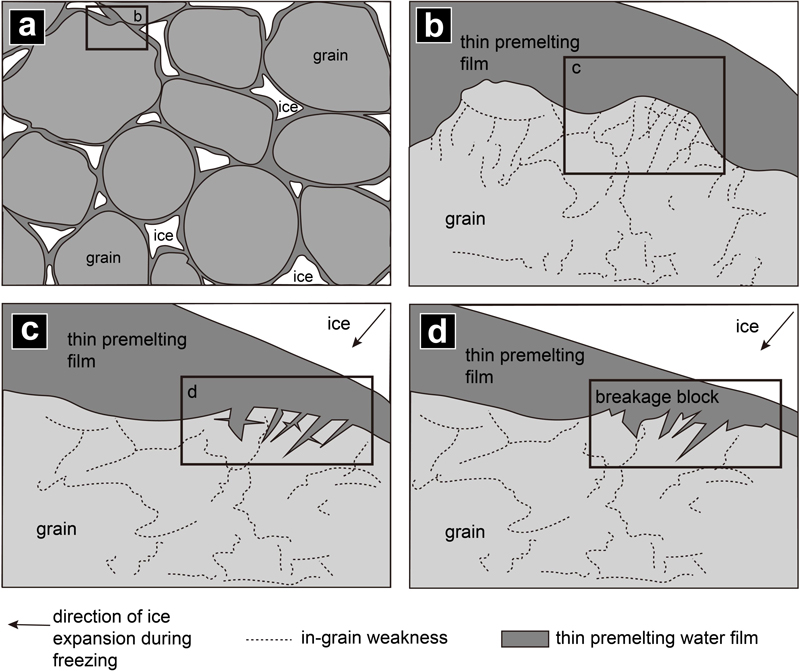
Schematic of the development of F-type frost weathering of quartz grains (Modified from Woronko and Pisarska-Jamroży, 2016). (a) Frozen sandy-sized deposit; (b) Fragment of quartz grain with in-grain weaknesses and thin unfrozen water (premelting film) adjacent to the surface of the grain within frozen sand sediment; (c) The growth of the crystal ice causes the increase of the pressure on the unfrozen water film and disintegration of the quartz grain along the in-grain weaknesses. It occurs when thickness of the unfrozen water film becomes less than irregularities on the surface of particles. At the beginning small conchoidal fractures are formed; (d) Multiple cycles of the freeze-thaw cause the overlapping of conchoidal features and forming breakage blocks microstructures.
4.2. 하성 환경
하천계(river system)는 그 형태와 규모가 극히 다양하여 퇴적물 운반 특성에서 큰 차이를 유발한다. 하천의 길이는 시스템 내에서 석영입자가 이동할 수 있는 거리를 제한하고, 일반적으로 이동거리가 길어질수록 V-형 충돌흔(V-shaped percussion cracks; 그림 6d)과 원형 윤곽선(rounded outline)의 산출빈도가 증가하는 결과는 그동안의 SMQ연구를 통해 잘 알려진 사실이다(그림 7b; Sweet and Brannan, 2016; Baek and Jo, 2025).
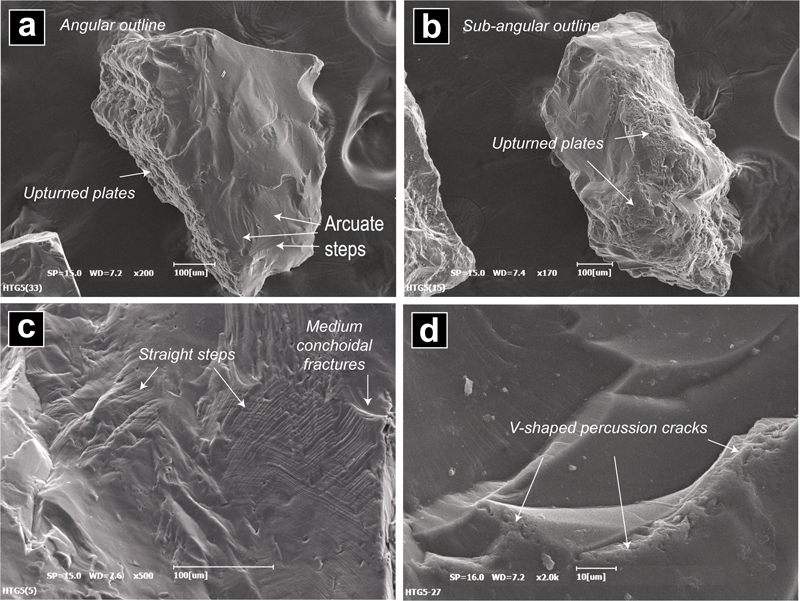
Low and high magnification SEM images showing various SMQ of Hantan River (Modified from Baek and Jo, 2025). (a) Angular grain. (b) Sub-angular grain. (c) Intersecting straight steps. (d) V-shaped percussion cracks.
하천 유속도 SMQ의 특성을 결정하는 데에 있어 주요하게 작용하는 요인 중 하나이다. Higgs (1979)는 하성환경을 에너지 세기에 따라 저에너지/중에너지/고에너지/급류환경 네 가지로 분류하였는데, 저~중에너지 환경에서는 상대적으로 화학적 침전조직을 우세하게 형성하는 데 반해, 급류 환경에서는 다양한 크기의 패각상 깨짐과 각형 윤곽선이 우점하는 것으로 보고되고 있다(e.g., Higgs, 1979). 이처럼 유속 변화에 의한 수력학적 에너지의 증감은 특정 물리적·화학적 조직의 산출 빈도를 변화시키지만(Li et al., 2021), 이 관계는 비선형적일 수 있다. 예를 들면, 중~고에너지 환경에서는 V-형 충돌흔과 원형 윤곽선의 형성이 가장 활발하지만, 그 이상의 에너지를 가지는 급류 환경에서는 오히려 감소하는 경향이 보고되고 있다. 즉, 더 높은 에너지 환경에서는 더욱 강한 입자 간 충돌이 발생하여 패각상 깨짐이나 평탄 벽개 등의 물리적 조직이 우세하게 생성된다. 심한 경우, 기존 저에너지 조건에서 형성되었던 V-형 충돌흔과 원형 윤곽선 등이 고에너지 조건 하에서 새롭게 형성되는 패각상 깨짐, 평탄 벽개, 각형 윤곽선 등에 의해 제거 혹은 전환되는 효과가 발생될 수 있다(그림 6a; Mahaney, 2002; Baek and Jo, 2025).
이는 우리나라와 같이 계절에 따라 수력학적 에너지의 변화가 매우 큰 하천 환경에 대해 시사하는 점이 매우 크다. 국내의 하성 환경 SMQ 연구는 현생 및 고기 한탄강 유역에서 수행되었다(그림 7a; Baek and Jo, 2023, 2025). Baek and Jo (2025)는 한탄강 본류와 지류 퇴적물 간 SMQ 산출빈도 결과에 대해 계층적 군집 분석(hierarchical clustering analysis)을 실시한 결과, 본류와 지류 퇴적물이 뚜렷하게 구분되는 것을 확인하였다(그림 7b; Baek and Jo, 2025). 이들은 거력에서부터 세립질 모래 크기의 입자가 공존하는 환경에서 주로 여름철 동안 입자 간 강한 수중 충돌이 발생하면서 무질서 편립(그림 6b) 및 평탄 벽개면 등과 같은 물리적 조직의 높은 발생 빈도(그림 6c)가 나타나는 것으로 해석하였다. 이와 같은 SMQ 결과는 유사한 여름 몬순 시스템에 영향받는 지역 혹은 아열대 지역과 같이 빈번한 집중 강우 조건을 보이는 지역에서도 보고되고 있으며(Smith et al., 2018; Chen et al., 2019; Baek and Jo, 2025), 이러한 하천 SMQ의 형성 원리는 동아시아 여름몬순에 의한 집중적 강우 현상이 SMQ에 효과적으로 기록될 수 있음을 암시한다.
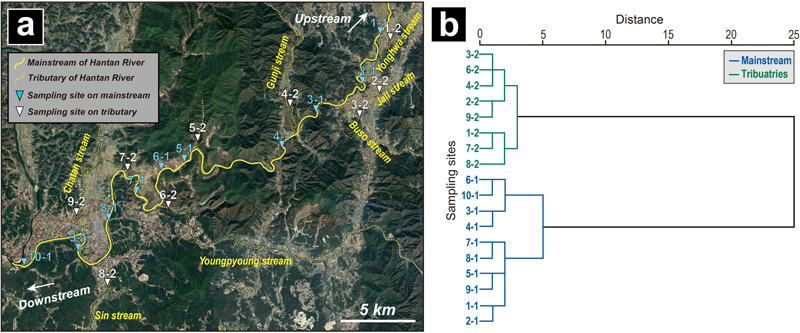
(a) Satellite image showing the mainstream and tributary sampling sites. (b) Dendrogram showing complete separation between mainstream and tributary sampling sites based on SMQ frequencies. Blue and green labels on the vertical axis indicate mainstream and tributary sampling sites, respectively. Horizontal axis indicates linkage distances (Modified from Baek and Jo, 2025).
하지만, 앞서 언급한 바와 같이 하성 환경은 기후, 지형, 식생분포 등의 영향에 따라 극히 다양한 특성을 보이기 때문에, 현재까지의 SMQ 연구 결과만으로는 개별 하천 시스템을 특성화하여 구분하는 것이 어려우며(e.g., Mahaney, 2002; Li et al., 2021), 이를 위한 보편적 판별 기준이 미비한 실정이다. 따라서 하성 SMQ를 통한 퇴적환경 판별은 토양, 해빈, 풍성 등 다른 환경과의 구분 또는 단일 하천 시스템 내에서의 정성적 운반에너지 차이(본류/지류 혹은 상류/하류 조건)를 구분하는 데 효과적일 수 있으나, 개별 하천 시스템을 특정하는 데에는 아직까지 많은 한계를 보이고 있다.
4.3. 해빈 환경
해빈 퇴적물은 다른 퇴적환경에 비해 조직적 성숙도가 매우 높으며, SMQ 특징 또한 매우 뚜렷한 차이를 보이는 것으로 알려져 있다(Ko and Jo, 2024). 해빈 환경에서 끊임없이 지속되는 파도의 영향은 주로 모래 크기의 유사한 입도로 제한된 조건에서 지표 환경 중 가장 지속적이고 활발한 입자 간 물리적 상호작용을 유발하게 된다. 이는 곧 외부 환경으로부터 공급된 석영입자 모서리의 마모를 극대화하여 윤곽선 또는 원마도를 빠르게 증가시키며(Hunt, 1887), 타 환경으로부터 해빈 SMQ 조합 및 빈도의 차별성을 뚜렷하게 만든다. 원형 윤곽선과 V-형 충돌흔은 해빈 SMQ에서 관찰되는 대표적인 조직으로서, 수중 환경에서의 지속적인 유사 크기 입자 간 충돌과 마모작용을 지시한다(그림 8a, 8b; Krinsley and Funnell, 1965; Krinsley and Donahue, 1968; Higgs 1979; Vos et al., 2014; Itamiya et al., 2019). 이들과 같은 표면미세조직은 과도한 입자 간 충돌 에너지 환경에서는 높은 빈도를 이루기 어려우나, 해빈 환경은 이들의 형성 조건에 가장 부합하는 환경을 제공하고 있다. Folk (1978)는 수중 입자의 경우 밀착되어있는 수막에 의해 강한 충격으로부터 보호받는다는 수막효과(water-film effect)를 언급하였고, 이 효과는 적정 수준의 충돌 에너지 형성에 기여하는 것으로 보인다.
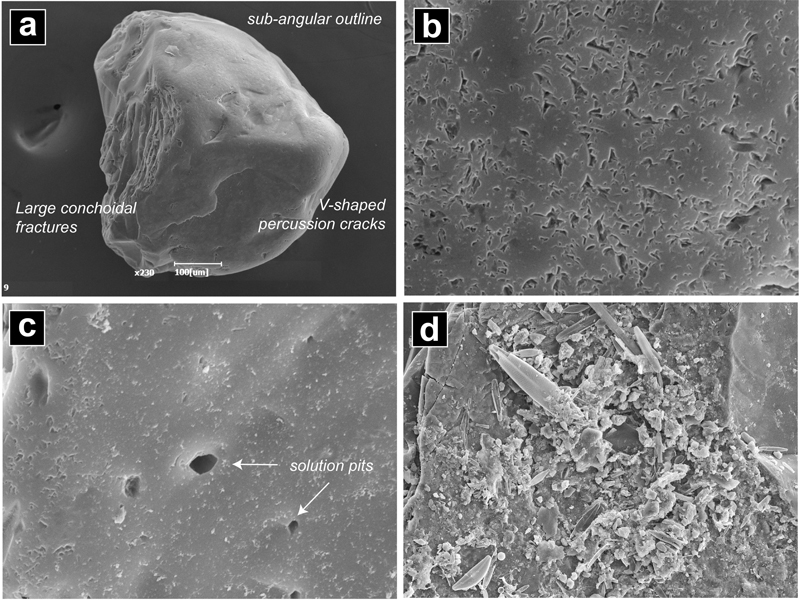
Low and high magnification SEM images showing various SMQ of East coast (Modified from Ko and Jo, 2024). (a) Sub-anaular grain from Hwajinpo Beach. (b) V-shaped percussion cracks. (c) Solution pits (d) Adhering particles and diatom.
해빈 석영의 또 다른 주요 특징은 해수와의 반응에 의한 화학적 조직이다. 해수의 평균 pH는 약 7.8~8.3으로, 석영의 용해도가 증가하는 pH 9.0 보다 약간 낮은 수치지만, 조간대와 인접한 해빈 환경에서와 같이 석영입자가 해수 내 유기성분이나 간헐적 증발에 자주 노출된다면 9.0보다 높은 pH를 가질 수 있는 것으로 알려져 있다(e.g., Krauskopf, 1959; Oppenheimer and Master, 1965). 이러한 기작으로 형성되는 대표적 화학적 조직으로는 용해소, 용해곡, 배열형 부식면, 구상 실리카, 화상 실리카 등이 보고되었다(그림 8c; Vos et al., 2014).
다소 이견은 존재하지만, 해수 환경에 서식하는 규조(diatom)도 부착입자의 한 종류로 해빈 SMQ의 표면미세조직적 특징으로 언급되기도 한다(그림 8d; Madhavaraju et al., 2022). 이들은 석영입자 표면에 부착되어 있는 규조의 종 분류를 통해 과거 해수의 영양염류 함량과 해수 유입 시기 등을 복원하기도 하였다(Armstrong-Altrin et al., 2023). 이러한 SMQ로서의 규조는 해빈환경 외에도 하천 및 극지와 같은 다양한 환경에서도 발견되기도 하지만(Manickam and Barbaroux, 1987; Baek and Jo, 2025), 해빈 환경에서 가장 우세하게 나타나는 특징이라고 할 수 있다.
Itamiya et al. (2019)은 일본의 여러 해빈에서 채취한 석영입자와 함께 인근 하천 시료를 분석하여 비교하였는데, 원형 윤곽선을 가지는 해빈 석영과는 달리 하천 SMQ에서는 상대적으로 구형도가 낮고 각형 윤곽선이 우세하게 나타냈다. 이러한 결과는 경사가 급한 하천 환경에서 계절에 따라 매우 높은 수력학적 에너지가 발생하기 때문이라고 해석되었으며, 이는 해빈 석영과 하천 석영의 모서리 마모 정도를 비교한 선행 연구들과 부합하는 결과에 해당한다(Helland and Holmes, 1997; Pyökäri, 1997).
국내 동해안의 청간해빈과 이에 직접 연결된 천진천을 대상으로 최근 수행한 연구에서도 하천과 해빈 영역의 SMQ 구분을 확연하게 보여주었다(Ko and Jo, 2024). 이 연구에 의하면, 하천 영역에서는 운반 거리에 따라 V-형 충돌흔, 아각형 윤곽선이 10% 이하에서 최대 60% 이상의 빈도까지 증가한 반면, 각형 윤곽선은 정반대의 결과를 보였다(그림 9). 해빈 SMQ에서도 운반 거리에 따른 경향성이 나타나지만, 여기서 주목할 점은 해빈 환경에서의 SMQ 진화 속도가 하천 환경에 비해 약 3~8배 컸다는 사실이다. 이는 해빈 환경이 V-형 충돌흔과 원형 윤곽선 형성에 얼마나 적합한 환경을 제공할 수 있는지를 단적으로 보여주는 사례이다.
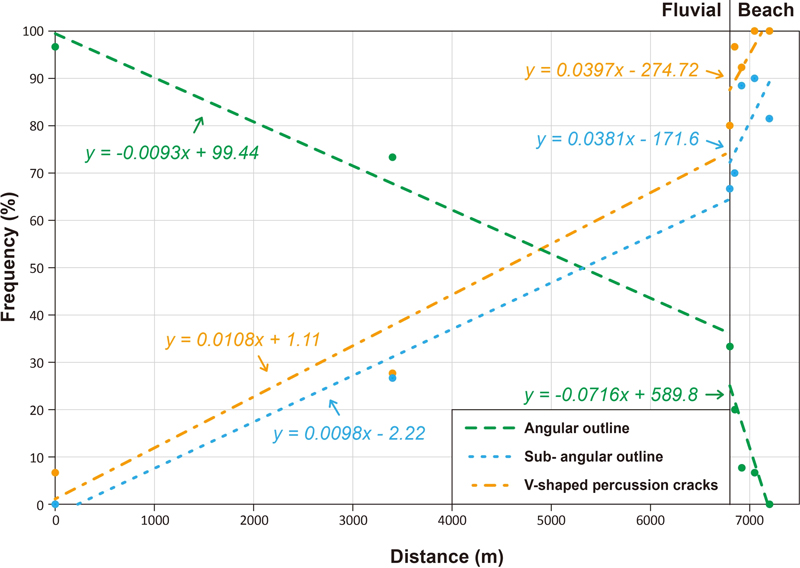
The regression line showing the frequency changes in SMQ depending on the transport distance from Cheonjin stream (0-6800 m) to Cheonggan beach (6800-7200 m) (Modified from Ko and Jo, 2024).
Costa et al. (2012)는 스코틀랜드, 포르투갈, 인도네시아에서 채취한 해빈 시료와 이를 모사한 실내 모형실험을 수행하였는데, 그들은 자석교반기를 이용하여 수중환경의 에너지 세기에 따라 달라지는 SMQ 특징을 분석하고, 이를 해빈 시료에서의 결과와 비교하는 연구를 진행하였다. 이 연구를 통해, 그들은 형성되는 SMQ의 종류를 결정하는 것은 퇴적물의 농도이지만, 산출빈도를 조절하는 것은 충돌 속도와 충돌 지속 시간이라고 주장하였다. 즉, 퇴적물의 농도가 낮으면 입자 간 충돌 발생 직전까지 높은 속도에 도달할 수 있기 때문에 석영입자 표면에 다수의 깨진 면을 형성할 수 있다고 설명하였다.
4.4. 풍성 환경
입자 간 반복되는 충돌에 의한 마모는 해빈환경 뿐만 아니라, 풍성환경에서도 나타날 수 있는 특징이며, 풍성 환경의 SMQ 조합과 산출빈도는 입자 크기 및 풍속과 밀접하게 관련된다. 즉, 풍성 환경에서는 입도가 크고 풍속이 빠를수록 모서리 마모에 의한 SMQ 형성이 더 원활해지는 경향이 일반적이다(그림 10a, 10b; Mahaney, 2002). 하지만 풍속이 일정 수준 이상 증가할 경우, 무질서 편립, 패각상 깨짐, 곡선형 능구조(meandering ridges), 부착입자 등 강한 충돌을 지시하는 물리적 조직들이 점차 우세해지며(Krinsley and Trusty, 1985), 이러한 특징은 실내 모형실험에서도 관찰된 바 있다(Nieter and Krinsley, 1976; Costa et al., 2013).
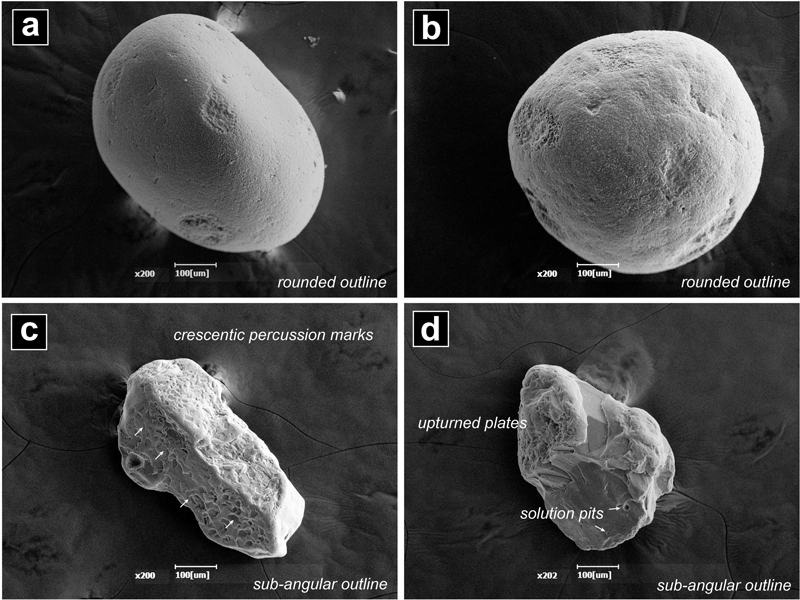
Various types of quartz grain in the aeolian environments. (a, b) SMQ of Page Glen Dam, USA. Grains rewarked by wind after deposition. (c, d) SMQ of Shinduri coastal dune, Korea.
풍성 환경은 기본적으로 건조한 기후 조건을 이루고 있으나, 적은 양의 강수나 이슬이 존재할 수 있으며 입자 사이 약알칼리성의 공극수가 증발하면서 pH가 증가해 석영입자 표면에 용해소와 용해곡과 같은 화학적 조직을 형성하기도 한다(Soutendam, 1967; Costa et al., 2013). 또한, 사막과 같은 지역의 큰 일교차로 인한 공극수의 증발과 침전은 석영입자 표면의 요철을 감소시킴으로써 매끈한 표면을 유도한다(Al-Saleh and Khalaf, 1982). 해안 사구에서의 경우에는 해빈 환경과 풍성 환경의 영향을 동시에 받을 수 있기 때문에 그 중간적인 특성을 보이게 되는데, 주로 볼록 활면(bulbous edges)과 찰과 충돌흔(abrasion fatigues)으로 대표되는 풍성 환경의 특징과 V-형 충돌흔으로 대표되는 해빈 환경의 특징이 동시에 우점한다. 또한, 해안 사구에서는 내륙 사막 지역의 사구에 비해 화학적 요인에 의한 SMQ가 더 높은 빈도로 나타난다는 특징이 있다(Al-Saleh and Khalaf, 1982).
국내에서는 현재까지 풍성 환경 SMQ에 대한 체계적인 연구가 수행된 사례는 없지만, 태안 신두리 사구의 석영입자 표면에서는 초승달형 충돌흔(crescentic percussion marks)과 V-형 충돌흔과 같이 풍성 환경과 해빈 환경을 대표하는 표면미세조직이 동시에 산출되었다(그림 10c, 10d).
4.5. 빙성 환경
빙성 환경은 SMQ 연구에 있어 화학적 풍화에 비해 물리적 작용을 우선적으로 고려할 수 있는 환경이다(Mahaney and Schwartz, 2016). 특히, 빙하 활동의 전후 차이를 연구하는 데 유용하며(Hernández-Hinojosa et al., 2018), 이는 빙하에 의한 석영입자의 운반은 동결작용과 강한 압력이 수반되기 때문이다(Krinsley and Takahashi, 1962). 이러한 빙하 관련 작용들은 각형 윤곽선, 패각상 파쇄면, 곡선형/직선형 계단, 평행 조선(parallel striatinstriation), 중첩분쇄흔(imbricated grinding features)과 같은 조직들을 생성하는 것이 특징이다(그림 11b, 11c; Margolis, 1968; Woronko and Pisarska-Jamroży, 2016; Kim et al., 2023). 하지만, 이들 빙성 환경을 특징 짓는 SMQ들 중 일부는 빙하 내에 안정적인 상태로 보존 및 운반되어 시료 채취지점에 도달할 수도 있다(그림 11a; Mahaney, 2002).
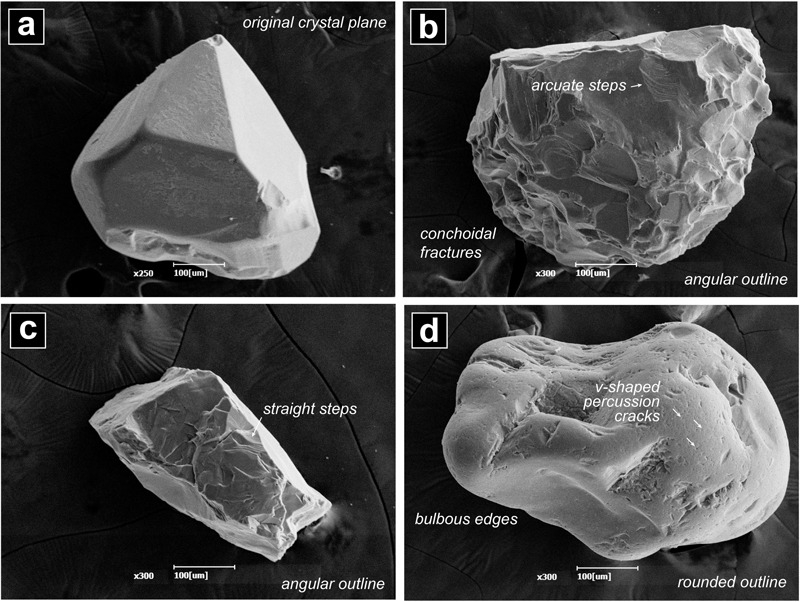
Low-magnification SEM images showing various SMQ of quartz grains from Antarctic sediments. (a) Quartz grain with original crystal plane. (b, c) Angular grains. (d) Rounded grain.
Strand et al. (2003)은 해양시추프로그램(ODP; ocean drilling program) SITE 1166에서 남극해 코어 퇴적물 시료의 SMQ 분석을 통해 빙하 운반 석영입자와 융빙수 운반에 의한 석영입자를 구분하는 것이 가능하다고 주장하였고, 나아가 주변 빙상(ice sheet) 진화의 주요 시기를 추정하였다. 이들은 원형 윤곽선을 보이는 입자가 에오세 중기~후기에 우세한 산출을 보이는 것에 비해, EOT (Eocene-Oligocene Transition) 시기 이후 각형 윤곽선, 모서리 마모, 곡선형/직선형 계단 등 전형적인 빙성 환경의 SMQ가 우세해지는 특징을 보고하였다. 따라서 이들의 연구는 빙성 환경과 연결된 수성 환경(혹은 시기)에서는 원형 윤곽선과 V-형 충돌흔 등과 같은 유수 운반에 의해 형성되는 조직이 관찰될 수 있음을 암시한다(그림 11d).
Krinsley and Takahashi (1962)는 브라질 석영맥에서 분리한 석영입자를 물과 혼합하여 스테인리스 실린더에 넣고 –15℃로 냉각시킨 상태로 500 bar의 압력을 가해 빙하 작용을 모사하였다. 이렇게 처리된 석영입자를 실제 빙하 환경의 석영입자와 비교했을 때, 패각상 파쇄면(대)(large conchoidal fractures; >100 μm)과 불규칙한 평행 조선 등 일부 유사성이 확인되기도 하였다. Górska and Woronko (2022) 역시, 실험실 조건에서 시료의 동결-융해를 반복적으로 실험하였다. 그들은 초기 단계에서는 패각상 파쇄면(대)가 우세했으나, 동결-융해 프로세스를 지속시킬수록 패각상 파쇄면(소)(small conchoidal fractures; <10 μm)의 산출빈도가 증가하고 최종 단계에서는 breakage blocks이 우세해지는 일련의 SMQ 변화과정을 관찰하였다.
5. 향후 연구를 위한 제언 및 결론
이 논평에서 지금까지 다룬 바와 같이, SMQ 연구의 활용가능성은 여전히 높다고 할 수 있다. 무엇보다, SMQ는 개별 석영입자를 대상으로 통계적 처리가 가능하고, 이를 기반하여 입자의 운반과정을 이해할 수 있는 정보를 제공한다는 점에서 그 차별성이 뚜렷하다. 또한, 현재까지의 연구결과를 통해 미지의 퇴적물 시료에 대해서 토양, 하성, 해빈, 풍성, 빙성 환경을 신뢰성 있게 구분하는 데에 매우 중요한 정보를 제공할 수 있다. 하지만, 국내외적으로 SMQ의 객관적 기재 기준이 여전히 표준화되어 있지 못하고 보편적 분류체계가 부재하여 경험이 부족한 연구자들의 주관성이 개입되는 문제점이 반복적으로 이어지고 있는 실정이다.
따라서 위와 같은 SMQ의 장점을 강화하고 단점을 보완하기 위해서는 다음과 같은 후속 연구와 발전 방안이 필요하다. 첫 번째로, 퇴적환경을 알고 있는 현생 퇴적물에 대한 면밀한 조사연구와 실내 모형실험을 접목한 반복 검증이 필수적이다. 이는 현재까지 연구되어 온 SMQ 결과의 재현성을 제고하고 신뢰성을 높임으로써, 다양한 분야로의 활용성을 넓힐 수 있을 것이다. 또한, 신규 연구자들이 SMQ 분석을 수행할 시 각 표면미세조직에 대해 예단이나 추정에 의한 오기재를 방지할 수 있도록 조직별 객관적 판별 기준이 조속히 마련되어야 한다. 이는 관련 학자들 간의 활발한 토론과 커뮤니케이션을 통한 일정 수준의 교육 훈련과 경험자에 의한 검증이 필요함을 의미한다. 만약 이와 같은 후속과정이 원활히 진행될 수 있다면 현재 가장 널리 활용되고 있으나 개선의 여지가 많은 기존의 SMQ 분류체계 및 퇴적환경별 분류표를 크게 발전시킬 수 있을 것이다.
두 번째로, 높은 객관성을 지니는 현생 퇴적물 SMQ 자료가 충분히 축적되면 환경별 SMQ 데이터베이스 구축이 이루어져야 한다. 이는 곧 미지의 시료에 대한 고기 퇴적환경 판별의 신뢰성을 높여 향후 다양한 미고결 퇴적물질에 대한 연구에 폭넓게 활용할 수 있는 조건을 마련할 수 있을것이다.
마지막으로, 최근 SMQ 분석 분야에서 주목받고 있는 것처럼 인공지능 기술 혹은 딥러닝 기술 등의 접목이 지속적으로 모색되어야 한다. 이는 객관성을 높이고 데이터베이스의 활용 측면에서 앞의 두 가지 제안점과도 밀접히 연결된다. 이와 같은 기술은 현재까지의 SMQ 분석이 매우 많은 양의 시간과 비용을 요구하는 단점을 획기적으로 개선할 수 있을 것으로 기대되며, 지질 분석 도구로서의 가치를 크게 확장할 수 있을 것이다.
향후의 후속 SMQ 연구는 미고결 제4기 퇴적물을 중심으로 한 퇴적학 분야 뿐만 아니라, 고환경 분야, 지질재해 분야, 범죄수사과학 그리고 행성지질학 등 다학제적 영역에서 폭넓은 활용을 기대할 수 있을 것으로 기대된다.
Acknowledgments
이 논문은 정부(과학기술정보통신부)의 재원으로 한국연구재단(RS-2023-NR076764)과 정보통신기획평가원-지역지능화혁신인재양성사업(IITP-2025-RS-2023-00260267)의 지원을 받아 수행되었습니다. 논문의 질적 향상을 위해 세심하게 검토해주신 익명의 심사위원분들께 감사드립니다.
References
-
Al-Saleh, S. and Khalaf, F.I., 1982, Surface textures of quartz grains from various recent sedimentary environments in Kuwait. Journal of Sedimentary Research, 52, 215-225.
[https://doi.org/10.1306/212F7F18-2B24-11D7-8648000102C1865D]

-
Armstrong-Altrin, J.S., Balaram, V., Madhavaraju, J., Verma, S.K. and James, R.A., 2023, Microtextures and trapped diatoms on quartz grain surfaces in the Acapulco Beach, Mexican Pacific: An insight into palaeoenvironment: Microtextures: An insight into palaeoenvironment. Journal of The Indian Association of Sedimentologists (peer reviewed), 40, 49-56.
[https://doi.org/10.51710/jias.v40iII.328]
-
Baek, S. and Jo, K.N., 2023, Surface microtextures of quartz grains and minor sedimentary components across the Paleolithic Jeongok-ri sediments, Yeoncheon, South Korea. Journal of Quaternary Science, 38, 1142-1158.
[https://doi.org/10.1002/jqs.3530]
-
Baek, S. and Jo, K.N., 2025, Surface microtextures of quartz grains under intermittent sediment transport in a gravel bed in the Hantan River, South Korea. Sedimentary Geology, 481, 106874.
[https://doi.org/10.1016/j.sedgeo.2025.106874]
-
Baker, H.W., 1976, Environmental sensitivity of submicroscopic surface textures on quartz sand grains; a statistical evaluation. Journal of Sedimentary Research, 46, 871-880.
[https://doi.org/10.1306/212F707C-2B24-11D7-8648000102C1865D]
-
Bellanova, P., Bahlburg, H., Nentwig, V. and Spiske, M., 2016, Microtextural analysis of quartz grains of tsunami and non-tsunami deposits-A case study from Tirúa (Chile). Sedimentary Geology, 343, 72-84.
[https://doi.org/10.1016/j.sedgeo.2016.08.001]
-
Biederman, E.W., 1962, Distinction of shoreline environments in New Jersey. Journal of Sedimentary Research, 32, 181-200.
[https://doi.org/10.1306/74D70C72-2B21-11D7-8648000102C1865D]
-
Bond, G., 1954, Surface textures of sand grains from the Victoria Falls area. Journal of Sedimentary Research, 24, 191-195.
[https://doi.org/10.1306/D4269788-2B26-11D7-8648000102C1865D]
-
Bogner, A., Jouneau, P.H., Thollet, G., Basset, D. and Gauthier, C., 2007, A history of scanning electron microscopy developments: Towards “wet-STEM” imaging. Micron, 38, 390-401.
[https://doi.org/10.1016/j.micron.2006.06.008]
- Breton, P.J., 1999, From microns to nanometers: early landmarks in the science of scanning electron microscope imaging. Scanning Microsc, 13, 1-6.
-
Brown, J.E., 1973, Depositional histories of sand grains from surface textures. Nature, 242, 396-398.
[https://doi.org/10.1038/242396a0]
-
Bull, P.A. and Morgan, R.M., 2006, Sediment fingerprints: a forensic technique using quartz sand grains. Science and justice, 46, 107-124.
[https://doi.org/10.1016/S1355-0306(06)71581-7]
-
Bull, P.A., 1981, Environmental reconstruction by electron microscopy. Progress in Physical Geography, 5, 368-397.
[https://doi.org/10.1177/030913338100500302]
-
Chen, R., Chen, J., Ma, J. and Cui, Z., 2019, Quartz grain surface microtextures of dam-break flood deposits from a landslide-dammed lake: A case study. Sedimentary Geology, 383, 238-247.
[https://doi.org/10.1016/j.sedgeo.2019.02.010]
-
Chmielowska, D., Woronko, B. and Dorocki, S., 2021, Applicability of automatic image analysis in quartz-grain shape discrimination for sedimentary setting reconstruction. Catena, 207, 105602.
[https://doi.org/10.1016/j.catena.2021.105602]
-
Costa, P.J., Andrade, C., Dawson, A.G., Mahaney, W.C., Freitas, M.C., Paris, R. and Taborda, R., 2012, Microtextural characteristics of quartz grains transported and deposited by tsunamis and storms. Sedimentary Geology, 275, 55-69.
[https://doi.org/10.1016/j.sedgeo.2012.07.013]
-
Costa, P.J.M., Andrade, C., Mahaney, W.C., Da Silva, F.M., Freire, P., Freitas, M.C., Janardo, C., Oliveira, M.A., Silva, T. and Lopes, V., 2013, Aeolian microtextures in silica spheres induced in a wind tunnel experiment: Comparison with aeolian quartz. Geomorphology, 180, 120-129.
[https://doi.org/10.1016/j.geomorph.2012.09.011]
-
Darmody, R.G.,1985, Weathering assessment of quartz grains: a semiquantitative approach. Soil Science Society of America Journal, 49, 1322-1324.
[https://doi.org/10.2136/sssaj1985.03615995004900050050x]
-
Douglas, L.A. and Platt, D.W., 1977, Surface morphology of quartz and age of soils. Soil Science Society of America Journal, 41, 641-645.
[https://doi.org/10.2136/sssaj1977.03615995004100030045x]
-
Eswaran, H. and Stoops, G., 1979, Surface textures of quartz in tropical soils. Soil Science Society of America Journal, 43, 420-424.
[https://doi.org/10.2136/sssaj1979.03615995004300020038x]
-
Evans, B., 1965, Application of a reaction-rate method to the breakdown equilibria of muscovite and muscovite plus quartz. American Journal of Science, 263, 647-667.
[https://doi.org/10.2475/ajs.263.8.647]
-
Folk, R.L., 1978, Angularity and silica coatings of Simpson Desert sand grains, Northern Territory, Australia. Journal of Sedimentary Research, 48, 611-624.
[https://doi.org/10.1306/212F74E6-2B24-11D7-8648000102C1865D]
-
Górska, M.E. and Woronko, B., 2022, Multi-stage evolution of frost-induced microtextures on the surface of quartz grains— An experimental study. Permafrost and Periglacial Processes, 33, 470-489.
[https://doi.org/10.1002/ppp.2164]
-
Hasson, M., Marvin, M.C. and Lapôtre, M.G., 2024, Automated determination of transport and depositional environments in sand and sandstones. Proceedings of the National Academy of Sciences, 121, e2407655121.
[https://doi.org/10.1073/pnas.2407655121]
-
Helland, P.E. and Holmes, M.A., 1997, Surface textural analysis of quartz sand grains from ODP Site 918 off the southeast coast of Greenland suggests glaciation of southern Greenland at 11 Ma. Palaeogeography, Palaeoclimatology, Palaeoecology, 135, 109-121.
[https://doi.org/10.1016/S0031-0182(97)00025-4]
-
Helland, P.E., Huang, P.H. and Diffendal Jr, R.F., 1997, SEM analysis of quartz sand grain surface textures indicates alluvial/colluvial origin of the Quaternary “glacial” boulder clays at Huangshan (Yellow Mountain), East-Central China. Quaternary research, 48, 177-186.
[https://doi.org/10.1006/qres.1997.1916]
-
Hernandez-Hinojosa, V., Montiel-Garcia, P.C., Armstrong-Altrin, J.S., Nagarajan, R. and Kasper-Zubillaga, J.J., 2018, Textural and geochemical characteristics of beach sands along the western Gulf of Mexico, Mexico. Carpathian Journal of Earth and Environmental Science, 13, 161-174.
[https://doi.org/10.26471/cjees/2018/013/015]
-
Higgs, R., 1979, Quartz-grain surface features of Mesozoic-Cenozoic sands from the Labrador and western Greenland continental margins. Journal of Sedimentary Research, 49, 599-610.
[https://doi.org/10.1306/212F779D-2B24-11D7-8648000102C1865D]
- Hunt, A.R., 1887, The Evidence of the Skerries Shoal on the wearing of fine sands by Waves. Devonshire Association for the Advancement of Science, Literature and Art, Report and Transactions, 19, 498-515.
-
Ingersoll, R.V., 1974, Surface textures of first cycle quartz sand grains. Journal of Sedimentary Research, 44, 151-157.
[https://doi.org/10.1306/74D729AA-2B21-11D7-8648000102C1865D]
-
Islam, M.R., 2018, Sample size and its role in Central Limit Theorem (CLT). Computational and Applied Mathematics Journal, 4, 1-7.
[https://doi.org/10.31295/pm.v1n1.42]
-
Itamiya, H., Kubo, M.O., Sugita, R. and Sugai, T., 2022, New method of structural analysis and measurement of V-shaped percussion cracks in quartz sands surface by confocal laser scanning microscope (CLSM). Micron, 153, 103174.
[https://doi.org/10.1016/j.micron.2021.103174]
-
Itamiya, H., Sugita, R. and Sugai, T., 2019, Analysis of the surface microtextures and morphologies of beach quartz grains in Japan and implications for provenance research. Progress in Earth and Planetary Science, 6, 43.
[https://doi.org/10.1186/s40645-019-0287-9]
-
Kim, H., Lee, A.C., Lee, Y.I. and Lee, M.K., 2023, Petrology and quartz grain microtextures of marine shoreline sands from the Punta Arenas area, southernmost Chile and King George Island, Antarctica and implications for their depositional history. Episodes Journal of International Geoscience, 46, 47-62.
[https://doi.org/10.18814/epiiugs/2022/022013]
-
Ko, Y. and Jo, K.N., 2024, Changes in surface microtextures of quartz grains by longshore current transport along the Northern East coast of Gangwon Province, Korea. Journal of the Geological Society of Korea, 60, 121-134 (in Korean with English abstract).
[https://doi.org/10.14770/jgsk.2024.011]
-
Konopinski, D.I., Hudziak, S., Morgan, R.M., Bull, P.A. and Kenyon, A.J., 2012, Investigation of quartz grain surface textures by atomic force microscopy for forensic analysis. Forensic science international, 223, 245-255.
[https://doi.org/10.1016/j.forsciint.2012.09.011]
- Krauskopf, K.B., 1959, The geochermistry of Silica in sedimentary environments, Ireland, H.A. (Editor), Silica in Sediments, society of economic paleontologists and mineralogists, special publication, 7, 4-19
-
Krinsley, D.H. and Donahue, J., 1968, Environmental interpretation of sand grain surface textures by electron microscopy. Geological Society of America Bulletin, 79, 743-748.
[https://doi.org/10.1130/0016-7606(1968)79[743:EIOSGS]2.0.CO;2]
- Krinsley, D.H. and Doornkamp, J.C., 1973, Altas of sand grain surface textures. Univ. Press Cambridge, Cambridge, 91 p.
-
Krinsley, D.H. and Funnell, B.M., 1965, Environmental history of quartz sand grains from the Lower and Middle Pleistocene of Norfolk, England. Quarterly Journal of the Geological Society, 121, 435-456.
[https://doi.org/10.1144/gsjgs.121.1.0435]
-
Krinsley, D.H. and Smith, D.B., 1981, A selective SEM study of grains from the Permian Yellow Sands of north-east England. Proceedings of the Geologists' Association, 92, 189-196.
[https://doi.org/10.1016/S0016-7878(81)80005-3]
-
Krinsley, D. and Takahashi, T., 1962a, Surface textures of sand grains: an application of electron microscopy. Science, 135, 923-925.
[https://doi.org/10.1126/science.135.3507.923]
-
Krinsley, D. and Takahashi, T., 1962b, Applications of electron microscopy to geology. Transactions of the New York Academy of Sciences, 25, 3-22.
[https://doi.org/10.1111/j.2164-0947.1962.tb03509.x]
-
Krinsley, D. and Trusty, P., 1985, Environmental interpretation of quartz grain surface textures. Provenance of Arenites, 148, 213-229.
[https://doi.org/10.1007/978-94-017-2809-6_10]
-
Krinsley, D. and Wellendorf, W., 1980, Wind velocities determined from the surface textures of sand grains. Nature, 283, 372-373.
[https://doi.org/10.1038/283372a0]
- Le Ribault, L., 1977, L'exoscopie des quartz. Masson, Paris, 150 p.
- Lee, Y.N., Son, M.K. and Kim, H.N., 2025, Comparison of Washing Methods for Fine Particle Removal from Quartz Surfaces and Their Effects on Surface Alteration, Korean Journal of Mineralogy and Petrology, 38, 39-53 (in Korean with English abstract).
- Lewis, C.A. and Armstrong, G.A., 1994, An evaluation of different methods of preparation of quartz grains for study of their surface features by scanning electron microscopy. Acta Microscopica, 3, 99-105.
-
Li, J., Wang, X. and Wu, W., 2021, Quantification of SEM quartz grain identifying the depositional environment. Arabian Journal of Geosciences, 14, 1006.
[https://doi.org/10.1007/s12517-021-07442-3]
-
Lindé, K. and Mycielska-Dowgiałło, E., 1980, Some experimentally produced microtextures on grain surfaces of quartz sand. Geografiska Annaler: Series A, Physical Geography, 62, 171-184.
[https://doi.org/10.1080/04353676.1980.11880008]
-
Liu, Q., Zhang, Z., Zhai, J., Zhang, S., Zhou, K., Melnikov, A. and Gagarin, L., 2023, Geometric form changes of soil quartz minerals under Freeze-thaw weathering. Engineering Geology, 320, 107133.
[https://doi.org/10.1016/j.enggeo.2023.107133]
-
Madhavaraju, J., Armstrong-Altrin, J.S., Selvaraj, K. and James, R.A., 2022, Microtextures on quartz grains from the Gulf of Mexico and the Mexican Pacific coastal sediments: Implications for sedimentary processes and depositional environment. Journal of Palaeogeography, 11, 256-274.
[https://doi.org/10.1016/j.jop.2022.04.001]
- Mahaney, W.C., 2002, Atlas of sand grain surface textures and applications. Oxford University Press, New York, 237 p.
-
Mahaney, W.C., Dohm, J.M., Costa, P. and Krinsley, D.H., 2010, Tsunamis on Mars: Earth analogues of projected Martian sediment. Planetary and Space Science, 58, 1823-1831.
[https://doi.org/10.1016/j.pss.2010.08.010]
-
Mahaney, W.C. and Schwartz, S., 2016, Paleoclimate of Antarctica reconstructed from clast weathering rind analysis. Palaeogeography, Palaeoclimatology, Palaeoecology, 446, 205-212.
[https://doi.org/10.1016/j.palaeo.2016.01.026]
-
Manickam, S. and Barbaroux, L., 1987, Variations in the surface texture of suspended quartz grains in the Loire River: an SEM study. Sedimentology, 34, 495-510.
[https://doi.org/10.1111/j.1365-3091.1987.tb00581.x]
-
Margolis, S.V., 1968, Electron microscopy of chemical solution and mechanical abrasion features on quartz sand grains. Sedimentary Geology, 2, 243-256.
[https://doi.org/10.1016/0037-0738(68)90002-X]
-
Margolis, S.V. and Krinsley, D.H., 1974, Processes of formation and environmental occurrence of microfeatures on detrital quartz grains. American Journal of Science, 274, 449-464.
[https://doi.org/10.2475/ajs.274.5.449]
-
Martín-García, J.M., Márquez, R., Delgado, G., Sánchez-Marañón, M. and Delgado, R., 2015, Relationships between quartz weathering and soil type (Entisol, Inceptisol and Alfisol) in Sierra Nevada (southeast Spain). European Journal of Soil Science, 66, 179-193.
[https://doi.org/10.1111/ejss.12214]
-
Mazzullo, J. and Ritter, C., 1991, Influence of sediment source on the shapes and surface textures of glacial quartz sand grains. Geology, 19, 384-388.
[https://doi.org/10.1130/0091-7613(1991)019<0384:IOSSOT>2.3.CO;2]
-
Mclaren, P. and Bowles, D., 1985, The effects of sediment transport on grain-size distributions. Journal of Sedimentary Research, 55, 457-470.
[https://doi.org/10.1306/212F86FC-2B24-11D7-8648000102C1865D]
-
Nieter, W.M. and Krinsley, D.H., 1976, The production and recognition of aeolian features on sand grains by silt abrasion. Sedimentology, 23, 713-720.
[https://doi.org/10.1111/j.1365-3091.1976.tb00104.x]
-
Oppenheimer, C.H. and Master, M., 1965, On the solution of quartz and precipitation of dolomite in sea water during photosynthesis and respiration. Zeitschrift für allgemeine Mikrobiologie, 5, 48-51.
[https://doi.org/10.1002/jobm.19650050107]
-
Porter, J.J., 1962, Electron microscopy of sand surface texture. Journal of Sedimentary Research, 32, 124-135.
[https://doi.org/10.1306/74D70C59-2B21-11D7-8648000102C1865D]
-
Powers, L.S., Brueckner, H.K. and Krinsley, D.H., 1979, Rb-Sr provenance ages from weathered and stream transported quartz grains from the Harney Peak Granite, Black Hills, South Dakota. Geochimica et Cosmochimica Acta, 43, 137-146.
[https://doi.org/10.1016/0016-7037(79)90053-X]
-
Pyökäri, M., 1997, The provenance of beach sediments on Rhodes, southeastern Greece, indicated by sediment texture, composition and roundness. Geomorphology, 18, 315-332.
[https://doi.org/10.1016/S0169-555X(96)00026-8]
-
Reuss, J.O. and Johnson, D.W., 1985, Effect of soil processes on the acidification of water by acid deposition. Journal of Environmental Quality, 14, 26-31.
[https://doi.org/10.2134/jeq1985.00472425001400010005x]
-
Schneider, H.E., 1970, Problems of quartz grain morphoscopy. Sedimentology, 14, 325-335.
[https://doi.org/10.1111/j.1365-3091.1970.tb00200.x]
-
Setlow, L.W. and Karpovich, R.P., 1972, “Glacial” micro-textures on quartz and heavy mineral sand grains from the littoral environment. Journal of Sedimentary Research, 42, 864-875.
[https://doi.org/10.1306/74D7265D-2B21-11D7-8648000102C1865D]
-
Shin, E.C. and Jo, K.N., 2024, Surface microtextures of quartz grains in the soil of the Chuncheon Basin. Journal of the Geological Society of Korea, 60, 23-36 (in Korean with English abstract).
[https://doi.org/10.14770/jgsk.2023.048]
-
Sikora, P., Kiac, M., Costa, P.J., Molinero-García, A. and Górska, M.E., 2024, Automatic image analysis applied to the recognition of quartz surface microtextures using neural network. Micron, 182, 103638.
[https://doi.org/10.1016/j.micron.2024.103638]
-
Smith, C., Soreghan, G.S. and Ohta, T., 2018, Scanning electron microscope (SEM) microtextural analysis as a paleoclimate tool for fluvial deposits: A modern test. Bulletin, 130, 1256-1272.
[https://doi.org/10.1130/B31692.1]
-
Soutendam, C.J.A., 1967, Some methods to study surface textures of sand grains. Sedimentology, 8, 281-290.
[https://doi.org/10.1111/j.1365-3091.1967.tb01328.x]
-
Strand, K., Passchier, S. and Näsi, J., 2003, Implications of quartz grain microtextures for onset Eocene/Oligocene glaciation in Prydz Bay, ODP Site 1166, Antarctica. Palaeogeography, Palaeoclimatology, Palaeoecology, 198, 101-111.
[https://doi.org/10.1016/S0031-0182(03)00396-1]
-
Sullivan, R. and Kok, J.F., 2017, Aeolian saltation on Mars at low wind speeds. Journal of Geophysical Research: Planets, 122, 2111-2143.
[https://doi.org/10.1002/2017JE005275]
-
Sweet, D.E. and Brannan, D.K., 2016, Proportion of glacially to fluvially induced quartz grain microtextures along the Chitina River, SE Alaska, USA. Journal of Sedimentary Research, 86, 749-761.
[https://doi.org/10.2110/jsr.2016.49]
-
Vos, K., Vandenberghe, N. and Elsen, J., 2014, Surface textural analysis of quartz grains by scanning electron microscopy (SEM): From sample preparation to environmental interpretation. Earth-Science Reviews, 128, 93-104.
[https://doi.org/10.1016/j.earscirev.2013.10.013]
-
Whalley, W.B. and Krinsley, D.H., 1974, A scanning electron microscope study of surface textures of quartz grains from glacial environments. Sedimentology, 21, 87-105.
[https://doi.org/10.1111/j.1365-3091.1974.tb01783.x]
-
Wilson, M.J., 2020, Dissolution and formation of quartz in soil environments: a review. Soil Science Annual, 71, 99-110.
[https://doi.org/10.37501/soilsa/122398]
-
Wilson, P., 1979, Experimental investigation of etch pit formation on quartz sand grains. Geological Magazine, 116, 477-482.
[https://doi.org/10.1017/S0016756800044472]
-
Woronko, B. and Pisarska-Jamroży, M., 2016, Micro-scale frost weathering of sand-sized quartz grains. Permafrost and Periglacial Processes, 27, 109-122.
[https://doi.org/10.1002/ppp.1855]